The Thing No One Tells Parents About Binge Eating Disorder in Teens


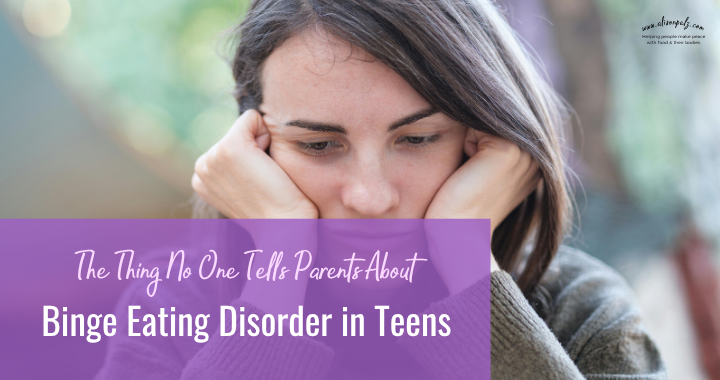
Teenager looking upset and withdrawn

If your teenager has been struggling with binge eating, there’s a good chance you already feel confused and a bit perplexed. You may have noticed food going missing. You may have found wrappers hidden in their room, or realized they’re eating in secret late at night. You may have tried talking to them about it and hit a wall. Or maybe they’ve shut down entirely, and you’re not sure why.

Here’s what I want you to know first: you are not the only parent in this situation. And your teen is not the only teenager going through it.

But there’s something about binge eating disorder that makes it much harder to talk about than other eating disorders, and that silence is part of what keeps families stuck. So let’s talk about it.

What Binge Eating Disorder Actually Is

Binge eating disorder, often called BED, is the most common eating disorder in the United States. More common than anorexia. More common than bulimia. And yet many people have never heard of it as a real diagnosis.

BED involves recurring episodes of eating large amounts of food in a short period of time, often past the point of fullness, and often feeling out of control while it’s happening. What makes it an eating disorder and not just overeating is the distress that comes with it. The shame afterward. The secrecy. The sense that something happened that your teen didn’t quite choose and couldn’t quite stop.

Unlike anorexia, BED doesn’t come with visible signs that most people are trained to look for. Your teen may not be losing weight. They may not look sick. And so the eating disorder can go unnoticed sometimes for a very long time.

The Thing Most Parents Don’t Know: Shame Is Running the Show

Here’s what I don’t see talked about enough: the central experience of binge eating disorder, for most teens, isn’t the eating itself. It’s the shame.

By the time a teenager is in the middle of a binge eating disorder, they are usually already caught in a cycle that’s very hard to see from the outside and very hard to break from the inside. Something happens. Stress, boredom, emotional pain, a fight with a friend, a hard day at school. The urge to eat feels overwhelming and then suddenly unstoppable. And then, after, comes the shame. Why did I do that? What is wrong with me? I have to hide this.

That shame does something important, and not in a good way: it drives the behavior underground. It makes it harder for your teen to tell you what’s happening. It makes them less likely to ask for help. And it often feeds the next episode, because shame is one of the most powerful emotional triggers for binge eating there is.

This is the cycle. It isn’t about willpower. It isn’t about discipline. It isn’t about how you raised them or what you put in the pantry. It’s a shame cycle, and it has a life of its own.

Your teen is probably hiding it from you not because they don’t trust you, but because they’re deeply ashamed of something they can’t explain. They may not have words for what’s happening, or they may worry you’ll be angry, disappointed, or put them on a diet, which often makes things worse. The hiding isn’t defiance. It’s self-protection, and it’s part of how well this disorder hides, even from a parent who’s paying close attention.

If You’ve Already Been Trying to Help

Most parents who end up here have tried to help their teen, often for a long time, in ways that made complete sense given what they knew.

Maybe you’ve had heart-to-heart conversations with your teen, the kind where you stayed up late, chose your words carefully, told them you loved them and just wanted them to be okay. Maybe you framed it around health, not weight, because you knew that was the right thing to do. Maybe you’ve started cooking differently, suggested a family walk after dinner, or quietly cleared the house of certain foods.

None of that is wrong. All of it came from love. But most of those approaches, even the thoughtful ones, work on the surface of the problem. A heart-to-heart about wanting your teen to be healthy, even when you’re genuinely not making it about weight, can still land on a teenager in a shame cycle as one more reminder that their eating is a problem, that they are a problem.

This isn’t a reflection of what you’ve done wrong. It’s a reflection of how well BED hides, and how much of it lives underneath the behaviors you can see.

What Helps (And What Doesn’t)

If you’ve been trying to address this by monitoring your teen’s food, commenting on what or how much they’re eating, or encouraging them to eat less, I want to gently tell you: that approach usually backfires. Not because you’re doing something wrong, but because it increases shame, and shame is what’s keeping this going.

What actually helps is the opposite of what most parents instinctively want to do. It starts with lowering the temperature around food in your home. Not making meals a place where your teen feels watched or judged. Finding small ways to signal that you are safe to talk to, not about eating, but about whatever is hard.

It also helps to get a professional involved. Binge eating disorder responds well to treatment. Cognitive behavioral therapy approaches have strong evidence behind them. A therapist and registered dietitian specializing in eating disorders can help your teen build a more regular relationship with food that reduces the conditions under which binges are most likely to happen. These aren’t quick fixes, but they work.

What your teen needs most from you, right now, probably isn’t a conversation about food. It’s to feel like you see them, that you’re not disgusted or disappointed, and that the relationship between you isn’t contingent on what or how much they eat.

What to Say (and What Not to Say)

This part is hard, because your instincts as a parent are to problem solve. To fix it. To say something useful.

But the most useful thing you can often say is something much simpler. Something like: I’ve noticed you seem like you’ve been having a hard time lately. I’m not here to make things harder. I just want you to know I’m in your corner.

And then leave space. Don’t push for details. Don’t bring up food or eating. Just let them know the door is open.

What tends to make things worse: comments about their body, about portions, about eating habits, about weight. Even gentle, well intentioned comments. Even comments framed as health concerns. For a teenager already deep in a shame cycle, these land as confirmation that they are the problem, and that confirmation makes the eating disorder louder, not quieter.

Getting the Support You and Your Teen Need

If you’re reading this and recognizing your family in it, the most important thing you can do right now is get support. Not a diet plan, not a meal tracking app, actual clinical support from someone who understands eating disorders.

That means finding a therapist who specializes in BED, and ideally also working with a registered dietitian who has eating disorder training. These two pieces, together, the psychological piece and the food relationship piece, are what give treatment the best chance of working.

You deserve support too. Parenting a teenager through an eating disorder is exhausting and frightening and often isolating. Finding a therapist or a parent support group can make a real difference, not just for you, but for your teen, because a calmer, more grounded parent is one of the most stabilizing things a teenager in recovery can have.

Your teen is not broken. You are not at fault.

If you have questions about what treatment for binge eating disorder might look like for your teenager, feel free to reach out. I’m happy to talk through what support could look like for your family. Schedule your free 20-minute consultation today

Frequently Asked Questions

Q: My child seems “addicted to sugar.” I’ll buy a pack of cookies, and they eat the whole thing in one sitting. When I ask about it, they tend to fib. Should I stop buying sugary foods?

It’s a completely understandable instinct. If the food disappears, maybe the problem does too. But this isn’t really about the cookies. If you remove sugar from the house, your child will likely find a way to get it elsewhere, because the food itself doesn’t drive the behavior. It’s driven by what the eating is helping them cope with. The more useful path is getting your child support to build other ways of handling difficult feelings. The food is the symptom, not the cause.

Q: Our pediatrician referred us to a dietitian, and we’ve been going, but it doesn’t seem to be helping. What should we do?

Working with a dietitian who has experience treating eating disorders is a great foundation. What I’d suggest adding is a therapist who also specializes in eating disorders. Binge eating has a psychological component that needs its own dedicated attention alongside the nutrition piece; the two work best in tandem, not in place of each other.

Q: We eat very “clean” at home, but when our teen is out of the house, they go after sugary food like crazy. We don’t understand what’s happening.

This happens more often than parents realize, and once you understand what’s driving it, it starts to make sense. We’re surrounded by confusing, often fear-based messaging about food, the idea that we’re one bite away from disaster. But research tells a different story: dietary restriction and rigid food rules are a known contributor to binge eating developing in the first place. The “clean” eating at home and the “going crazy” outside it are often two sides of the same cycle, not two separate problems.

Please feel free to reach out for a free 20-minute consultation if you would like to discuss your child’s relationship with food further.

If you are a clinician who wants to learn more about eating disorders, check out my services for clinicians here.
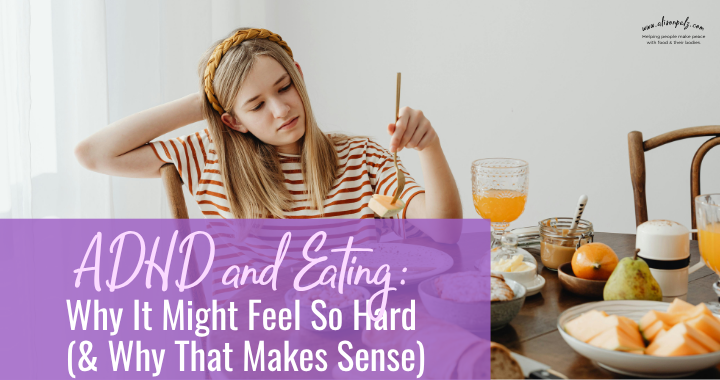
"ADHD and Eating Why This Might Feel So Hard (and Why It Makes Sense)" over a photo of a white teen girl, picking at her food, looking upset.

ADHD and Eating: Why It Might Feel So Hard (& Why That Makes Sense)

Have you ever had moments where you wondered, Why is eating so much harder for me than it seems to be for other people? Or maybe, I can manage work or school, so why does something as basic as feeding myself feel so overwhelming?

If that sounds familiar, there may be a reason that actually makes sense.

We know from research that people with ADHD are more likely to experience eating disorders such as anorexia, bulimia, binge eating, or ARFID. But beyond the statistics, what matters most is this: 

For many people, their struggles with food are not random. They are connected to how their brain works and how they are trying to cope in a world that often expects consistency, structure, and follow-through.

That mismatch can be exhausting.

When ADHD Doesn’t Look Like ADHD

A lot of people don’t immediately recognize themselves in ADHD.

You might have been told that you are doing fine. Maybe you did well in school or you are managing your job. From the outside, things may look steady enough. And part of you might think, If I really had ADHD, wouldn’t it be obvious?

But many forms of ADHD, especially inattentive ADHD, are easy to miss. This is particularly true for girls and women. Instead of being loud or disruptive, it often shows up internally. It can feel like constantly pushing yourself to stay organized, to keep up, to not forget things that seem like they should be easy. It can mean feeling overwhelmed by everyday tasks while also being very hard on yourself for struggling.

On the outside, you may appear capable. On the inside, it can feel like you are working much harder than everyone else just to stay afloat.

Over time, that gap between how things look and how they feel can turn into shame or self-doubt. You may not have the language for it, but you can feel that something is off.

Why Challenges Often Show Up Around Food

When eating feels difficult, it is easy to assume it is a personal failing. You might think you lack discipline or that you should have figured this out by now.

But eating regularly asks a lot from your brain. It requires planning, starting tasks, remembering, organizing, and following through. These are all part of executive functioning, which is exactly where ADHD creates challenges.

So when you find yourself putting off meals, skipping them, or feeling overwhelmed by the idea of cooking and cleaning, it is not because you do not care. It is because your brain has a harder time getting started and moving through all the steps.

You may even notice a pattern where you do not eat for a while and then suddenly you are extremely hungry and trying to catch up. Then afterward, there can be confusion or frustration about how it got to that point again.

When Food Feels Complicated or Overwhelming

For some people, eating is not just about getting started. It is also about how food feels.

You might notice that certain textures or smells are hard to tolerate, or that food has to be just right for you to eat it. At the same time, it may be difficult to recognize hunger until it becomes intense.

This can create a strange push and pull. Sometimes eating feels like too much. Other times it barely registers until your body demands attention all at once.

From the outside, this might look inconsistent or restrictive. From the inside, it often feels confusing and hard to predict.

When Eating Becomes a Way to Cope

If you have experienced binge eating, you might feel stuck in a cycle that does not make sense to you. You may wonder why it keeps happening, especially when you genuinely want it to stop.

But in those moments, eating often serves a purpose. It can soothe overwhelming emotions, create stimulation when things feel dull or restless, or provide a sense of relief. Even if that relief is temporary, it matters.

Understanding this does not mean the behavior feels good or sustainable. It simply means there is a reason your brain keeps returning to it.

When Control Starts to Feel Important

For others, the struggle can look very different. Eating less or creating strict rules around food can feel grounding, especially when everything else feels unpredictable or overwhelming.

You might notice a sense of calm or clarity when things are controlled, and anxiety when that control is disrupted.

This can become more intense during times of change, like adolescence or moving into adulthood, when external structure disappears and you are expected to manage everything on your own. Without enough support, food can become one of the few areas that feels manageable.

A More Compassionate Way to Understand Your Eating Patterns

It is easy to fall into the belief that something is wrong with you.

But what if your eating patterns are not random or broken, but actually attempts to cope with stress, overwhelm, or disconnection?

That does not mean they are working in the long term. But it does mean they deserve understanding, not judgment.

How Healing Can Look Different for People with ADHD

Instead of focusing on fixing yourself, the work becomes about understanding yourself.

Together, we look at how your brain works, what makes things harder, and what kinds of support actually help. We explore what your eating patterns have been doing for you and where there may be unmet needs.

From there, we begin to build systems and strategies that feel more sustainable. Not perfect, not rigid, but supportive and realistic for your life.

If You See Yourself in This

You might feel tired of fighting with yourself. You might feel confused about why something that seems simple feels so difficult. Or you might just want to feel more steady, more nourished, and less overwhelmed.

That is where this work begins.

Ready to Take the Next Step?

If this resonates with you, you do not have to sort it out alone. I offer a free 20-minute consultation where we can talk about what has been going on and what kind of support might actually feel helpful.

Are you struggling with eating, food, or your relationship with your body, or just not sure if something feels off? You don’t need all the answers to reach out. If you’re in Texas and interested in working with me, click here to fill out a contact form.

If you’re a parent supporting a child with an eating disorder or ARFID/”picky eating”, therapy can give you the space to heal and show up for your child. You don’t have to carry this alone.

"Tackling Healthism in Eating Disorder Recovery" in white text on a purple background over a photo of a wellness yoga class

Tackling Healthism in Eating Disorder Recovery

One of the most persistent and invisible roadblocks on this path of recovery is healthism.

When you’re in recovery from an eating disorder, the journey isn’t just about food or body image—it’s about unlearning many of the messages that have shaped your relationship with health, worth, and identity.

What Is Healthism?

Healthism is the belief that a person’s moral worth is tied to their health status—and that “health” is something we can fully control through the “right” choices. It often masquerades as wellness advice, clean eating trends, or motivational fitness culture. It’s sneaky. It’s normalized. And it can deeply harm those recovering from disordered eating.

It tells us:

  • That our body is a problem to solve.
  • That health looks a certain way (usually thin, active, and visibly “fit”).
  • That if we are not constantly optimizing our health, we are failing.

Sound familiar?

Where Did Healthism Come From?

Healthism isn’t just a personal mindset—it’s a cultural narrative with deep historical roots. The term was first coined in the 1980s by sociologist Robert Crawford, who observed a growing trend: people were being taught that health was a personal, moral responsibility, and that individuals—not systems—were to blame for their well-being.

Since then, this idea has been reinforced by everything from public health campaigns to social media influencers. Over time, “healthy” became a synonym for “good,” and illness or difference became something to fix or avoid.

Diet culture, fatphobia, ableism, and capitalism all amplified the message: control your body, and you’ll be safe, accepted, and successful. But here’s the truth: most of the factors that shape our health are outside of our control, including genetics, trauma, systemic oppression, and access to medical care.

If you’ve internalized the belief that your worth is tied to how “healthy” you are, that’s not a personal failure. It’s a product of living in a culture steeped in healthism.

When “Wellness” Becomes a Disguise for the Disorder

It’s not uncommon for someone in recovery to shift from calorie restriction to obsessive “clean eating,” or from compulsive weighing to compulsive step counting. All under the guise of “being healthy.”

But here’s the truth: If your pursuit of health is causing you harm, mentally, physically, and/or emotionally, it’s not actually healthy.

Therapy holds space for the messy, complicated process of rethinking what health really means. And gently challenge the idea that health should ever be the benchmark for your value as a human being.

Healing Beyond the Health Narrative

You deserve a recovery that allows you to reclaim your life. Not just fit into a new version of diet culture with a wellness filter.

Here’s what it can look like to move beyond healthism in recovery:

  • Embracing body diversity: All bodies are worthy, and all bodies are different. Health does not have one size or shape.

  • Redefining health: Instead of perfection, explore how to care for your body in a way that feels sustainable, flexible, and joyful.

  • Focusing on values: What matters most to you beyond your body? I help clients reconnect with those parts of themselves.

  • Practicing self-compassion: You are not a failure for struggling. You are a person, doing your best in a culture that makes recovery hard.

You Don’t Need to Be “Healthy” to Deserve Care

One of the most radical things we can say in a healing space is: You deserve support, rest, love, and acceptance—whether or not you’re “healthy.”

Health is not a prerequisite for dignity.

In my work with clients, I hold this truth close. Whether you’re early in recovery or years into your healing. I understand how deeply embedded healthism can be, and here to help you untangle from it with compassion and curiosity.

Ready to Explore a New Way Forward?

If you’re feeling burnt out by the pressure to “recover perfectly” or be the picture of health, you’re not alone. Let’s explore what healing could look like when it’s rooted in connection, not control.

Curious about working together?
Reach out to schedule a consultation. I would be honored to walk alongside you.


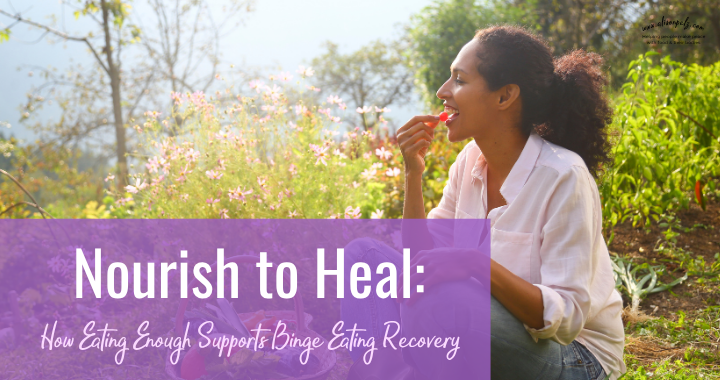
Nourish to Heal: How Eating Enough Supports Binge Eating Recovery

Nourish to Heal: How Eating Enough Supports Binge Eating Recovery

Eating more will likely help you reduce binge eating.

This feels counterintuitive and is certainly not what the weight loss industry or the medical community typically advises, so I know this recommendation can feel very scary. 

The weight loss industry provides “tricks” to reduce binge eating, usually focusing on how to limit consumption of certain foods. However, rather than helping navigate binge eating, it often fuels and perpetuates binge eating. Science has taught us that dietary restriction is a risk factor for developing an eating disorder, including binge eating. Dietary restriction also maintains the eating disorder–in other words, a restrictive diet keeps the disorder going. 

Binge eating can cause significant distress to those who are experiencing it, so understandably, you would do almost anything to stop it. 

First, we need to normalize binge eating. Most humans experience eating episodes related to emotions, as eating can be a common way we cope with and regulate emotions. If you have sensory and neurological differences, including anxiety or ADHD, eating can be a useful tool to help you feel more comfortable. 

We hear harmful messages in our culture about binge eating: that it means something negative about us, or that we “have no will power or we are not disciplined enough”.  Of course, we then internalize these messages, meaning we believe these untrue messages about ourselves, further disconnecting us from self. 

Let’s take a closer look at why eating more helps to reduce binge eating.

Our brain’s primary job is to keep us alive. We need food to survive. Most of us experience pleasure from eating (That’s our brain’s way to ensure that we eat!).

If your meal gets delayed for some reason, you feel really hungry, often leading to feeling “hangry” (hungry & angry–that grumpy feeling we get when we’ve gone too long without food)-our body’s cue to eat. Consequently,  you might eat quickly and possibly more than usual. This is our body’s nifty mechanism to keep us alive. 

Many people who experience binge eating try to limit their food intake or the types of food they typically binge on. This makes perfect sense given the messages about food in our culture. But dietary restriction is eating less food than your body needs. An example of dietary restriction may be “I am going to eat out for lunch, so I’ll skip or have a ‘light’ breakfast”.  This simple act, which our culture often rewards, sets our body’s drive up to alert us to eat.

Dietary restriction is a key feature in what initiates and sustains eating disorders. 

Herman and Polivy coined the term dietary restraint in the 1970s. It suggests that when human eating behavior is under cognitive control, it reduces the ability to read internal satiety cues. 

In other words, simply thinking about restricting food types and amounts can lead us to eat past fullness. Dietary restraint is the key feature of EVERY DIET. And dietary restraint is a significant risk factor for developing an eating disorder. 

What can be done? 

Many clients who experience binge eating also experience dietary restriction and restraint–the natural reaction is often to focus on eliminating binge eating by using more dietary restriction and restraint. Again, this makes sense given diet culture and our medical system. However, it often maintains the eating disorder. 

One of the first steps in my work with clients is to gradually reduce dietary restraint and restriction. I can understand that this can feel very scary. 

In sessions, we explore your personal story and understand where you learned about dietary restriction and restraint.  We then consider if it makes sense to approach things differently.  

We do work on reducing binges, but that typically comes later in treatment. First, dismantling the restriction and restraint is needed to reduce binge eating. 

If you want to learn more about binge eating, I highly recommend this book. Additionally, Decolonizing Wellness is an excellent resource. If you would like to learn more about how I work with clients struggling with binge eating, the first step is to schedule an initial consultation. I would love to hear from you. 

A graphic that reads "2021: A Year In Review" over a stock photo of some pine branches and gifts wrapped in brown paper, on a red background.

2021: A Year In Review

What a year! 2021 was our second year in a pandemic, and seemed just as chaotic and challenging as 2020 was. Take a moment to pat yourself on the back for making it to the end of this year, it certainly hasn’t been easy, but I’m so glad you’re here. This too shall pass, and until it does, I’ll be here to support you virtually to stop feeling out of control and gain a sense of calm in relationship with food and your body

This year, more than ever, people experienced anxiety and burnout. If you’re feeling like you’re running on empty, you’re not alone. I hope you get some quality time to rest and recuperate this season. It’s always important to rest, but with the constant chaos of existence right now you might be feeling the need to slow down more than ever. I encourage you to lean into it!

You’re allowed to have periods of rest, and it’s important to listen to your body when it’s trying to tell you something. Consider this your permission slip to do nothing but self-care for the rest of the year! 

Every year, I like to round up all of my blog posts from the year in one place. It’s fun to look back on the year through these posts, and I hope you find them useful as you work toward peace with food. 

Here’s what I wrote about this year: 

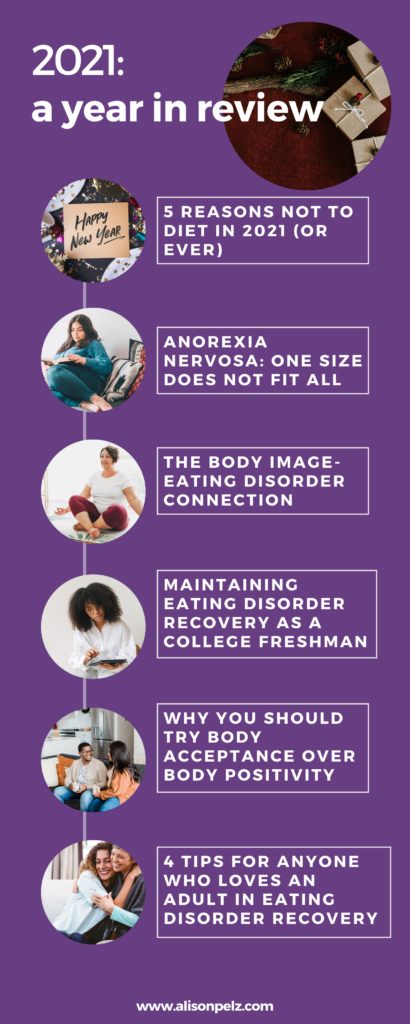
5 Reasons not to Diet in 2021 (or Ever)

“Unless you are taking a break from social media and the news, you most likely have been bombarded with messages about dieting and weight related New Year’s resolutions. Diet programs are promising the magic bullet for good health and weight loss in the New Year.

Maybe this year you are re-thinking your New Year’s resolutions. Perhaps you are beginning to notice that dieting is taking up too much space in your life or you are tired of worrying about what you eat or what you look like. It could be you are looking to “get off the diet roller coaster” permanently and heal your relationship with food and your body.

If you are ready to give up dieting, you’re not alone. Consider these five reasons to quit dieting for good.”

Anorexia Nervosa: One Size Does NOT Fit All

“Unfortunately, there are many incorrect assumptions associated with eating disorders. One I see a lot is the assumption that in order to have an eating disorder, particularly anorexia nervosa, one has to have very low body weight. This is simply not true.

Sadly these assumptions block those suffering from eating disorders from getting the life-saving treatment they need. In fact, most people with eating disorders don’t necessarily fit neatly into an eating disorder category.

Eating disorders are more about how the person relates to food, exercise, and body than what a person looks like.”

The Body Image-Eating Disorder Connection

“How we perceive our bodies is influenced by many factors, including family, friends, media, gender identity, culture, and the health-care system, to name a few. Body image is not static. It may change depending on our mood, situation, stage of life, or the season.

The majority of those who suffer with eating disorders have a negative body image. One of the key features of eating disorders is the overvaluation of weight, shape, and eating habits on self-worth.

Self-worth is how and what we think about ourselves. In other words, those who struggle with eating disorders equate much of their self-worth with their ability to control their weight, shape, and eating habits. Having a negative body image often keeps the eating disorder going.”

Maintaining Eating Disorder Recovery as a College Freshman

“College can be a difficult transition for anyone, but if you’re in recovery for an eating disorder, it can be a particularly stressful transition! 

Some of the challenges of maintaining your recovery while returning to school include change in routine, increased demands and independence, and exercise/diet culture. 

Remember: it’s normal for eating disorder symptoms to recur in times of high stress and periods of transition. But by taking time to consider how your recovery will be impacted in this period of transition, you can create a plan to cope with stress and continue with your recovery.”

Why You Should Try Body Acceptance Over Body Positivity

“The idea of body positivity has its roots in fighting diet culture, but the term doesn’t resonate with everyone. After all, feeling positive about your body is a tall order for a lot of people. 

First of all, there is a multi-billion dollar diet industry that uses its considerable resources and influence to convince us all that there is something wrong with our bodies. Feeling insecure about how our bodies look is a surefire way to get us to buy products that will “fix” us. However, consider the idea that there was nothing wrong with your body in the first place. 

People who are chronically ill or disabled might not feel like they can be positive about a body that is constantly in pain or not able to move through the world easily. People who are recovering from eating disorders might not trust their body’s cues or might feel distress when thinking about their bodies. 

Body acceptance might feel like a more attainable goal than body positivity.”

4 Tips for Anyone Who Loves an Adult in Eating Disorder Recovery

“It’s possible for eating disorders to initially develop later in life, not just during adolescence. It’s also possible that adults suffering from an eating disorder developed it during adolescence and never fully recovered.  Life stressors (like a pandemic, for example!) later in life can also cause a relapse of eating disorders.

Eating disorders develop for a variety of reasons including genetics, temperament, gender, and dieting history to name a few.

It is less important why and how the eating disorder developed, and more important to focus on supporting your loved one in their eating disorder recovery.”

A graphic that reads "2021: A Year In Review" over a stock photo of some pine branches and gifts wrapped in brown paper, on a red background.

I’ll be back in 2022, writing more about ED recovery, food peace, and weight bias. If there are any topics you want me to cover next year, let me know. You can send me a message here, and you can also follow me on Facebook. Every week, I share resources from myself + other eating disorder experts, so follow if you’re looking for more information. 

Diet Culture, COVID-19, and Weight Stigma: 2020 in Review

Diet Culture, COVID-19, and Weight Stigma: 2020 in Review

At the end of every year, I like to put together a post that collects everything I’ve published on my blog over the last year. And what a year it’s been. This year is nothing like we imagined it would be. We have lost almost a year of being with family and friends, experiencing new things, and living our ‘normal’ lives. If you’re feeling grief about this year, the lives lost and changed, and what could have been, you’re not alone. 

This year has been hard, sad, lonely, scary, weird, and pretty much any other adjective out there. It can be hard to hold space for all of those things at once, so be gentle with yourself as you work through your feelings about 2020. 

Here’s what I wrote about this year: 

This year, I wrote a lot about the COVID-19 pandemic and how that interacts with folks in eating disorder recovery. 

When things get hard, communities thrive. The eating disorder recovery community is more important than ever with many of us isolated and unable to connect with other ED survivors in real life. I wrote about 5 Ways to Stay on Track With Eating Disorder Recovery During COVID-19, Virtual (and Free) Eating Disorder Support Groups During COVID-19, and Coping With COVID-19 and Eating Disorder Recovery: Tips for College Students.

Rejecting Diet culture

One of my favorite ways to learn about rejecting the diet mentality is through podcasts! I put together a list of my top podcasts to help you break free from diet culture. (I also included a tip for how to find anti-diet resources: “It’s easy to be wary of what you find related to body positivity and anti-diet resources, since the movement has been flooded with people trying to cash in without spreading the actual message of the anti-diet movement. When looking for a trusted resource online, make sure that they mention on their website (hopefully prominently!) that they believe in dismantling diet culture, center larger bodies, and don’t mention weight loss anywhere on their site.”

Eating Disorders

Eating disorders are a complicated subject. One of my goals is to help people challenged with ED and other food & weight-related concerns to move from constantly worrying about food and their weight to being free to create the lives they want. The first step here is understanding what eating disorders actually are. To help, I discussed 3 Important FAQs about Binge Eating Disorder on the blog. While some of us understand the basics of eating disorders and anxiety on our own, it’s rare to see a blog post connect the two and tell you what you need to know if you’re living with an eating disorder and an anxiety disorder. I wrote about frequently asked questions related to eating disorders and anxiety to share what I know!

Weight Bias + Stigma

Weight bias is everywhere we look in our culture. It’s led to systematic discrimination of larger bodies in many areas of life – medical care, job opportunities, social interactions, to name a few. So many folks railing against people in larger bodies don’t realize that what really causes negative health outcomes is a result of stigma, not a result of having a larger body, so I wrote about how weight bias and stigma are the real hazards to health, not body size. 

Diet Culture, COVID-19, and Weight Stigma: 2020 in Review

If there are any topics you’d like me to cover in 2021, let me know! You can message me here. If you’re looking for even more resources, make sure you’re following me on Facebook and Pinterest!Every week, I share resources from myself + other experts in the field on both platforms!