"The Binge–Purge Cycle in Bulimia & Why it Feels So Hard to Stop" over a photo of a young woman, sitting looking tired and upset.

The Binge–Purge Cycle in Bulimia and Why It Feels So Hard to Stop

You may not think of it as bulimia.

More often, it sounds like a quiet, ongoing negotiation with yourself: I just need to get my eating under control. Or, I won’t do this again.

And yet, it keeps happening.

If you’re reading this, you may be struggling with your relationship with food, or you may be worried about someone you love. Either way, you’re not alone, and help is available.

In my work with clients, I help you understand the factors that contributed to the development and what keeps you feeling stuck in the cycle of binge-purge, while compassionately guiding you toward a path forward grounded in hope and recovery.

The binge-purge cycle you may feel trapped in

For many, bulimia isn’t just about behavior but it’s about a painful cycle that can feel impossible to escape.

It might look something like this:

“I’m not going to do this again. Tomorrow will be different.”
“I’ll be more disciplined. I’ll eat perfectly.”

And for a while, maybe things feel under control. But then something happens: an increase in stress, loneliness, boredom, overwhelm, or even just hunger and the urge builds.

“I’ve already messed up. I might as well keep going.”
“I’ll just start over tomorrow.”

The binge happens. Then comes the guilt, the discomfort, the shame.

“I can’t believe I did that again.”
“I need to fix this.”

Purging follows, bringing a brief sense of relief both physically and emotionally.

And then the cycle resets:
“I swear this is the last time.”

What is bulimia nervosa?

Bulimia nervosa is a serious eating disorder characterized by a cycle of:

  • Binge eating, or consuming large amounts of food in a short period, often with a sense of loss of control, followed by
  • Compensatory behaviors such as vomiting, excessive exercise, fasting, or misuse of laxatives to “undo” the binge

One of the hallmarks of binge eating is that feeling of “I can’t stop.” It’s often followed by intense shame, guilt, and distress.

This isn’t a failure of willpower. It’s a learned cycle in which your brain and body try to cope with distress and emotions. 

Why does bulimia nervosa develop?

There isn’t a single cause of bulimia. It’s a complex condition influenced by emotional, psychological, and biological factors.

Some known risk factors include:

  • Chronic dieting or food restriction
  • Body image distress
  • ADHD, anxiety, depression, or chronic stress
  • Low self-worth
  • Family history of eating disorders

Bulimia often begins in late adolescence (around age 18), and while it is more commonly diagnosed in women, it affects people of all genders, body sizes, and backgrounds, including those in marginalized communities.

Without support, it can become chronic. Unfortunately, only about 50–60% of people ever seek treatment.

Why bingeing and purging “work” (in the short term)

Binge eating often serves a purpose. It can temporarily soothe intense emotions like anxiety, loneliness, exhaustion, or overwhelm. In those moments, food can feel like relief. But that relief is short-lived, and over time, it often increases distress.

Purging behaviors tend to follow intense emotional or physical discomfort including shame, panic, or sensory overload. Purging can create a rapid shift in the body, leading to a temporary sense of release.

Your brain learns: this reduces distress.
And so the cycle repeats.

Even if it feels “manageable,” the toll adds up physically, mentally, and emotionally.

The impact on physical and mental health

Physically, bulimia can lead to:

  • Electrolyte imbalances (which can be life-threatening)
  • Gastrointestinal distress
  • Dental problems
  • Hormonal disruptions

Emotionally, the cycle often deepens distress over time.

Thoughts like:
“Why do I keep doing this?”
“What is wrong with me?”
“I’ll stop tomorrow.”

…can reinforce shame, guilt, and self-criticism.

Many people begin to isolate themselves to hide the behavior. Relationships can suffer. You may find yourself avoiding socializing. You may not find joy in activities that you normally would. Going to school or work may feel harder.

Thoughts of what to eat and not eat and worries about your body may take over much of your thoughts. 

You may feel more easily annoyed and frustrated. 

The eating disorder takes up more and more space in your life. 

What recovery looks like

Recovery from bulimia is both behavioral and insight-oriented.

That means we work on:

  • Gradually reducing eating disorder behaviors
  • Building more consistent, nourishing eating patterns
  • Developing healthier ways to cope with emotions
  • Understanding and addressing underlying factors like anxiety, depression, or low self-worth
  • Challenging unhelpful thoughts about food and body image
  • Building self-compassion and resilience

In my work, I use a combination of cognitive behavioral therapy, mindfulness, parts work, and radical acceptance to help guide recovery.

Recovery is not linear. It often feels like a few steps forward and a few steps back. It can feel messy at times and that’s okay. That’s part of the process.

You don’t have to do this alone

Many people with bulimia feel stuck in secrecy and shame. Reaching out can feel scary but it can also be the beginning of something different or perhaps feel a bit of relief.

If you are struggling with your eating, it doesn’t mean something is wrong with you. It means you’ve been trying to cope in the best way you knew how.

Recovery is possible. Healing is possible. Whether this has been going on for a short time or for years, it is not too early or too late to get help.

If you’re ready to take the next step, I invite you to reach out. Even a single conversation can begin to shift things. Sign up for a free consultation to learn more about how I can help you.

Nourish to Heal: How Eating Enough Supports Binge Eating Recovery

Nourish to Heal: How Eating Enough Supports Binge Eating Recovery

Eating more will likely help you reduce binge eating.

This feels counterintuitive and is certainly not what the weight loss industry or the medical community typically advises, so I know this recommendation can feel very scary. 

The weight loss industry provides “tricks” to reduce binge eating, usually focusing on how to limit consumption of certain foods. However, rather than helping navigate binge eating, it often fuels and perpetuates binge eating. Science has taught us that dietary restriction is a risk factor for developing an eating disorder, including binge eating. Dietary restriction also maintains the eating disorder–in other words, a restrictive diet keeps the disorder going. 

Binge eating can cause significant distress to those who are experiencing it, so understandably, you would do almost anything to stop it. 

First, we need to normalize binge eating. Most humans experience eating episodes related to emotions, as eating can be a common way we cope with and regulate emotions. If you have sensory and neurological differences, including anxiety or ADHD, eating can be a useful tool to help you feel more comfortable. 

We hear harmful messages in our culture about binge eating: that it means something negative about us, or that we “have no will power or we are not disciplined enough”.  Of course, we then internalize these messages, meaning we believe these untrue messages about ourselves, further disconnecting us from self. 

Let’s take a closer look at why eating more helps to reduce binge eating.

Our brain’s primary job is to keep us alive. We need food to survive. Most of us experience pleasure from eating (That’s our brain’s way to ensure that we eat!).

If your meal gets delayed for some reason, you feel really hungry, often leading to feeling “hangry” (hungry & angry–that grumpy feeling we get when we’ve gone too long without food)-our body’s cue to eat. Consequently,  you might eat quickly and possibly more than usual. This is our body’s nifty mechanism to keep us alive. 

Many people who experience binge eating try to limit their food intake or the types of food they typically binge on. This makes perfect sense given the messages about food in our culture. But dietary restriction is eating less food than your body needs. An example of dietary restriction may be “I am going to eat out for lunch, so I’ll skip or have a ‘light’ breakfast”.  This simple act, which our culture often rewards, sets our body’s drive up to alert us to eat.

Dietary restriction is a key feature in what initiates and sustains eating disorders. 

Herman and Polivy coined the term dietary restraint in the 1970s. It suggests that when human eating behavior is under cognitive control, it reduces the ability to read internal satiety cues. 

In other words, simply thinking about restricting food types and amounts can lead us to eat past fullness. Dietary restraint is the key feature of EVERY DIET. And dietary restraint is a significant risk factor for developing an eating disorder. 

What can be done? 

Many clients who experience binge eating also experience dietary restriction and restraint–the natural reaction is often to focus on eliminating binge eating by using more dietary restriction and restraint. Again, this makes sense given diet culture and our medical system. However, it often maintains the eating disorder. 

One of the first steps in my work with clients is to gradually reduce dietary restraint and restriction. I can understand that this can feel very scary. 

In sessions, we explore your personal story and understand where you learned about dietary restriction and restraint.  We then consider if it makes sense to approach things differently.  

We do work on reducing binges, but that typically comes later in treatment. First, dismantling the restriction and restraint is needed to reduce binge eating. 

If you want to learn more about binge eating, I highly recommend this book. Additionally, Decolonizing Wellness is an excellent resource. If you would like to learn more about how I work with clients struggling with binge eating, the first step is to schedule an initial consultation. I would love to hear from you. 

Must-Ask Questions When Looking For An Eating Disorder Therapist

Must-Ask Questions When Looking For An Eating Disorder Therapist

Let’s face it, finding the right eating disorder therapist for your eating disorder can be daunting. It can feel downright overwhelming. You may be ambivalent about getting treatment. Maybe you are worried that your eating disorder isn’t “bad enough” to warrant treatment (trust me, it is). Or perhaps you are feeling hopeless about finding another therapist after being treated in the past.

Whether you are an individual with an eating disorder or a loved one of a person with an eating disorder, looking for a qualified therapist can be tough.

This post will give you tips on what to look for in a treatment provider, and questions to ask to help you determine the right eating disorder therapist for you.

Most therapists are willing to talk with you on the phone before you set an initial appointment. They will help assess goodness of fit in regards to scheduling, payment, and issues you may want to address in therapy.

If the therapist doesn’t offer a phone consultation, then these questions can be asked in the initial face-to-face appointment.

You can use the following questions and talking points when interviewing a potential therapist:

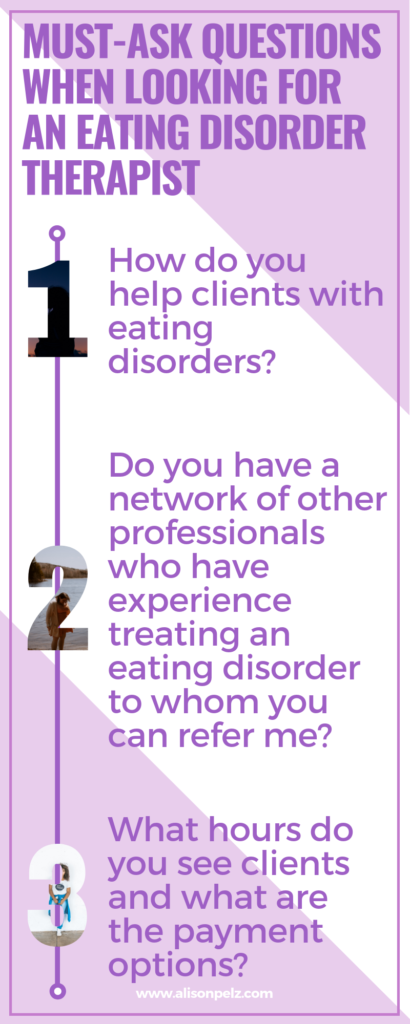
How do you help clients with eating disorders?

If a therapist has a lot of experience treating eating disorders, they should have a concise and clear answer. Many well-meaning therapists indicate on their website, referral site, or insurance websites that eating disorders are their specialty, but really don’t have experience treating eating disorders.

Because of the complex nature of eating disorders, try to get a therapist with extensive experience with eating disorders if possible.

Do you have a network of other professionals who have experience treating an eating disorder to whom you can refer me?

The gold standard of care in eating disorder treatment is to have a multidisciplinary team. An eating disorder treatment team usually consists of a therapist, registered dietitian, medical doctor, psychiatrist, family therapist, and possibly other specialists.

If the therapist has experience treating eating disorders, they should have a relationship with other treatment providers in your community. To learn more about eating disorder treatment teams click here.

What hours do you see clients and what are the payment options?

The course of eating disorder treatment can be long. Having a conversation up front with a potential eating disorder therapist about finances and scheduling is important. Be sure that the scheduling and payment options work for you over the longer -term.

Here are a few resources to help you find a qualified eating disorder therapist in your area:

Finding an eating disorder therapist can take time.  Consider breaking down your search into smaller pieces and chip away at it each day.

Additionally, if you feel overwhelmed trying to find an eating disorder therapist, ask a friend or family member to help you in your search.

Please call for a free 20-minute telehealth consultation to learn how I work with clients with eating disorders.

Don’t live in the Austin Area, but want tips about how to improve your relationship with food and your body? Subscribe to my newsletter here.

Must-Ask Questions When Looking For An Eating Disorder Therapist


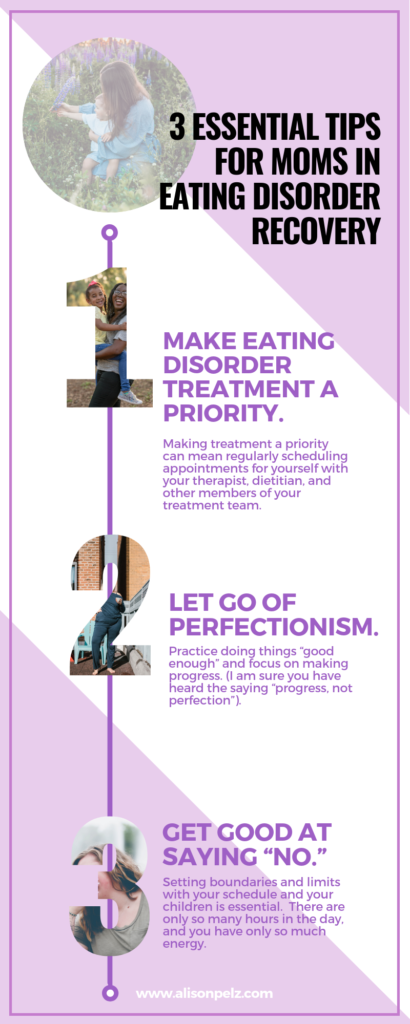
3 Essential Tips for Moms in Eating Disorder Recovery

Often, teenage girls are most associated with eating disorders. While it is true that eating disorders often develop in adolescence, they still affect people of all ages. Motherhood, unfortunately, does not immunize us from eating disorders, either.

There are three common circumstances in which adults suffer from eating disorders:

  1. The eating disorder developed in adolescence or in young adulthood and the individual never fully recovered or never received treatment.
  2. The eating disorder developed earlier on in life and it re-occured in midlife.
  3. The initial onset of the eating disorder occurred in adulthood.

In my counseling practice, I exclusively see adults with eating disorders, and many of my clients are also moms.

Motherhood presents a unique set challenge for individuals suffering from an eating disorder. Although, becoming a mother is associated with great excitement, it also comes with some stressors.

New moms are learning how to navigate their new identify while maintaining old identities of partner, friend, employee, etc. Because of this, parents often feel like they are being pulled in a million different directions.

Furthermore, normal changes in the body that are associated with pregnancy and beyond can be particularly stressful for some with an active or history of an eating disorder.

Change is a constant as a parent.  As children grow, their needs change, and so do our roles as parent.  Change along with with other stressors can trigger or exacerbate eating disorder symptoms.

Below there three basic tips to navigating motherhood while in eating disorder recovery.  

1). Make eating disorder treatment a priority.

Moms are often pulled in several different directions, busy taking care of everything and everyone.  Motherhood does not leave much time for self-care let alone recovery.

Making treatment a priority can mean regularly scheduling appointments for yourself with your therapist, dietitian, and other members of your treatment team.    

2).  Let go of perfectionism.

Perfectionist traits are often associated with eating disorders.  Furthermore, motherhood at times can feel like a competitive sport, which can reinforce perfectionism.  

Perfectionism is a never-ending cycle of setting very high and rigid stands in efforts to control and boost self-esteem, and when impossibly high standards aren’t met, feelings of failure set in, and the cycle of perfectionism begins all over again.

Practice doing things “good enough” and focus on making progress. (I am sure you have heard the saying “progress, not perfection”).  For more tips on how to overcome perfectionism, click here.

3).  Get good at saying “no.”

Setting boundaries and limits with your schedule and your children is essential.  There are only so many hours in the day, and you have only so much energy.

It is easy to let your recovery get sidetracked with over scheduling yourself.

One important part of setting boundaries is first assessing what the most important things are to you:  where do you want to spend your energy and time? Second, once your priorities are established, get good at saying no to things that aren’t on your priority list.

So often, there is fear around saying no due to fear of hurting others, appearing selfish, or missing out.  Once you practice saying no, I think you will learn that none of these fears pan out.

Reserving energy and time to focus on your recovery is not selfish.   When you are actively working on your eating disorder recovery and taking care of yourself, you will be more available to be a stronger mother, partner, and friend.

Please call for a free 15-minute phone consultation to learn how I work with clients with eating disorders.

Don’t live in the Austin Area, but want tips about how to improve your relationship with food and your body? Subscribe to my newsletter here.


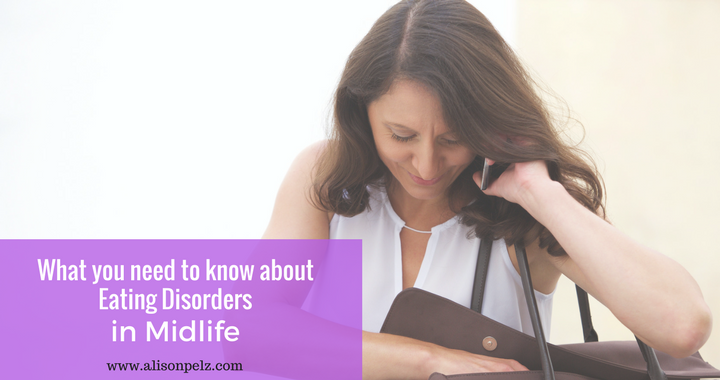
Eating disorders in midlife

Not Your Teens Eating Disorder: What you need to know about eating disorders in midlife.

Unfortunately, eating disorders in midlife are on the rise.  Many eating disorders in adult women may go undiagnosed because of the mistaken belief that older women don’t develop eating disorders.   It is true that adolescent girls are at a higher risk, but women of all ages are at risk for developing and maintaining an eating disorder.

Adult women usually present with eating disorders in the three following ways:

  1. An eating disorder was developed earlier in their life. That is, as an adolescent or young adult the individual developed her eating disorder, but never fully recovered.  Adequate treatment, motivation to change, social & family support, etc. are all necessary for a full recovery.
  2. The second scenario is similar to the first, an eating disorder developed in adolescence or early adulthood and the individual fully recovered through treatment.  But, then in midlife, a relapse took place either in response to environmental, social, psychological and/or physical stressors and the eating disorder returned.
  3. In this last scenario, which is the least common, is that the onset of the eating disorder first occurred in midlife. That is to say, the individual had no pre-existing eating disorder. The most common type of eating disorder that starts in mid-life is binge eating disorder (click here to learn more about binge eating disorder).

Continue reading

Dieting increases risk for an eating disorder

Why Dieting is Hazardous to your Health

We are knee-deep in the diet culture.   Messages about what we should and shouldn’t eat are everywhere: social & print media, TV, on food labels and even well-meaning friends and family.

We forget that food is necessary to survive. Food is not optional. Dieting makes us think we can go without carbohydrates, fats or other food groups. But, we just can’t. Food and eating are not about willpower, it is about biology.

Dieting leads to food preoccupation

The most basic function of our brain is to keep us alive. When our basic needs are not being met, our bodies experience stress. Our brain sends us alerts to get us what we need. Most diets aren’t sufficient in energy (calories) or macronutrients (carbohydrates, protein & fat). Therefore, our brains alert us that we need to eat.
Continue reading