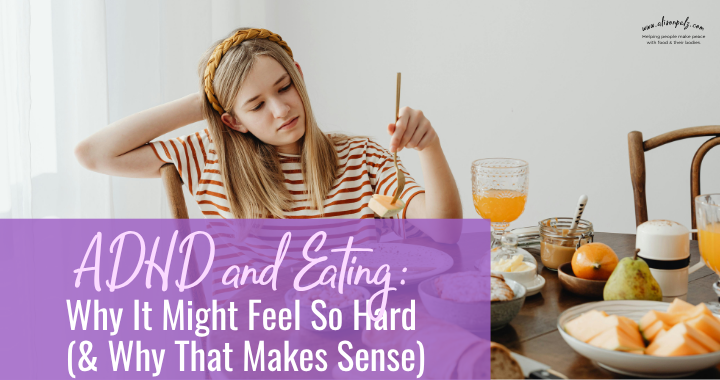
"ADHD and Eating Why This Might Feel So Hard (and Why It Makes Sense)" over a photo of a white teen girl, picking at her food, looking upset.

ADHD and Eating: Why It Might Feel So Hard (& Why That Makes Sense)

Have you ever had moments where you wondered, Why is eating so much harder for me than it seems to be for other people? Or maybe, I can manage work or school, so why does something as basic as feeding myself feel so overwhelming?

If that sounds familiar, there may be a reason that actually makes sense.

We know from research that people with ADHD are more likely to experience eating disorders such as anorexia, bulimia, binge eating, or ARFID. But beyond the statistics, what matters most is this: 

For many people, their struggles with food are not random. They are connected to how their brain works and how they are trying to cope in a world that often expects consistency, structure, and follow-through.

That mismatch can be exhausting.

When ADHD Doesn’t Look Like ADHD

A lot of people don’t immediately recognize themselves in ADHD.

You might have been told that you are doing fine. Maybe you did well in school or you are managing your job. From the outside, things may look steady enough. And part of you might think, If I really had ADHD, wouldn’t it be obvious?

But many forms of ADHD, especially inattentive ADHD, are easy to miss. This is particularly true for girls and women. Instead of being loud or disruptive, it often shows up internally. It can feel like constantly pushing yourself to stay organized, to keep up, to not forget things that seem like they should be easy. It can mean feeling overwhelmed by everyday tasks while also being very hard on yourself for struggling.

On the outside, you may appear capable. On the inside, it can feel like you are working much harder than everyone else just to stay afloat.

Over time, that gap between how things look and how they feel can turn into shame or self-doubt. You may not have the language for it, but you can feel that something is off.

Why Challenges Often Show Up Around Food

When eating feels difficult, it is easy to assume it is a personal failing. You might think you lack discipline or that you should have figured this out by now.

But eating regularly asks a lot from your brain. It requires planning, starting tasks, remembering, organizing, and following through. These are all part of executive functioning, which is exactly where ADHD creates challenges.

So when you find yourself putting off meals, skipping them, or feeling overwhelmed by the idea of cooking and cleaning, it is not because you do not care. It is because your brain has a harder time getting started and moving through all the steps.

You may even notice a pattern where you do not eat for a while and then suddenly you are extremely hungry and trying to catch up. Then afterward, there can be confusion or frustration about how it got to that point again.

When Food Feels Complicated or Overwhelming

For some people, eating is not just about getting started. It is also about how food feels.

You might notice that certain textures or smells are hard to tolerate, or that food has to be just right for you to eat it. At the same time, it may be difficult to recognize hunger until it becomes intense.

This can create a strange push and pull. Sometimes eating feels like too much. Other times it barely registers until your body demands attention all at once.

From the outside, this might look inconsistent or restrictive. From the inside, it often feels confusing and hard to predict.

When Eating Becomes a Way to Cope

If you have experienced binge eating, you might feel stuck in a cycle that does not make sense to you. You may wonder why it keeps happening, especially when you genuinely want it to stop.

But in those moments, eating often serves a purpose. It can soothe overwhelming emotions, create stimulation when things feel dull or restless, or provide a sense of relief. Even if that relief is temporary, it matters.

Understanding this does not mean the behavior feels good or sustainable. It simply means there is a reason your brain keeps returning to it.

When Control Starts to Feel Important

For others, the struggle can look very different. Eating less or creating strict rules around food can feel grounding, especially when everything else feels unpredictable or overwhelming.

You might notice a sense of calm or clarity when things are controlled, and anxiety when that control is disrupted.

This can become more intense during times of change, like adolescence or moving into adulthood, when external structure disappears and you are expected to manage everything on your own. Without enough support, food can become one of the few areas that feels manageable.

A More Compassionate Way to Understand Your Eating Patterns

It is easy to fall into the belief that something is wrong with you.

But what if your eating patterns are not random or broken, but actually attempts to cope with stress, overwhelm, or disconnection?

That does not mean they are working in the long term. But it does mean they deserve understanding, not judgment.

How Healing Can Look Different for People with ADHD

Instead of focusing on fixing yourself, the work becomes about understanding yourself.

Together, we look at how your brain works, what makes things harder, and what kinds of support actually help. We explore what your eating patterns have been doing for you and where there may be unmet needs.

From there, we begin to build systems and strategies that feel more sustainable. Not perfect, not rigid, but supportive and realistic for your life.

If You See Yourself in This

You might feel tired of fighting with yourself. You might feel confused about why something that seems simple feels so difficult. Or you might just want to feel more steady, more nourished, and less overwhelmed.

That is where this work begins.

Ready to Take the Next Step?

If this resonates with you, you do not have to sort it out alone. I offer a free 20-minute consultation where we can talk about what has been going on and what kind of support might actually feel helpful.

Are you struggling with eating, food, or your relationship with your body, or just not sure if something feels off? You don’t need all the answers to reach out. If you’re in Texas and interested in working with me, click here to fill out a contact form.

If you’re a parent supporting a child with an eating disorder or ARFID/”picky eating”, therapy can give you the space to heal and show up for your child. You don’t have to carry this alone.

"The Binge–Purge Cycle in Bulimia & Why it Feels So Hard to Stop" over a photo of a young woman, sitting looking tired and upset.

The Binge–Purge Cycle in Bulimia and Why It Feels So Hard to Stop

You may not think of it as bulimia.

More often, it sounds like a quiet, ongoing negotiation with yourself: I just need to get my eating under control. Or, I won’t do this again.

And yet, it keeps happening.

If you’re reading this, you may be struggling with your relationship with food, or you may be worried about someone you love. Either way, you’re not alone, and help is available.

In my work with clients, I help you understand the factors that contributed to the development and what keeps you feeling stuck in the cycle of binge-purge, while compassionately guiding you toward a path forward grounded in hope and recovery.

The binge-purge cycle you may feel trapped in

For many, bulimia isn’t just about behavior but it’s about a painful cycle that can feel impossible to escape.

It might look something like this:

“I’m not going to do this again. Tomorrow will be different.”
“I’ll be more disciplined. I’ll eat perfectly.”

And for a while, maybe things feel under control. But then something happens: an increase in stress, loneliness, boredom, overwhelm, or even just hunger and the urge builds.

“I’ve already messed up. I might as well keep going.”
“I’ll just start over tomorrow.”

The binge happens. Then comes the guilt, the discomfort, the shame.

“I can’t believe I did that again.”
“I need to fix this.”

Purging follows, bringing a brief sense of relief both physically and emotionally.

And then the cycle resets:
“I swear this is the last time.”

What is bulimia nervosa?

Bulimia nervosa is a serious eating disorder characterized by a cycle of:

  • Binge eating, or consuming large amounts of food in a short period, often with a sense of loss of control, followed by
  • Compensatory behaviors such as vomiting, excessive exercise, fasting, or misuse of laxatives to “undo” the binge

One of the hallmarks of binge eating is that feeling of “I can’t stop.” It’s often followed by intense shame, guilt, and distress.

This isn’t a failure of willpower. It’s a learned cycle in which your brain and body try to cope with distress and emotions. 

Why does bulimia nervosa develop?

There isn’t a single cause of bulimia. It’s a complex condition influenced by emotional, psychological, and biological factors.

Some known risk factors include:

  • Chronic dieting or food restriction
  • Body image distress
  • ADHD, anxiety, depression, or chronic stress
  • Low self-worth
  • Family history of eating disorders

Bulimia often begins in late adolescence (around age 18), and while it is more commonly diagnosed in women, it affects people of all genders, body sizes, and backgrounds, including those in marginalized communities.

Without support, it can become chronic. Unfortunately, only about 50–60% of people ever seek treatment.

Why bingeing and purging “work” (in the short term)

Binge eating often serves a purpose. It can temporarily soothe intense emotions like anxiety, loneliness, exhaustion, or overwhelm. In those moments, food can feel like relief. But that relief is short-lived, and over time, it often increases distress.

Purging behaviors tend to follow intense emotional or physical discomfort including shame, panic, or sensory overload. Purging can create a rapid shift in the body, leading to a temporary sense of release.

Your brain learns: this reduces distress.
And so the cycle repeats.

Even if it feels “manageable,” the toll adds up physically, mentally, and emotionally.

The impact on physical and mental health

Physically, bulimia can lead to:

  • Electrolyte imbalances (which can be life-threatening)
  • Gastrointestinal distress
  • Dental problems
  • Hormonal disruptions

Emotionally, the cycle often deepens distress over time.

Thoughts like:
“Why do I keep doing this?”
“What is wrong with me?”
“I’ll stop tomorrow.”

…can reinforce shame, guilt, and self-criticism.

Many people begin to isolate themselves to hide the behavior. Relationships can suffer. You may find yourself avoiding socializing. You may not find joy in activities that you normally would. Going to school or work may feel harder.

Thoughts of what to eat and not eat and worries about your body may take over much of your thoughts. 

You may feel more easily annoyed and frustrated. 

The eating disorder takes up more and more space in your life. 

What recovery looks like

Recovery from bulimia is both behavioral and insight-oriented.

That means we work on:

  • Gradually reducing eating disorder behaviors
  • Building more consistent, nourishing eating patterns
  • Developing healthier ways to cope with emotions
  • Understanding and addressing underlying factors like anxiety, depression, or low self-worth
  • Challenging unhelpful thoughts about food and body image
  • Building self-compassion and resilience

In my work, I use a combination of cognitive behavioral therapy, mindfulness, parts work, and radical acceptance to help guide recovery.

Recovery is not linear. It often feels like a few steps forward and a few steps back. It can feel messy at times and that’s okay. That’s part of the process.

You don’t have to do this alone

Many people with bulimia feel stuck in secrecy and shame. Reaching out can feel scary but it can also be the beginning of something different or perhaps feel a bit of relief.

If you are struggling with your eating, it doesn’t mean something is wrong with you. It means you’ve been trying to cope in the best way you knew how.

Recovery is possible. Healing is possible. Whether this has been going on for a short time or for years, it is not too early or too late to get help.

If you’re ready to take the next step, I invite you to reach out. Even a single conversation can begin to shift things. Sign up for a free consultation to learn more about how I can help you.

"Understanding Eating Disorders Looking Beyond the Behavior" over a photo of a redheaded teen looking thoughtfully away from her mom in the background.

Understanding Eating Disorders: Looking Beyond the Behavior

When you or your child is struggling with food, whether that looks like purging, restricting, binge eating, and/or rigid exercise, it can be terrifying and confusing for parents. It can also feel deeply isolating for the person living inside the experience.

What we see on the outside is food behavior: increased rigidity around food, eating in isolation, eating large amounts of food, or purging. The behaviors can look or feel so baffling that it may be hard to get curious about what is happening on the inside. But having this understanding is key to long-standing eating disorder recovery. 

Most eating disorders serve some function, which means that they are “helpful” or serve a purpose for the person living with them. This may sound counterintuitive, because the behaviors can feel distressing and can be physically harmful. While the outcome is harmful, there is often a root need that it feels like the disorder is addressing.

Eating disorders are rarely about stubbornness or vanity

Eating disorder behaviors are the tip of the iceberg. These behaviors can look willful, defiant, obsessive, or confusing. But they are rarely about stubbornness or vanity. They are usually nervous system strategies.

When a child (or adult) cannot eat, eats beyond fullness, purges, or restricts, their body is often trying to regulate something overwhelming inside.

The nervous system is the hidden driver. Our nervous system is constantly scanning for safety or danger. This process happens automatically and below our conscious awareness.

Eating disorders are a survival response

When our nervous system is well regulated and feels safe, we can eat with flexibility, have awareness of hunger and fullness, digest food well, tolerate a wide range of emotions, and have the capacity for problem-solving.

In contrast, when our nervous system is in fight, flight, or freeze in reaction to distress, our brains and bodies do quite the opposite. Eating disorder behaviors often map directly onto these survival responses.

Not eating enough calories can subdue emotions

Dietary restriction, or not being able to eat enough, functions to dampen the nervous system over time, which reduces the intensity of our feelings. When the world feels chaotic, overwhelming or unpredictable, malnutrition can create a sense of safety and stability.

This is one of the reasons we think that anorexia nervosa often begins in early adolescence. During this time, lots of change is happening, including the onset of puberty. Additionally, the transition between high school and college represents another vulnerable period during which anorexia may emerge. 

Binge eating and purging can function to help reduce distress 

Binge eating is thought to be soothing when intense emotions crop up. In other words, food is used as an attempt to self-soothe or regulate distress. For someone who feels anxious, overwhelmed, depleted or lonely, eating can temporarily bring short-term relief. However, longer-term it makes one’s distress grow. 

Purging behaviors often follow intense nervous system activation, including overwhelm, shame, panic, or sensory overload. Purging can create a rapid physiological shift. It may temporarily reduce anxiety or provide a feeling of release. The body learns: This brings relief. And so the cycle repeats.

Similar to purging, rigid, compulsive or overexercising can create quick physiological changes. These changes include a release of endorphins and changes in dopamine and serotonin, which can improve mood. Exercise can create short-term relief from emotions such as anxiety, guilt, shame, stress or sadness. Because of this relief, the brain learns to repeat it, which leads to increased amounts of exercise. 

Understanding eating disorders is a key step in recovery

You or your child may be experiencing one or any combination of these eating disorder behaviors. The thing to remember is that eating disorder behaviors are serving some function. So, it makes sense that attempts to “have more willpower” or trying to abstain from the behaviors are often short-lived and ineffective. In fact, approaching eating disorders this way often causes an increase in shame, isolation and feelings of failure. 

Treating eating disorders usually utilizes a combination of insight-oriented & behavioral therapies. The goal of insight-oriented therapy is to develop a deeper awareness of unconscious patterns, past experiences, and internal conflicts that influence current problems. The goal of behavioral therapies is to identify, modify, and replace maladaptive behaviors with healthier ones by changing the learning and reinforcement patterns that maintain them. Both are needed to recover. 

Eating disorders are not just about food. They are about regulation, safety, and survival. If you or your teen are living inside this experience, your behaviors make sense in the context of your nervous system. They are not proof that you are broken or weak or that you failed as a parent.

Remember: recovery is possible.

Do you want to learn more about your treatment options? Sign up for a free consultation to learn more about how I can help you.

Do you want to earn continuing education credits that are affordable, complete at your own pace and relevant to your clinical work? Sign up for the Pelz Institute newsletter and get 10% off your first Pelz Institute course!

Understanding ARFID in Adults

Understanding ARFID in Adults

When Avoidant/Restrictive Food Intake Disorder (ARFID) is discussed, the focus is often on children. Pediatric feeding clinics, early intervention models, and parent-led treatment approaches dominate the literature and training spaces. While this work is essential, it can unintentionally leave an important group of overlooked: adults with ARRID. 

People do not “grow out of” ARFID simply because they age. Many adults meet full diagnostic criteria, experience significant impairment, and struggle to access appropriate care, often because ARFID is still viewed primarily as a childhood condition.

ARFID started in childhood

If you are an adult with ARFID, your eating challenges may have started in childhood. In fact, you may not remember ever not struggling with food. Perhaps differences in your eating may have waxed and waned over the years–for some people with ARFID, when stress increases, their ability to eat decreases. 

As a child, you may not have gotten any help with your eating. Your parents may have asked your well-meaning pediatrician about your food selectivity, and the pediatrician may have offered advice along the lines of: “they will grow out of it.” Children often reject new foods at first, this is a normal part of learning to eat. In the case of ARFID, more often than not, children don’t naturally “grow out of it.” 

“When they get hungry enough, they will eat” is another piece of advice your parents may have received. Again, if you have ARFID, this advice doesn’t appear to be effective. Often, people who experience ARFID struggle to eat due to sensory differences, fear, and/or low hunger. Even when they may feel hungry, eating feels too overwhelming. 

ARFID started after a medical condition or traumatic experience with food

Your ARFID may have developed due to medical or chronic conditions that started in childhood or adulthood. For instance, gastrointestinal disorders (IBS, gastroparesis, heartburn, etc.), chronic nausea or vomiting, pain with eating or swallowing, and sensory differences, are a few common examples. 

ARFID can also develop if you had a traumatic event around food, such as a choking episode, allergic reaction, vomiting, or other medical emergency involving food. 

Over time, food avoidance may become reinforced as a protective strategy, thereby reducing discomfort, symptoms, or fear of symptom flare-ups. While initially adaptive, this avoidance can evolve into a rigid restriction that persists even when medical symptoms improve.

The medical community, family, friends, and our culture at large may have indicated that your eating challenges are “all in your head.” These messages are not true but often stigmatize eating and lead to an increase in shame and embarrassment, which can then function as a barrier to accessing treatment. Treatments such as CBT-AR and client-centered treatments that pay particular attention to sensory differences are being studied.

Socializing like dating, getting together with friends, and going to work or school events is often what brings adults into treatment. Reduction in socializing can lead to feelings of isolation, depression, anxiety, and low self-confidence. 

Wanting to increase body weight is another reason adults seek treatment. You may also be experiencing physical symptoms such as fatigue, low energy, and nutritional deficiencies. 

ARFID treatment

You are not “just a picky eater” or “difficult,” but rather you do deserve to receive care that addresses ARFID as a legitimate eating disorder. It is not too late to change your relationship with food and, most importantly, reduce feelings of shame about your eating. 

Do you want to learn more about your treatment options? Sign up for a free consultation to learn more about how I can help you.

Do you want to earn continuing education credits that are affordable, complete at your own pace and relevant to your clinical work? Sign up for the Pelz Institute newsletter and get 10% off your first Pelz Institute course!

2025 in Review: Resources for Eating Disorder Recovery and Caregivers

2025 in Review: Resources for Eating Disorder Recovery and Caregivers

We’re about to wrap up 2025, so I wanted to take a look back at what I’ve discussed on the blog this year. Every year, different themes emerge, and this year was no different. This year, I focused on providing resources for the support network that often accompanies the individual in eating disorder recovery. We don’t heal in isolation, and the role of parents and caregivers in eating disorder recovery is an important one.

I’m passionate about making research accessible to parents and caregivers to empower families and increase compassion for their loved one who is experiencing the eating disorder. That’s why I focused so much on family-based treatment and validation, as tools in your toolbox to help you and your loved ones navigate eating disorder recovery and our diet obsessed culture.

I hope these posts are helpful to you on your journey to recovery and food peace.

Here’s what I wrote about this year:

Book Review: Binge Eating Disorder: The Journey to Recovery and Beyond is a Must Read

Binge Eating Disorder: The Journey to Recovery and Beyond by Amy Pershing with Chevese Turner, seamlessly blends clinical knowledge with the lived experiences of those affected by BED. It is an invaluable guide for individuals experiencing BED and their families. It is divided into three parts: understanding BED, addressing its root causes, and finding sustainable recovery strategies. This book is a must-read for anyone looking for an insightful and compassionate resource on binge eating disorder (BED).” Read the full review here.

Supporting Your Child Through an Eating Disorder: A Guide for Parents

“Eating disorders are complex, but that doesn’t mean they are unknowable. Education is one of the most powerful tools you have at your disposal, not only to help you find effective methods of support, but also to help expand your understanding of what causes and may impact eating disorders, so you can give informed care to your teen–rather than having to rely on guess work and risk causing harm.

Understanding the nature of eating disorders and their impact on both physical and mental health can demystify the illness and empower you to provide informed support to your teen. Here are some highly recommended resources to deepen your knowledge and help you in supporting your child.” Get the resources here.

The Power of Validation: Supporting Your Child Through Eating Disorder Recovery

“Witnessing your child struggling with an eating disorder can feel overwhelming, confusing, and deeply painful. As a parent, you naturally want to help, but knowing how to respond in the most effective way is not always intuitive. One key tool you can use to support your child’s recovery is validation–understanding what it is, why it matters, and how to practice it can make a world of difference for both your child and your family.” Learn how to use it here.

Sick Enough: A Guide to the Medical Complications of Eating Disorders is a Must-Read

“All people with an eating disorder deserve care and treatment. This is a simple but powerful idea that is reinforced again and again throughout Sick Enough.

Eating disorders affect people’s physical health, not just their mental health. It is important to know how being underfed and undernourished can affect the body. People with bulimia, binge eating, and anorexia can experience these effects. Undernourishment can happen across the weight spectrum. It affects the digestive tract, mood, muscle tone, and much more.

Yes, Gaudiani emphasizes, all who experience eating disorders are “Sick Enough” to warrant treatment.Get the full review here.

Free Workbook for Parents and Caregivers: Supporting Teens with an Eating Disorder

“Validation is not something that you learned from a typical parenting book. In fact it is something that therapists spend endless hours learning about in grad school and practicing with clients.

Because it is so tricky I wanted to provide a resource for caregivers to help learn more and hone their skills in validation–that’s why I created this free validation workbook. This workbook is geared towards parents supporting a teen with anorexia, bulimia or binge eating (not ARFID-that is a whole other workbook-stay tuned!) I hope you find the workbook helpful!” Download the workbook here.

Eating Disorder Recovery: Gain Momentum Over Summer Break

“Summer break, however, offers something the school year rarely does: breathing room. With fewer academic pressures and more control over your schedule, summer can be an opportunity to gain real momentum in your recovery journey. Here’s how you can use this season to refocus, reconnect, and strengthen your foundation for eating disorder recovery.” Get the tips here.

Nourish to Heal: How Eating Enough Supports Binge Eating Recovery

“Eating more will likely help you reduce binge eating. This feels counterintuitive and is certainly not what the weight loss industry or the medical community typically advises, so I know this recommendation can feel very scary.

The weight loss industry provides “tricks” to reduce binge eating, usually focusing on how to limit consumption of certain foods. However, rather than helping navigate binge eating, it often fuels and perpetuates binge eating. Science has taught us that dietary restriction is a risk factor for developing an eating disorder, including binge eating. Dietary restriction also maintains the eating disorder–in other words, a restrictive diet keeps the disorder going.” Here’s why.

Understanding ARFID: More Than Picky Eating

“Avoidant/Restrictive Food Intake Disorder is not just a simple case of picky eating; it is a complex psychological condition that can cause significant nutritional and reduced quality of life, particularly if it endures into adulthood.

Unlike other eating disorders that are often driven by concerns about weight and body image, ARFID is characterized by an avoidance of food based on sensory sensitivity, lack of interest in eating, depressed appetite, and/or fear of adverse consequences such as choking, throwing-up, or an allergic reaction.” Here’s what you should know.

Freshman Year of College: Why Eating Disorders May Start or Reappear

“The first year of college is often described as a thrilling new chapter—freedom, independence, new friends, late-night pizza, dorm life, and so much possibility. For many students, this first year is fun and exciting. But it’s also filled with major transitions—many of which are invisible until you’re in them. And for students with a history of disordered eating, or even those without, the shift can be enough to stir up or intensify existing eating disorders and their symptoms.” This is why–and what you can do about it.

A Note to Parents of Teens with Anorexia Nervosa

“If you’re reading this, chances are you’re scared, confused, and doing everything you can to help your teen who seems to be struggling with anorexia nervosa. Maybe you’ve noticed weight loss, increasing rigidity around food, or a once joyful child who now seems consumed by rules and restrictions. You’ve already tried reasoning, negotiating, and reassuring them, only to be met with resistance, tears, or even silence. You’re not alone—and you’re not to blame.” Read the rest of the note here.

Tackling Healthism in Eating Disorder Recovery

“Healthism is the belief that a person’s moral worth is tied to their health status—and that “health” is something we can fully control through the “right” choices. It often masquerades as wellness advice, clean eating trends, or motivational fitness culture. It’s sneaky. It’s normalized. And it can deeply harm those recovering from disordered eating.” Here’s how you can move beyond it.

Powerful Lived-Experience Stories About Avoidant/Restrictive Food Intake Disorder (ARFID)

“Avoidant/Restrictive Food Intake Disorder (ARFID) is often misunderstood by family members, school personnel and professionals, and sometimes even by the individuals who have ARFID.

Training as a therapist, of course, has been helpful in my work with clients, but listening to people with lived experience has been so powerful. It deepens understanding and builds compassion for oneself and for those around them.” Read the stories here.

I’ll be back with more in 2026! I’ll be writing more about eating disorder recovery, caregiver support, family-based treatment, body image, making peace with food, and navigating weight bias.

If you are in Texas and interested in working with me, click here to fill out a contact form. If there are any topics you want me to cover on the blog next year, let me know! You can send me a message here.

Powerful Lived-Experience Stories About Avoidant/Restrictive Food Intake Disorder (ARFID)

Powerful Lived-Experience Stories About Avoidant/Restrictive Food Intake Disorder (ARFID)

Avoidant/Restrictive Food Intake Disorder (ARFID) is often misunderstood by family members, school personnel and professionals, and sometimes even by the individuals who have ARFID.

Training as a therapist, of course, has been helpful in my work with clients, but listening to people with lived experience has been so powerful. It deepens understanding and builds compassion for oneself and for those around them.

Here are five impactful stories from individuals and parents who share what life with ARFID is really like in their own words.

1. What I Wish People Knew About ARFID  [Source: YoungMinds]

“ARFID isn’t about body image. It’s about fear.”

In this heartfelt blog post, a young person shares what it’s like to live with ARFID, including the isolation of not being understood and the relief of getting a correct diagnosis. They offer insight into the anxiety around food and how well-meaning comments can feel invalidating. Although body image distress is not a criterion for having ARFID, people with ARFID can experience it.

Read it here: What I Wish People Knew About ARFID

2. Reclaiming Autistic Food Identity [Source: The Autistic Advocate]

“I am not a picky eater. I am an autistic person with a different sensory profile.”

This powerful essay reframes “picky eating” through an autistic lens, challenging shame and stigma around restricted eating. The author talks about reclaiming joy in food on their own terms and the importance of acceptance.

Read it here: Reclaiming Autistic Food Identity: Feeding Shame and Swallowing Stigma

3. Everyday Life With ARFID: [Instagram Account: KevinDoesARFID]

“Every meal is like climbing a mountain. But I’ve learned to celebrate even the smallest steps.”

Kevin shares their daily experiences living with ARFID, from navigating meals to dealing with sensory overwhelm. Their posts and stories offer real-time glimpses into the emotional ups and downs of managing food fear and building safe-food routines.

Find them on Instagram: @kevindoesarfid

4. Making Cooking More Accessible By Dani [Source: RDs for Neurodiversity]

“Cooking doesn’t have to look like the glossy version on TV. It just has to work for me.”

An autistic and chronically ill writer shares how they’ve adapted cooking and baking to fit their sensory and energy needs. While not exclusively about ARFID, their strategies such as simplifying steps, reducing overwhelm, and celebrating small wins can resonate deeply with those who find food tasks daunting.

Read it here: How I Make Cooking & Baking More Accessible and More Enjoyable

5. A Parent’s Perspective: Understanding ARFID as a Mother  [Source: Mental Health America]

“I thought my child was just being picky. I didn’t realize it could be something more.”

In this moving blog post, a mother shares her journey from confusion and frustration to understanding when her child was diagnosed with ARFID. She describes the stress of mealtimes, the guilt she felt for not recognizing the signs sooner, and the relief of finally having a name and support for what her child was experiencing.

Read it here: Understanding avoidant/restrictive food intake disorder as a mother

Why These Stories About Avoidant/Restrictive Food Intake Disorder Matter

Reading first-hand accounts reminds us that ARFID isn’t a choice or a phase. Rather, it’s a real and challenging experience. It’s not something that one will “grow out of” or should be minimized by health professionals. These voices bring nuance, compassion, and hope to conversations about ARFID, and to individuals with ARFID, as well as help families, educators, and clinicians understand how to offer meaningful support.

Are you concerned that you or your child are dealing with Avoidant/Restrictive Food Intake Disorder? Sign up for a free consultation to learn more about how I can help you and your family.