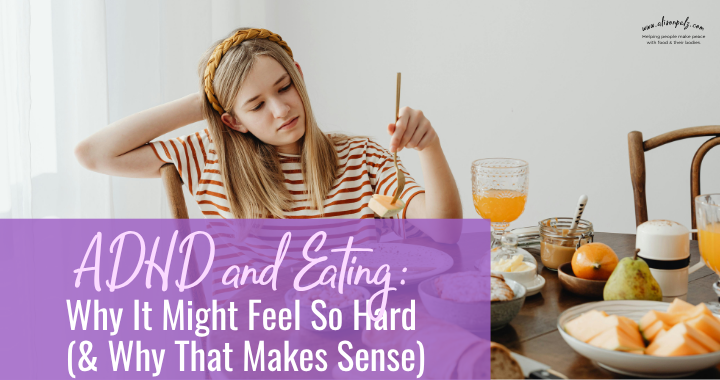
Have you ever had moments where you wondered, Why is eating so much harder for me than it seems to be for other people? Or maybe, I can manage work or school, so why does something as basic as feeding myself feel so overwhelming?
If that sounds familiar, there may be a reason that actually makes sense.
We know from research that people with ADHD are more likely to experience eating disorders such as anorexia, bulimia, binge eating, or ARFID. But beyond the statistics, what matters most is this:
For many people, their struggles with food are not random. They are connected to how their brain works and how they are trying to cope in a world that often expects consistency, structure, and follow-through.
That mismatch can be exhausting.
When ADHD Doesn’t Look Like ADHD
A lot of people don’t immediately recognize themselves in ADHD.
You might have been told that you are doing fine. Maybe you did well in school or you are managing your job. From the outside, things may look steady enough. And part of you might think, If I really had ADHD, wouldn’t it be obvious?
But many forms of ADHD, especially inattentive ADHD, are easy to miss. This is particularly true for girls and women. Instead of being loud or disruptive, it often shows up internally. It can feel like constantly pushing yourself to stay organized, to keep up, to not forget things that seem like they should be easy. It can mean feeling overwhelmed by everyday tasks while also being very hard on yourself for struggling.
On the outside, you may appear capable. On the inside, it can feel like you are working much harder than everyone else just to stay afloat.
Over time, that gap between how things look and how they feel can turn into shame or self-doubt. You may not have the language for it, but you can feel that something is off.
Why Challenges Often Show Up Around Food
When eating feels difficult, it is easy to assume it is a personal failing. You might think you lack discipline or that you should have figured this out by now.
But eating regularly asks a lot from your brain. It requires planning, starting tasks, remembering, organizing, and following through. These are all part of executive functioning, which is exactly where ADHD creates challenges.
So when you find yourself putting off meals, skipping them, or feeling overwhelmed by the idea of cooking and cleaning, it is not because you do not care. It is because your brain has a harder time getting started and moving through all the steps.
You may even notice a pattern where you do not eat for a while and then suddenly you are extremely hungry and trying to catch up. Then afterward, there can be confusion or frustration about how it got to that point again.
When Food Feels Complicated or Overwhelming
For some people, eating is not just about getting started. It is also about how food feels.
You might notice that certain textures or smells are hard to tolerate, or that food has to be just right for you to eat it. At the same time, it may be difficult to recognize hunger until it becomes intense.
This can create a strange push and pull. Sometimes eating feels like too much. Other times it barely registers until your body demands attention all at once.
From the outside, this might look inconsistent or restrictive. From the inside, it often feels confusing and hard to predict.
When Eating Becomes a Way to Cope
If you have experienced binge eating, you might feel stuck in a cycle that does not make sense to you. You may wonder why it keeps happening, especially when you genuinely want it to stop.
But in those moments, eating often serves a purpose. It can soothe overwhelming emotions, create stimulation when things feel dull or restless, or provide a sense of relief. Even if that relief is temporary, it matters.
Understanding this does not mean the behavior feels good or sustainable. It simply means there is a reason your brain keeps returning to it.
When Control Starts to Feel Important
For others, the struggle can look very different. Eating less or creating strict rules around food can feel grounding, especially when everything else feels unpredictable or overwhelming.
You might notice a sense of calm or clarity when things are controlled, and anxiety when that control is disrupted.
This can become more intense during times of change, like adolescence or moving into adulthood, when external structure disappears and you are expected to manage everything on your own. Without enough support, food can become one of the few areas that feels manageable.
A More Compassionate Way to Understand Your Eating Patterns
It is easy to fall into the belief that something is wrong with you.
But what if your eating patterns are not random or broken, but actually attempts to cope with stress, overwhelm, or disconnection?
That does not mean they are working in the long term. But it does mean they deserve understanding, not judgment.
How Healing Can Look Different for People with ADHD
Instead of focusing on fixing yourself, the work becomes about understanding yourself.
Together, we look at how your brain works, what makes things harder, and what kinds of support actually help. We explore what your eating patterns have been doing for you and where there may be unmet needs.
From there, we begin to build systems and strategies that feel more sustainable. Not perfect, not rigid, but supportive and realistic for your life.
If You See Yourself in This
You might feel tired of fighting with yourself. You might feel confused about why something that seems simple feels so difficult. Or you might just want to feel more steady, more nourished, and less overwhelmed.
That is where this work begins.
Ready to Take the Next Step?
If this resonates with you, you do not have to sort it out alone. I offer a free 20-minute consultation where we can talk about what has been going on and what kind of support might actually feel helpful.
Are you struggling with eating, food, or your relationship with your body, or just not sure if something feels off? You don’t need all the answers to reach out. If you’re in Texas and interested in working with me, click here to fill out a contact form.
If you’re a parent supporting a child with an eating disorder or ARFID/”picky eating”, therapy can give you the space to heal and show up for your child. You don’t have to carry this alone.