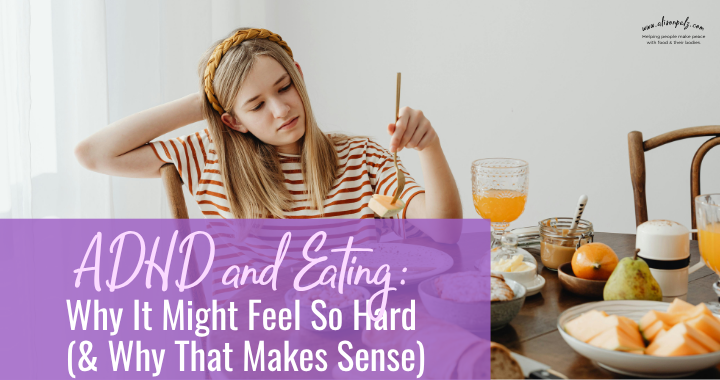
"ADHD and Eating Why This Might Feel So Hard (and Why It Makes Sense)" over a photo of a white teen girl, picking at her food, looking upset.

ADHD and Eating: Why It Might Feel So Hard (& Why That Makes Sense)

Have you ever had moments where you wondered, Why is eating so much harder for me than it seems to be for other people? Or maybe, I can manage work or school, so why does something as basic as feeding myself feel so overwhelming?

If that sounds familiar, there may be a reason that actually makes sense.

We know from research that people with ADHD are more likely to experience eating disorders such as anorexia, bulimia, binge eating, or ARFID. But beyond the statistics, what matters most is this: 

For many people, their struggles with food are not random. They are connected to how their brain works and how they are trying to cope in a world that often expects consistency, structure, and follow-through.

That mismatch can be exhausting.

When ADHD Doesn’t Look Like ADHD

A lot of people don’t immediately recognize themselves in ADHD.

You might have been told that you are doing fine. Maybe you did well in school or you are managing your job. From the outside, things may look steady enough. And part of you might think, If I really had ADHD, wouldn’t it be obvious?

But many forms of ADHD, especially inattentive ADHD, are easy to miss. This is particularly true for girls and women. Instead of being loud or disruptive, it often shows up internally. It can feel like constantly pushing yourself to stay organized, to keep up, to not forget things that seem like they should be easy. It can mean feeling overwhelmed by everyday tasks while also being very hard on yourself for struggling.

On the outside, you may appear capable. On the inside, it can feel like you are working much harder than everyone else just to stay afloat.

Over time, that gap between how things look and how they feel can turn into shame or self-doubt. You may not have the language for it, but you can feel that something is off.

Why Challenges Often Show Up Around Food

When eating feels difficult, it is easy to assume it is a personal failing. You might think you lack discipline or that you should have figured this out by now.

But eating regularly asks a lot from your brain. It requires planning, starting tasks, remembering, organizing, and following through. These are all part of executive functioning, which is exactly where ADHD creates challenges.

So when you find yourself putting off meals, skipping them, or feeling overwhelmed by the idea of cooking and cleaning, it is not because you do not care. It is because your brain has a harder time getting started and moving through all the steps.

You may even notice a pattern where you do not eat for a while and then suddenly you are extremely hungry and trying to catch up. Then afterward, there can be confusion or frustration about how it got to that point again.

When Food Feels Complicated or Overwhelming

For some people, eating is not just about getting started. It is also about how food feels.

You might notice that certain textures or smells are hard to tolerate, or that food has to be just right for you to eat it. At the same time, it may be difficult to recognize hunger until it becomes intense.

This can create a strange push and pull. Sometimes eating feels like too much. Other times it barely registers until your body demands attention all at once.

From the outside, this might look inconsistent or restrictive. From the inside, it often feels confusing and hard to predict.

When Eating Becomes a Way to Cope

If you have experienced binge eating, you might feel stuck in a cycle that does not make sense to you. You may wonder why it keeps happening, especially when you genuinely want it to stop.

But in those moments, eating often serves a purpose. It can soothe overwhelming emotions, create stimulation when things feel dull or restless, or provide a sense of relief. Even if that relief is temporary, it matters.

Understanding this does not mean the behavior feels good or sustainable. It simply means there is a reason your brain keeps returning to it.

When Control Starts to Feel Important

For others, the struggle can look very different. Eating less or creating strict rules around food can feel grounding, especially when everything else feels unpredictable or overwhelming.

You might notice a sense of calm or clarity when things are controlled, and anxiety when that control is disrupted.

This can become more intense during times of change, like adolescence or moving into adulthood, when external structure disappears and you are expected to manage everything on your own. Without enough support, food can become one of the few areas that feels manageable.

A More Compassionate Way to Understand Your Eating Patterns

It is easy to fall into the belief that something is wrong with you.

But what if your eating patterns are not random or broken, but actually attempts to cope with stress, overwhelm, or disconnection?

That does not mean they are working in the long term. But it does mean they deserve understanding, not judgment.

How Healing Can Look Different for People with ADHD

Instead of focusing on fixing yourself, the work becomes about understanding yourself.

Together, we look at how your brain works, what makes things harder, and what kinds of support actually help. We explore what your eating patterns have been doing for you and where there may be unmet needs.

From there, we begin to build systems and strategies that feel more sustainable. Not perfect, not rigid, but supportive and realistic for your life.

If You See Yourself in This

You might feel tired of fighting with yourself. You might feel confused about why something that seems simple feels so difficult. Or you might just want to feel more steady, more nourished, and less overwhelmed.

That is where this work begins.

Ready to Take the Next Step?

If this resonates with you, you do not have to sort it out alone. I offer a free 20-minute consultation where we can talk about what has been going on and what kind of support might actually feel helpful.

Are you struggling with eating, food, or your relationship with your body, or just not sure if something feels off? You don’t need all the answers to reach out. If you’re in Texas and interested in working with me, click here to fill out a contact form.

If you’re a parent supporting a child with an eating disorder or ARFID/”picky eating”, therapy can give you the space to heal and show up for your child. You don’t have to carry this alone.
A Note to Parents of Teens with Anorexia Nervosa

A Note to Parents of Teens with Anorexia Nervosa

If you’re reading this, chances are you’re scared, confused, and doing everything you can to help your teen who seems to be struggling with anorexia nervosa. Maybe you’ve noticed weight loss, increasing rigidity around food, or a once joyful child who now seems consumed by rules and restrictions. You’ve already tried reasoning, negotiating, and reassuring them, only to be met with resistance, tears, or even silence. You’re not alone—and you’re not to blame.

Eating Disorders Don’t Happen in a Vacuum

First, let’s clear some things up: eating disorders happen for a variety of reasons, and you did not cause this. Your child is not being difficult or manipulative. Anorexia nervosa is not a choice—it’s a serious mental illness, one that often emerges as a way to cope with overwhelming emotions, stress, or internal distress. While it’s common to want to understand the “why,” we’ve found that what’s often more helpful is understanding the “function” of the eating disorder.

Many teens develop anorexia as a way to regulate their nervous systems. It gives them a false sense of control, numbs emotions, or provides structure during times when life feels chaotic or uncertain. To you, their stressors may look like typical teenage challenges—school pressure, friendships, body changes—but to them, it may feel unmanageable. Anorexia becomes their coping strategy.

The First Priority: Nutrition

It’s completely understandable to want your teen to be motivated to recover. That desire is beautiful—and sometimes, they do. But more often than not, especially early on, they don’t. That’s because the eating disorder is serving a function that feels protective, even comforting. This is why insight is often low, particularly in the early stages. Your teen likely does not recognize the danger they’re in.

But as a parent, you must.

Malnutrition affects every system in the body—heart, bones, hormones, digestive system, and most importantly, the brain. When the brain is undernourished, it struggles to think clearly, manage emotions, and perceive risk. That means your child may not recognize how sick they are—or even that they’re sick at all. In this light, food is not just fuel—it’s medicine. Without nutritional rehabilitation, anorexia becomes more dangerous and more entrenched. Left untreated, it can be fatal.

Supporting Your Teen: Think “Food First, Life Second”

Your role as a parent is critical—and powerful. You don’t have to wait until your teen agrees there’s a problem. In fact, waiting can lead to more severe illness. Instead, treat this the way you would treat any other safety concern. If your child was struggling to breathe, you wouldn’t wait until they acknowledged the problem—you’d act. Anorexia nervosa requires the same kind of decisive care.

So what does that look like?

  • Offer three meals and three snacks a day. These should be complete, nourishing meals designed to support weight restoration and healing—not what your teen requests or feels “safe” eating. (Remember, the eating disorder is often dictating their choices right now.)
  • Before starting nutrition rehabilitation process, first get a full medical workup from your teens doctor, as they may be at risk for refeeding syndrome, which can be life-threatening.
  • Sit with them while they eat. This isn’t just about supervision—it’s about support. Offer to distract them if they’d like—scroll through social media together, play a card game, or watch a show. Distraction can be a helpful tool.
  • Validate, validate, validate. Acknowledge how hard this is. Say things like, “I know this is scary,” or “I can see how uncomfortable this feels.” Your calm, steady presence will help more than you know.

You’ve probably already tried to help your child eat more and have been met with pushback. That’s normal. Remember, the eating disorder is helping them cope, and asking them to let go of it—especially before they’ve learned other ways to regulate—is asking a lot. But with nourishment, the brain begins to heal. With nourishment, new coping strategies become possible.

You’re Not Alone

Recovery from anorexia is hard—but it’s possible. And no one should do it alone. Reach out to treatment professionals who understand eating disorders, and look for support groups for families walking the same path. Family-Based Therapy (FBT) is designed to support you as you support your teen.

Above all, remember this: your love is not enough to cure anorexia, but it is the foundation on which recovery is built. You can be firm and compassionate. And set boundaries and offer comfort. You can lead your teen through something they don’t yet want to leave behind.

You’re not failing. You’re fighting for your child’s life. And that matters more than anything else.

This article is meant to be educational about anoerxia nervosa, but it does not suffice as treatment. If you think your teen has an eating disorder, please seek a medical evaluation from your teen’s doctor. 

If you would like to connect about how I work with families, feel free to schedule a consultation here. 

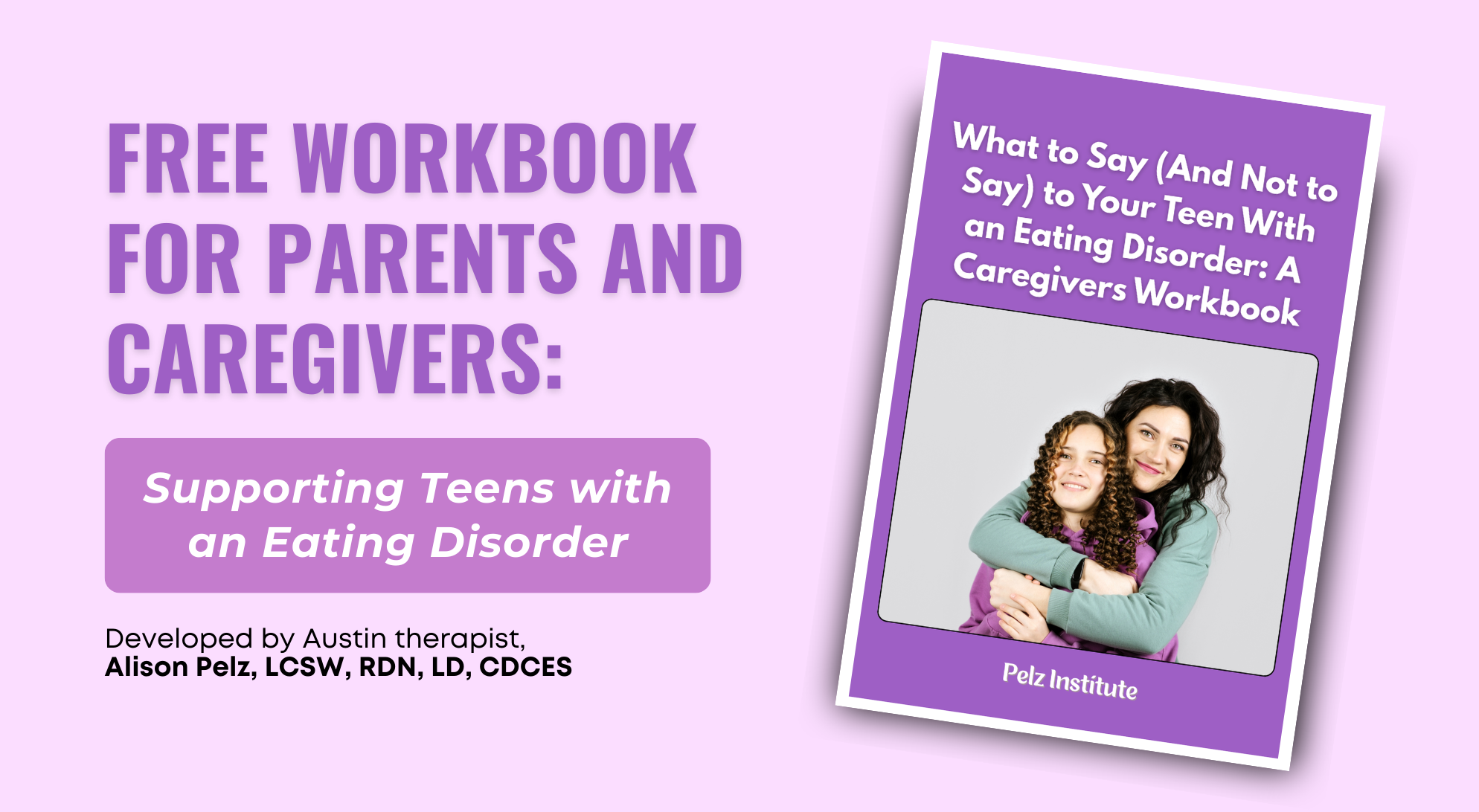
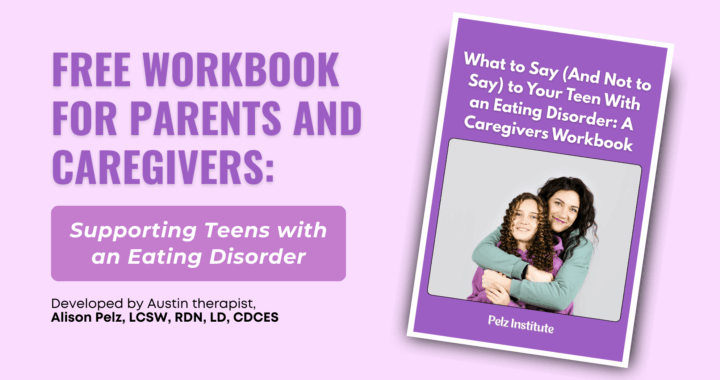
Free Workbook for Parents and Caregivers: Supporting Teens with an Eating Disorder

In March I wrote a blog post about validation and how it can be used to support your teen in their recovery from their eating disorder.

Validation stuff is tricky. Take it from me. I am a parent and a trained therapist and sometimes I still get it wrong.

And it is still worth pursuing.

Validation is not something that you learned from a typical parenting book.

In fact it is something that therapists spend endless hours learning about in grad school and practicing with clients.

Because it is so tricky I wanted to provide a resource for caregivers to help learn more and hone their skills in validation–that’s why I created this free validation workbook. This workbook is geared towards parents supporting a teen with anorexia, bulimia or binge eating (not ARFID-that is a whole other workbook-stay tuned!) I hope you find the workbook helpful!

Quick recap why validation is important:

  • It fosters trust
  • Helps regulate your teens nervous system be feeling seen and heard
  • A regulated nervous system allows your teen to engage in problem solving
  • And as a parent you may notice that it helps you feel calm!

Grab the Free Workbook for Parents and Caregivers Supporting Teens with an Eating Disorder here!

Schedule your free 20 minute consultation here.

The Power of Validation: Supporting Your Child Through Eating Disorder Recovery

The Power of Validation: Supporting Your Child Through Eating Disorder Recovery

Is your teen struggling with an eating disorder?

As a parent, witnessing that struggle and feeling like nothing you say helps or wondering if you’re helping or are making things worse, can be one of the most difficult obstacles to navigate as a parent. And if you’ve felt this way, know that you are not alone. These aren’t experiences most of us know how to prepare for–there are no tools for caring for a loved one with an eating disorder in general parenting books. Unlike clinicians who go to school and receive on-going training to help people in recovery, parents have no such roadmap.

Witnessing your child struggling with an eating disorder can feel overwhelming, confusing, and deeply painful. As a parent, you naturally want to help, but knowing how to respond in the most effective way is not always intuitive. One key tool you can use to support your child’s recovery is validation–understanding what it is, why it matters, and how to practice it can make a world of difference for both your child and your family.

What Is Validation (And what it is not)?

Validation is the act of recognizing, understanding, and accepting someone’s feelings or experiences as real and meaningful.

Caregivers often worry that their validation will give their child permission to restrict food or purge–but that’s not the effect that validation has. Validating your child’s emotional experience doesn’t mean endorsing or encouraging damaging behaviors. What it does mean is that you are able to acknowledge their emotional reality without judgment. This practice lets your teen know that you are someone safe to turn to, because you will listen without assigning “right” or “wrong” to what they are feeling, and are instead there to try and understand their experience so you can better support them. Practicing validation can also be helpful for parents or caregivers in the moment because it often diffuses intense reactions you may be experiencing, and give you a moment to listen rather than react.

What validation is:

  • Actively listening and showing empathy.
  • Communicating that their feelings make sense, given their perspective.
  • Offering a safe space for them to share their struggles without fear of criticism.

What validation is not:

  • Agreeing with unhealthy behaviors or distorted beliefs about food, body, or worth.
  • Dismissing your own boundaries or enabling harmful actions.
  • Fixing their problems or trying to reason them out of their feelings.

Why Validation Is Crucial in Healing

Validation is a cornerstone of emotional healing because it helps your child feel heard, understood, and less alone. Eating disorders often thrive in silence and shame, and by validating the emotional experience your child is having, you help dismantle the isolation that fuels their struggle.

When your child feels validated, their nervous system can move out of a heightened state of stress or fear (often referred to as “fight, flight, or freeze”) into a calmer, more regulated state. This shift is essential because a regulated nervous system allows your child to:

  • Think more clearly and process emotions more effectively.
  • Develop healthy coping mechanisms.
  • Engage more fully in therapy and other forms of treatment.

Fears Parents May Have About Validation

Parents often worry that validation might:

  • Encourage unhealthy behaviors: It’s important to remember that validating your child’s feelings is not the same as endorsing their actions. For example, “I can imagine that it is very hard for you to complete your meal right now because it makes you anxious” is letting them know that you understand what they are struggling against, without encouraging them to restrict themselves.
  • Undermine parental authority: Validation doesn’t mean you have to compromise your boundaries or expectations. In other words, because you understand how hard it is for them to eat, that doesn’t mean you let them go unnourished.
  • Reinforce disordered thoughts: Validation focuses on emotions, not necessarily agreeing with the thoughts driving them. For example, saying, “It makes sense that you feel overwhelmed right now” doesn’t mean you agree with their belief that they “must” restrict food to feel in control.

Barriers to Validating Your Child

It’s not always easy to validate your child’s emotions, especially when:

  • Their feelings seem irrational or extreme. For example, your child may be fearful that they will gain a bunch of weight if they eat a piece of bread or that if they get a B in a class they won’t get a good job.
  • You’re feeling triggered, stressed, or unsure of how to respond.
  • You’re worried about saying the “wrong” thing and making things worse. The important thing is that you are trying and your teen will see that you are trying to understand them and what they are experiencing.
  • Your own emotions—such as frustration, fear, or sadness—are taking over in the moment. If this is the case, you may need to take a step back and come back later to your teen and validate them later. It is never too late.

Validation often doesn’t come naturally to us (I know when in my personal relationships I often find it challenging, and I am a therapist!). The good news is that validation is a skill that you can learn and practice.

Examples of How to Validate

Here are some ways to practice validation in everyday conversations:

  1. Listen Without Interrupting: Show you’re fully present by maintaining eye contact, nodding, and responding with short affirmations like “I’m listening” or “Tell me more.”
  2. Reflect Their Emotions: Paraphrase what they’ve shared to make sure you understand what they are saying. For example, “It sounds like you’re feeling really anxious about eating today, am I understanding that correctly?”
  3. Normalize Their Feelings: Help them see their emotions as a natural response. For instance, “I can understand why you’d feel overwhelmed; this is a big change for you.”
  4. Acknowledge Their Struggle: Recognize the difficulty of their experience. For example, “I can see how hard this is for you, and I’m here to support you.”

Ways to Practice Validation

Validation is a skill that can be developed with practice. Here are some tips:

  • Pause Before Responding: Take a deep breath to ground yourself if you’re feeling reactive. This both gives you a moment to decide how to respond, and helps to regulate your emotions so you are more able to respond intentionally.
  • Practice Empathy: Try to see the situation from your child’s perspective. Ask yourself, “How might this feel for them?” If you don’t know how they are feeling, ask.
  • Use “I” Statements: For example, “I’m here for you” or “I want to understand how you’re feeling” or “I can see why this feels overwhelming” rather than focusing on what they “should” do can help show your teen that you want to be an active support for them, and don’t want to blame them for what they are struggling with.
  • Role-Play Scenarios: If you’re working with a therapist or support group, practice validating responses to common situations.

A Path to Healing

Validation is not a magic cure, but it lays a critical foundation for healing. By helping your child feel seen and understood, you create a space where they can face their struggles without fear of judgment. Over time, this fosters the emotional resilience and trust they need to move toward recovery.

As a parent, you don’t have to be perfect—and there will be times when you stumble. 

But each effort you make to validate your child’s emotions is a step toward connection and healing. Remember, you are not alone in this journey. Reach out for support, whether from therapists, support groups, or other parents who understand the challenges of eating disorder recovery. Together, you can help your child find their way to health and hope.

As a therapist who is also a dietitian, I can help you understand what is going on from both angles. If you are in Texas and interested in working with me, click here to fill out a contact form. I would love to support you and your child on your journey to health.

Supporting Your Child Through an Eating Disorder: A Guide for Parents

Supporting Your Child Through an Eating Disorder: A Guide for Parents

Feeling overwhelmed, frightened, and unsure of how to help when your teen is struggling with an eating disorder is a common and natural experience for parents. And while eating disorders are complex and often misunderstood, with the right resources and support, recovery is possible for your teen. And as a parent, you play a crucial role in your teen’s healing journey.

Below you can find compassionate guidance as well as therapist recommended resources to help you support your teen through their eating disorder recovery effectively.

Start With Understanding:

Eating disorders are complex, but that doesn’t mean they are unknowable. Education is one of the most powerful tools you have at your disposal, not only to help you find effective methods of support, but also to help expand your understanding of what causes and may impact eating disorders, so you can give informed care to your teen–rather than having to rely on guess work and risk causing harm. Understanding the nature of eating disorders and their impact on both physical and mental health can demystify the illness and empower you to provide informed support to your teen.

Here are some highly recommended resources to deepen your knowledge and help you in supporting your child:

When Your Teen Has an Eating Disorder by Lauren Muhlheim:

This book provides practical advice for parents navigating their child’s eating disorder, offering evidence-based strategies rooted in Family-Based Treatment (FBT) in a non-clinical manner so they’re accessible to the non-clinical reader. Muhlheim is the founder of Eating Disorder Therapy LA, an outpatient treatment center, has trained many clinicians and is a frequent speaker at eating disorder trainings and conferences. You can read my full review of this book, and why I consider it a must read here.

Sick Enough: A Guide to the Medical Complications of Eating Disorders by Jennifer Gaudiani:

Dr. Gaudiani’s offers a compassionate exploration of the medical side of eating disorders throughout Sick Enough, helping parents understand the seriousness of eating disorders and how to advocate for their child’s car by breaking down the impact of dietary restriction on your children’s bodies and brains, providing descriptions of common medical problems associated with eating disorders, as well as common co-occurring medical issues that complicate diagnosis and treatment.

Dr. Gaudiani is a board certified-internal medicine doctor who specializes in the treatment of eating disorders, as well as the founder of the Gaudiani Clinic: an outpatient medical practice specializing in the treatment of eating disorders, and a highly respected physician in the eating disorder community.

How to Nourish Your Child Through an Eating Disorder by Casey Crosbie and Wendy Sterling.

Authors Crosbie and Sterling are registered dietitians who specialize in the treatment of eating disorders. How to Nourish Your Child focuses on the Plate-by-Plate approach, a  resource which gives parents actionable steps to help their child restore nutrition-without counting calories or macros.This book helps parents answer the question, “what and how much should I be feeding my child,” especially for parents of teens with eating disorders.

Anorexia and Other Eating Disorders: How to Help Your Child Eat Well and Be Well By Eva Musby.

Eva Musby’s lived experience as parent supporting a teen daughter through in an eating disorder makes her book a wonderful resource. She provides invaluable tools for parents, including guidance on communicating with compassion, handling mealtime challenges, and navigating the emotional toll of supporting a child with an eating disorder. You can visit her website for free resources and updates.

Lean on Community

Try to remember that you are not alone in this journey. Many parents have walked this path and found solace, guidance, and strength in connecting with community and many who have found healing in connecting with others who understand your struggles.  Some places to start:

FEAST-ED.org:

F.E.A.S.T-ED (Families Empowered and Supporting Treatment of Eating Disorders) is an organization that offers resources specifically for parents and caregivers of children with eating disorders. Their community of parents provides support and shared experiences, and resources like forums, educational materials, and a library of researched back information

The Alliance for Eating Disorders Awareness:

This organization offers support groups, treatment referrals, and education for families. Their resources can help you find professionals and programs tailored to your child’s needs.

Practical Tips for Supporting Your Child Effectively:

  1. Practice Patience and Empathy: Recovery is a marathon, not a sprint. Validate your child’s feelings, even when you don’t fully understand them. If you want to learn more about why validation is important (and how to do it) in your child’s recovery I highly recommend this video on emotional coaching.
  2. Focus on Nourishment, Not Blame: Approach meals and food with a goal of healing and restoration, rather than criticism or punishment.
  3. Prioritize Your Own Well-Being: Supporting a child through an eating disorder is emotionally taxing. Seek support for yourself, whether through therapy, parent groups, or trusted friends.
  4. Communicate Openly With Your Child: Foster an environment where your child feels safe to share their thoughts and feelings without fear of judgment.

A Final Word

As daunting as this journey may seem, remember that recovery is possible. By equipping yourself with knowledge, support, and compassion, you can help your child reclaim their health and happiness. Keep taking it one step at a time, and don’t hesitate to reach out for help when you need it. You are not alone in this fight—and neither is your child.

Do you have a teen who is struggling with an eating disorder? Working with a therapist who is experienced in Family-Based Treatment can help. If you are in Texas and interested in working with me, click here to fill out a contact form.

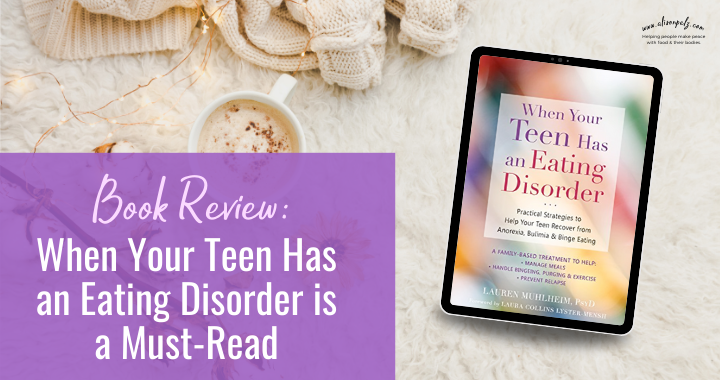
Book Review: When Your Teen Has an Eating Disorder is a Must-Read

The book When Your Teen Has an Eating Disorder: Practical Strategies to Help Your Teen Recover from Anorexia, Bulimia, and Binge Eating, author Dr. Lauren Muhlheim discusses eating disorders and their treatment in great depth.

If you think your child or teen has an eating disorder, this is a must-read.

Eating disorders can perplex many parents and clinicians alike. Your teen may not be acting like their usual self. It’s hard to know if this is just normal teenage angst or something more serious. If your teen has an eating disorder, they may have changed greatly right before your eyes. Including food refusal, increased anxiety around eating, or changes in mood and energy.

You may have talked with them about the importance of eating and tried to reassure them that they are not gaining weight. (In fact, they are likely losing weight.) But your child’s struggles seem to be getting worse, not better.

If your teen has not seen a doctor yet about their eating disorder, this is the first step to make sure they are medically stable.

This book can help guide you and your family in treatment while establishing an eating disorder treatment team consisting, at minimum, of a doctor and therapist.

About the Book

When Your Teen Has an Eating Disorder discusses the complicated concepts surrounding eating disorders in teens in a non-clinical manner. The book provides an overview of various treatment options. It goes into depth about a unique and well-studied treatment called Family-Based Treatment (FBT).

The author of the book, Dr. Lauren Mulheim, owns a counseling and training center in southern California. She uses Family-Based Treatment in her clinic and has been instrumental in training many of the eating disorder therapists in the Los Angeles area and beyond. And she is currently serving on the advisory panel of FEAST (an organization for parents). She is a regular speaker at national eating disorder conferences.

If you are a parent worried about your child and unsure how to help them overcome their eating disorder, this book is a must-read. As an eating disorder therapist myself, I recommend this book to all of the families that I work with. It is a great resource and provides a glimmer of hope to you on your journey.

What is discussed in When Your Teen Has an Eating Disorder?

When Your Teen Has an Eating Disorder outlines the complexities of eating disorders and the impact that they can have on your teen (and your family’s) life.

Learn the warning signs:

  • Changes in eating and/or exercise habits
  • Frequent trips to the bathroom
  • Changes in body weight
  • Loss of menstrual cycle
  • Complaining of feeling cold all of the time
  • Lack of growth
  • Obsessive thoughts about food, body image
  • Changes in overall mood
  • Poorer concentration

Muhlheim highlights the importance of early detection and intervention with trained clinicians, so that the eating disorder can be addressed before it escalates or becomes chronic.

She provides the reader with an excellent explanation of how malnourishment impacts your teen’s ability to understand how the eating disorder is impacting their mind and body. Parents often feel perplexed when their bright, loving child begins to act irrationally around food. You will also learn how to separate your child from their illness, one of the basic assumptions of family-based treatment.

The majority of the book really gets to the heart of the matter: What parents really want to know when their child has an eating disorder. You might be asking yourself questions like “What do we do?”.  Or, “How do we improve our child or teen’s health and get them feeling better again?”

This book can help you answer those questions. In it, Mulheim:

  • Outlines the path to help your child or teen heal from their eating disorder using family-based treatment (FBT). 
  • Discusses the three stages of recovery-nutrition rehabilitation, eating independence, and relapse prevention in depth.
  • Provides parents rationale behind each step so parents can feel empowered to help their child.

Discover Practical and Helpful Tools to Help Your Teen in Eating Disorder Recovery

This book is a practical guide that provides effective, concrete strategies for eating disorder treatment, and examples of how to use them.

Family-based treatment helps parents become empowered agents of change amid their child’s eating disorder. The book provides general guidelines about what to feed your child and how to structure meal times. Additionally, highlights how to effectively interact with your child at each stage of treatment. Including how to be empathetic with them when they are struggling.

In addition to concrete strategies and practical steps, it also covers the challenges that parents might face during treatment. The book details what to do when your child refuses to eat. It also explains how the parents can get support throughout the difficult journey of helping their child get better. You know about The hard aspects of treatment athat they are prepared.

Muhlheim provides all of this information while also sharing real-life examples throughout the book. The stories within this book help parents feel less alone about what is going on with their child. It also provides them with a realistic picture of what they are facing. These examples make parents feel more confident about applying the practical tools needed for recovery.

It is normal for parents to worry about how treatment will affect their relationship with their teen. When Your Teen Has an Eating Disorder emphasizes the importance of your relationship with your teen in the treatment of their eating disorder. A family culture of unconditional acceptance, respect, trust, and empathy supports your child in their recovery. Furthermore, it provides strategies of how to talk to your teen about food and body image during the recovery process.

When Your Teen Has an Eating Disorder is a Great Resource For Parents

Whether your teen is struggling with anorexia, bulimia, or binge eating disorder, this book is helpful for parents. This book will help you if your child is newly diagnosed with an eating disorder, in early stages of treatment, or if your teen has been through several rounds of treatment already.

This book will empower you to support your child’s recovery. If you are seeking treatment for your child, it will give you enough information to decide whether or not Family-Based Treatment is right for your family. If you decide that FBT is the best treatment option, this book walks you through how to create a treatment team that will be the best fit for your child and family.

As a therapist and parent, I appreciate how this book (and FBT in general), takes a very non-blaming stance on eating disorders. Parents aren’t faulted for the disorder and the child isn’t isolated from their family. This book recognizes the family-based treatment approach and belief that parents are the experts on their child. It emphasizes how treatment for eating disorders needs to include the family for best results and also the importance of meal support and nutritional rehabilitation for recovery. I highly recommend reading this book!


If you think your teen has an eating disorder please consult their doctor for assessment and medical care as eating disorders can be life threatening. If you are a parent and are interested in family-based treatment for your child in Texas, you can schedule a consultation with me here.


If you are a clinician looking for a book that can help you understand eating disorders and family-based treatment, you can get CEU’s for reading this book by clicking here.

*Please note this book is not a substitute for professional help from a doctor and eating disorder treatment professionals.