The Thing No One Tells Parents About Binge Eating Disorder in Teens


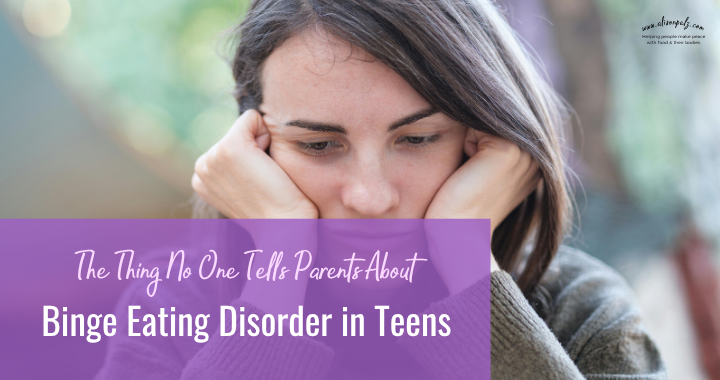
Teenager looking upset and withdrawn

If your teenager has been struggling with binge eating, there’s a good chance you already feel confused and a bit perplexed. You may have noticed food going missing. You may have found wrappers hidden in their room, or realized they’re eating in secret late at night. You may have tried talking to them about it and hit a wall. Or maybe they’ve shut down entirely, and you’re not sure why.

Here’s what I want you to know first: you are not the only parent in this situation. And your teen is not the only teenager going through it.

But there’s something about binge eating disorder that makes it much harder to talk about than other eating disorders, and that silence is part of what keeps families stuck. So let’s talk about it.

What Binge Eating Disorder Actually Is

Binge eating disorder, often called BED, is the most common eating disorder in the United States. More common than anorexia. More common than bulimia. And yet many people have never heard of it as a real diagnosis.

BED involves recurring episodes of eating large amounts of food in a short period of time, often past the point of fullness, and often feeling out of control while it’s happening. What makes it an eating disorder and not just overeating is the distress that comes with it. The shame afterward. The secrecy. The sense that something happened that your teen didn’t quite choose and couldn’t quite stop.

Unlike anorexia, BED doesn’t come with visible signs that most people are trained to look for. Your teen may not be losing weight. They may not look sick. And so the eating disorder can go unnoticed sometimes for a very long time.

The Thing Most Parents Don’t Know: Shame Is Running the Show

Here’s what I don’t see talked about enough: the central experience of binge eating disorder, for most teens, isn’t the eating itself. It’s the shame.

By the time a teenager is in the middle of a binge eating disorder, they are usually already caught in a cycle that’s very hard to see from the outside and very hard to break from the inside. Something happens. Stress, boredom, emotional pain, a fight with a friend, a hard day at school. The urge to eat feels overwhelming and then suddenly unstoppable. And then, after, comes the shame. Why did I do that? What is wrong with me? I have to hide this.

That shame does something important, and not in a good way: it drives the behavior underground. It makes it harder for your teen to tell you what’s happening. It makes them less likely to ask for help. And it often feeds the next episode, because shame is one of the most powerful emotional triggers for binge eating there is.

This is the cycle. It isn’t about willpower. It isn’t about discipline. It isn’t about how you raised them or what you put in the pantry. It’s a shame cycle, and it has a life of its own.

Your teen is probably hiding it from you not because they don’t trust you, but because they’re deeply ashamed of something they can’t explain. They may not have words for what’s happening, or they may worry you’ll be angry, disappointed, or put them on a diet, which often makes things worse. The hiding isn’t defiance. It’s self-protection, and it’s part of how well this disorder hides, even from a parent who’s paying close attention.

If You’ve Already Been Trying to Help

Most parents who end up here have tried to help their teen, often for a long time, in ways that made complete sense given what they knew.

Maybe you’ve had heart-to-heart conversations with your teen, the kind where you stayed up late, chose your words carefully, told them you loved them and just wanted them to be okay. Maybe you framed it around health, not weight, because you knew that was the right thing to do. Maybe you’ve started cooking differently, suggested a family walk after dinner, or quietly cleared the house of certain foods.

None of that is wrong. All of it came from love. But most of those approaches, even the thoughtful ones, work on the surface of the problem. A heart-to-heart about wanting your teen to be healthy, even when you’re genuinely not making it about weight, can still land on a teenager in a shame cycle as one more reminder that their eating is a problem, that they are a problem.

This isn’t a reflection of what you’ve done wrong. It’s a reflection of how well BED hides, and how much of it lives underneath the behaviors you can see.

What Helps (And What Doesn’t)

If you’ve been trying to address this by monitoring your teen’s food, commenting on what or how much they’re eating, or encouraging them to eat less, I want to gently tell you: that approach usually backfires. Not because you’re doing something wrong, but because it increases shame, and shame is what’s keeping this going.

What actually helps is the opposite of what most parents instinctively want to do. It starts with lowering the temperature around food in your home. Not making meals a place where your teen feels watched or judged. Finding small ways to signal that you are safe to talk to, not about eating, but about whatever is hard.

It also helps to get a professional involved. Binge eating disorder responds well to treatment. Cognitive behavioral therapy approaches have strong evidence behind them. A therapist and registered dietitian specializing in eating disorders can help your teen build a more regular relationship with food that reduces the conditions under which binges are most likely to happen. These aren’t quick fixes, but they work.

What your teen needs most from you, right now, probably isn’t a conversation about food. It’s to feel like you see them, that you’re not disgusted or disappointed, and that the relationship between you isn’t contingent on what or how much they eat.

What to Say (and What Not to Say)

This part is hard, because your instincts as a parent are to problem solve. To fix it. To say something useful.

But the most useful thing you can often say is something much simpler. Something like: I’ve noticed you seem like you’ve been having a hard time lately. I’m not here to make things harder. I just want you to know I’m in your corner.

And then leave space. Don’t push for details. Don’t bring up food or eating. Just let them know the door is open.

What tends to make things worse: comments about their body, about portions, about eating habits, about weight. Even gentle, well intentioned comments. Even comments framed as health concerns. For a teenager already deep in a shame cycle, these land as confirmation that they are the problem, and that confirmation makes the eating disorder louder, not quieter.

Getting the Support You and Your Teen Need

If you’re reading this and recognizing your family in it, the most important thing you can do right now is get support. Not a diet plan, not a meal tracking app, actual clinical support from someone who understands eating disorders.

That means finding a therapist who specializes in BED, and ideally also working with a registered dietitian who has eating disorder training. These two pieces, together, the psychological piece and the food relationship piece, are what give treatment the best chance of working.

You deserve support too. Parenting a teenager through an eating disorder is exhausting and frightening and often isolating. Finding a therapist or a parent support group can make a real difference, not just for you, but for your teen, because a calmer, more grounded parent is one of the most stabilizing things a teenager in recovery can have.

Your teen is not broken. You are not at fault.

If you have questions about what treatment for binge eating disorder might look like for your teenager, feel free to reach out. I’m happy to talk through what support could look like for your family. Schedule your free 20-minute consultation today

Frequently Asked Questions

Q: My child seems “addicted to sugar.” I’ll buy a pack of cookies, and they eat the whole thing in one sitting. When I ask about it, they tend to fib. Should I stop buying sugary foods?

It’s a completely understandable instinct. If the food disappears, maybe the problem does too. But this isn’t really about the cookies. If you remove sugar from the house, your child will likely find a way to get it elsewhere, because the food itself doesn’t drive the behavior. It’s driven by what the eating is helping them cope with. The more useful path is getting your child support to build other ways of handling difficult feelings. The food is the symptom, not the cause.

Q: Our pediatrician referred us to a dietitian, and we’ve been going, but it doesn’t seem to be helping. What should we do?

Working with a dietitian who has experience treating eating disorders is a great foundation. What I’d suggest adding is a therapist who also specializes in eating disorders. Binge eating has a psychological component that needs its own dedicated attention alongside the nutrition piece; the two work best in tandem, not in place of each other.

Q: We eat very “clean” at home, but when our teen is out of the house, they go after sugary food like crazy. We don’t understand what’s happening.

This happens more often than parents realize, and once you understand what’s driving it, it starts to make sense. We’re surrounded by confusing, often fear-based messaging about food, the idea that we’re one bite away from disaster. But research tells a different story: dietary restriction and rigid food rules are a known contributor to binge eating developing in the first place. The “clean” eating at home and the “going crazy” outside it are often two sides of the same cycle, not two separate problems.

Please feel free to reach out for a free 20-minute consultation if you would like to discuss your child’s relationship with food further.

If you are a clinician who wants to learn more about eating disorders, check out my services for clinicians here.

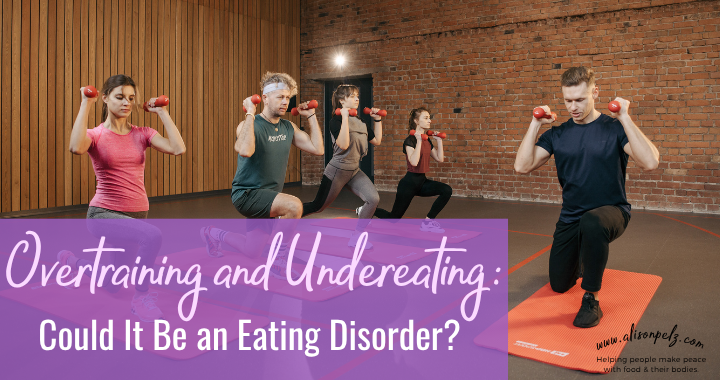
People exercising with dumbbells for a blog about overtraining, undereating, and eating disorders.

Overtraining and Undereating: Could It Be an Eating Disorder?

The short answer: possibly, and you’re not alone in wondering.

If you’re an athlete questioning your relationship with food and exercise, or a parent worried about a teen who trains hard and eats less, this is worth understanding. The line between athletic discipline and disordered eating can be genuinely hard to see, especially from the inside.

This post breaks down the signs of an eating disorder in athletes, why athletes are at higher risk, and what to do if you’re concerned.

What Is Disordered Eating in Athletes?

Disordered eating in athletes exists on a spectrum. It doesn’t always look like the stereotypes.

You might be:

  • Following strict food rules that feel necessary for performance
  • Eating in ways that feel out of control after high-output training days
  • Restricting intake to make weight or achieve a certain body composition
  • Exercising through illness or injury because skipping feels unbearable

These patterns can overlap with recognized eating disorders, including anorexia nervosa, bulimia nervosa, binge eating disorder, and ARFID, as well as clinical syndromes specific to athletes, including Relative Energy Deficiency in Sport (RED-S) and the Female Athlete Triad (low energy availability, menstrual dysfunction, and low bone density).

Signs of an Eating Disorder in Athletes

Behavioral signs:

  • Rigid rules around food: what, when, and how much to eat
  • Binge eating: large amounts of food consumed with a feeling of loss of control
  • Purging behaviors
  • Continuing to train when sick or injured
  • Excessive preoccupation with food, weight, or body shape
  • Low insight that eating has become a problem
  • Excessive worry about food, weight, and body shape
  • Continuing to train when sick or injured

Physical signs:

  • Significant weight changes (loss or gain)
  • Low resting heart rate
  • Loss of menstrual cycle
  • Changes in appetite, mood, or energy
  • Dizziness or lightheadedness
  • Low blood sugar
  • Stress fractures or osteopenia

If any of this sounds familiar for yourself or a teen you care about, an evaluation by a doctor or mental health provider is a worthwhile next step.

Why Athletes Are at Higher Risk for Eating Disorders

Eating disorders don’t develop randomly. For athletes, several factors converge:

  • Performance culture. Athletic environments reward discipline, control, and pushing through discomfort — qualities that can easily slide into disordered patterns.
  • Perfectionism. Strongly correlated with anorexia nervosa, perfectionism is common among high-achieving athletes.
  • Body and weight pressure. Many sports emphasize a specific build to be competitive. That pressure is distressing on its own and even more so because genetics, not willpower, largely determines body shape and weight.
  • Diet culture overlap. The pressure athletes feel to eat the “right way” is amplified by a broader culture already obsessed with food rules.
  • Sport type. Endurance sports (distance running, triathlon, ultra-endurance) and weight or appearance-focused sports (wrestling, gymnastics, figure skating) are associated with a higher risk of eating disorders.

Eating Disorders Affect All Athletes

Disordered eating in athletes does not have a single look. Eating disorders affect:

  • Elite and recreational athletes
  • All genders
  • All ages: children, teens, young adults, and adults at midlife and beyond
  • All body sizes: most people who meet diagnostic criteria have what others would consider a “normal” body
  • All races, ethnicities, and socioeconomic backgrounds

Presentations vary widely, too. You might restrict and binge, purge without restricting, eat the same foods on rotation, or go all day without eating and then have a seemingly ordinary dinner. You may have gone to the doctor and gotten a “clean bill of health”, but the psychological distress of the eating disorder feels like it’s taking on a life of its own.  None of these patterns is less real or less deserving of care.

What to Do If You Think You (Or Your Athlete) Has an Eating Disorder

Get support sooner rather than later. Eating disorders are chronically undertreated. Most people don’t seek help until things have been serious for a long time. You don’t have to wait.

If you have had an eating disorder for years and have “been O.K.” so far you still deserve treatment. If you have had a chronic eating disorder and received treatment before, don’t give up.

Eating disorders rarely announce themselves as disorders. They often start as wanting to “eat healthier” or “get in better shape” and then take on a life of their own. Like all behaviors, they serve a function: managing distress, feeling in control, and coping with difficult emotions. Recovery involves both nutritional stabilization and building new ways to navigate life. 


Frequently Asked Questions: Eating Disorders and Athletes

What is the difference between athletic training and disordered eating? The key distinction is psychological distress and functional impairment. Athletes who train hard but eat flexibly, rest when injured, and don’t experience significant anxiety around food are generally not in disordered territory. When food rules feel rigid and non-negotiable, when missing a workout causes panic, or when eating feels out of control — those are signs worth paying attention to.

I don’t look like I have an eating disorder. Does that mean I don’t need help? No. Body size is not a reliable indicator of eating disorder severity. You can have a larger body and be dealing with a serious, life-affecting eating disorder that deserves treatment.

My eating disorder doesn’t feel that bad. Do I still need treatment? Yes. Eating disorders are underdiagnosed and often minimized by the people experiencing them and by providers. They can become chronic, affect relationships, work, school, and family life, and they can be fatal. They also carry a significant association with suicide.

If I start treatment, do I have to stop my sport? Maybe, but likely only temporarily. Whether exercise needs to pause depends on your physical and mental health at the time. The goal of eating disorder treatment is always to restore a healthy relationship with both food and movement and ultimately return to sport.


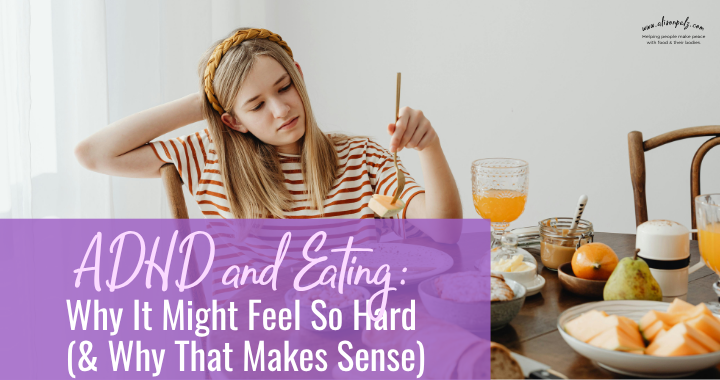
"ADHD and Eating Why This Might Feel So Hard (and Why It Makes Sense)" over a photo of a white teen girl, picking at her food, looking upset.

ADHD and Eating: Why It Might Feel So Hard (& Why That Makes Sense)

Have you ever had moments where you wondered, Why is eating so much harder for me than it seems to be for other people? Or maybe, I can manage work or school, so why does something as basic as feeding myself feel so overwhelming?

If that sounds familiar, there may be a reason that actually makes sense.

We know from research that people with ADHD are more likely to experience eating disorders such as anorexia, bulimia, binge eating, or ARFID. But beyond the statistics, what matters most is this: 

For many people, their struggles with food are not random. They are connected to how their brain works and how they are trying to cope in a world that often expects consistency, structure, and follow-through.

That mismatch can be exhausting.

When ADHD Doesn’t Look Like ADHD

A lot of people don’t immediately recognize themselves in ADHD.

You might have been told that you are doing fine. Maybe you did well in school or you are managing your job. From the outside, things may look steady enough. And part of you might think, If I really had ADHD, wouldn’t it be obvious?

But many forms of ADHD, especially inattentive ADHD, are easy to miss. This is particularly true for girls and women. Instead of being loud or disruptive, it often shows up internally. It can feel like constantly pushing yourself to stay organized, to keep up, to not forget things that seem like they should be easy. It can mean feeling overwhelmed by everyday tasks while also being very hard on yourself for struggling.

On the outside, you may appear capable. On the inside, it can feel like you are working much harder than everyone else just to stay afloat.

Over time, that gap between how things look and how they feel can turn into shame or self-doubt. You may not have the language for it, but you can feel that something is off.

Why Challenges Often Show Up Around Food

When eating feels difficult, it is easy to assume it is a personal failing. You might think you lack discipline or that you should have figured this out by now.

But eating regularly asks a lot from your brain. It requires planning, starting tasks, remembering, organizing, and following through. These are all part of executive functioning, which is exactly where ADHD creates challenges.

So when you find yourself putting off meals, skipping them, or feeling overwhelmed by the idea of cooking and cleaning, it is not because you do not care. It is because your brain has a harder time getting started and moving through all the steps.

You may even notice a pattern where you do not eat for a while and then suddenly you are extremely hungry and trying to catch up. Then afterward, there can be confusion or frustration about how it got to that point again.

When Food Feels Complicated or Overwhelming

For some people, eating is not just about getting started. It is also about how food feels.

You might notice that certain textures or smells are hard to tolerate, or that food has to be just right for you to eat it. At the same time, it may be difficult to recognize hunger until it becomes intense.

This can create a strange push and pull. Sometimes eating feels like too much. Other times it barely registers until your body demands attention all at once.

From the outside, this might look inconsistent or restrictive. From the inside, it often feels confusing and hard to predict.

When Eating Becomes a Way to Cope

If you have experienced binge eating, you might feel stuck in a cycle that does not make sense to you. You may wonder why it keeps happening, especially when you genuinely want it to stop.

But in those moments, eating often serves a purpose. It can soothe overwhelming emotions, create stimulation when things feel dull or restless, or provide a sense of relief. Even if that relief is temporary, it matters.

Understanding this does not mean the behavior feels good or sustainable. It simply means there is a reason your brain keeps returning to it.

When Control Starts to Feel Important

For others, the struggle can look very different. Eating less or creating strict rules around food can feel grounding, especially when everything else feels unpredictable or overwhelming.

You might notice a sense of calm or clarity when things are controlled, and anxiety when that control is disrupted.

This can become more intense during times of change, like adolescence or moving into adulthood, when external structure disappears and you are expected to manage everything on your own. Without enough support, food can become one of the few areas that feels manageable.

A More Compassionate Way to Understand Your Eating Patterns

It is easy to fall into the belief that something is wrong with you.

But what if your eating patterns are not random or broken, but actually attempts to cope with stress, overwhelm, or disconnection?

That does not mean they are working in the long term. But it does mean they deserve understanding, not judgment.

How Healing Can Look Different for People with ADHD

Instead of focusing on fixing yourself, the work becomes about understanding yourself.

Together, we look at how your brain works, what makes things harder, and what kinds of support actually help. We explore what your eating patterns have been doing for you and where there may be unmet needs.

From there, we begin to build systems and strategies that feel more sustainable. Not perfect, not rigid, but supportive and realistic for your life.

If You See Yourself in This

You might feel tired of fighting with yourself. You might feel confused about why something that seems simple feels so difficult. Or you might just want to feel more steady, more nourished, and less overwhelmed.

That is where this work begins.

Ready to Take the Next Step?

If this resonates with you, you do not have to sort it out alone. I offer a free 20-minute consultation where we can talk about what has been going on and what kind of support might actually feel helpful.

Are you struggling with eating, food, or your relationship with your body, or just not sure if something feels off? You don’t need all the answers to reach out. If you’re in Texas and interested in working with me, click here to fill out a contact form.

If you’re a parent supporting a child with an eating disorder or ARFID/”picky eating”, therapy can give you the space to heal and show up for your child. You don’t have to carry this alone.

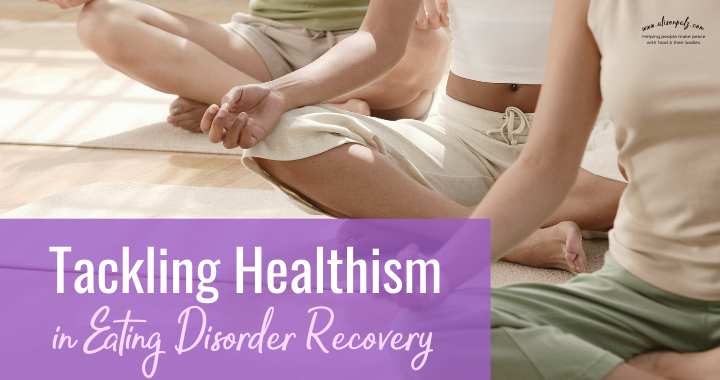
"Tackling Healthism in Eating Disorder Recovery" in white text on a purple background over a photo of a wellness yoga class

Tackling Healthism in Eating Disorder Recovery

One of the most persistent and invisible roadblocks on this path of recovery is healthism.

When you’re in recovery from an eating disorder, the journey isn’t just about food or body image—it’s about unlearning many of the messages that have shaped your relationship with health, worth, and identity.

What Is Healthism?

Healthism is the belief that a person’s moral worth is tied to their health status—and that “health” is something we can fully control through the “right” choices. It often masquerades as wellness advice, clean eating trends, or motivational fitness culture. It’s sneaky. It’s normalized. And it can deeply harm those recovering from disordered eating.

It tells us:

  • That our body is a problem to solve.
  • That health looks a certain way (usually thin, active, and visibly “fit”).
  • That if we are not constantly optimizing our health, we are failing.

Sound familiar?

Where Did Healthism Come From?

Healthism isn’t just a personal mindset—it’s a cultural narrative with deep historical roots. The term was first coined in the 1980s by sociologist Robert Crawford, who observed a growing trend: people were being taught that health was a personal, moral responsibility, and that individuals—not systems—were to blame for their well-being.

Since then, this idea has been reinforced by everything from public health campaigns to social media influencers. Over time, “healthy” became a synonym for “good,” and illness or difference became something to fix or avoid.

Diet culture, fatphobia, ableism, and capitalism all amplified the message: control your body, and you’ll be safe, accepted, and successful. But here’s the truth: most of the factors that shape our health are outside of our control, including genetics, trauma, systemic oppression, and access to medical care.

If you’ve internalized the belief that your worth is tied to how “healthy” you are, that’s not a personal failure. It’s a product of living in a culture steeped in healthism.

When “Wellness” Becomes a Disguise for the Disorder

It’s not uncommon for someone in recovery to shift from calorie restriction to obsessive “clean eating,” or from compulsive weighing to compulsive step counting. All under the guise of “being healthy.”

But here’s the truth: If your pursuit of health is causing you harm, mentally, physically, and/or emotionally, it’s not actually healthy.

Therapy holds space for the messy, complicated process of rethinking what health really means. And gently challenge the idea that health should ever be the benchmark for your value as a human being.

Healing Beyond the Health Narrative

You deserve a recovery that allows you to reclaim your life. Not just fit into a new version of diet culture with a wellness filter.

Here’s what it can look like to move beyond healthism in recovery:

  • Embracing body diversity: All bodies are worthy, and all bodies are different. Health does not have one size or shape.

  • Redefining health: Instead of perfection, explore how to care for your body in a way that feels sustainable, flexible, and joyful.

  • Focusing on values: What matters most to you beyond your body? I help clients reconnect with those parts of themselves.

  • Practicing self-compassion: You are not a failure for struggling. You are a person, doing your best in a culture that makes recovery hard.

You Don’t Need to Be “Healthy” to Deserve Care

One of the most radical things we can say in a healing space is: You deserve support, rest, love, and acceptance—whether or not you’re “healthy.”

Health is not a prerequisite for dignity.

In my work with clients, I hold this truth close. Whether you’re early in recovery or years into your healing. I understand how deeply embedded healthism can be, and here to help you untangle from it with compassion and curiosity.

Ready to Explore a New Way Forward?

If you’re feeling burnt out by the pressure to “recover perfectly” or be the picture of health, you’re not alone. Let’s explore what healing could look like when it’s rooted in connection, not control.

Curious about working together?
Reach out to schedule a consultation. I would be honored to walk alongside you.


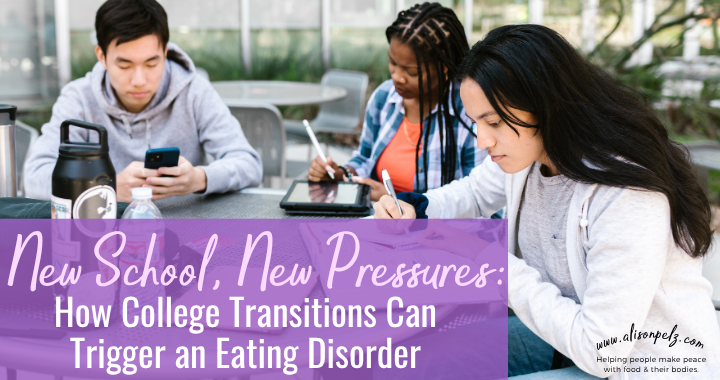
Freshman Year of College Why Eating Disorders May Start or Reappear

Freshman Year of College: Why Eating Disorders May Start or Reappear

The first year of college is often described as a thrilling new chapter—freedom, independence, new friends, late-night pizza, dorm life, and so much possibility. For many students, this first year is fun and exciting. But it’s also filled with major transitions—many of which are invisible until you’re in them. And for students with a history of disordered eating, or even those without, the shift can be enough to stir up or intensify existing eating disorders and their symptoms.

The Perfect Storm of Change

Think about the months, even years, leading up to college: there’s pressure to get in, choose the “right” school, imagine your dream experience, and count down to this next life stage. Students often hear, “These will be the best years of your life.” That narrative leaves little room for the complicated, and very real, emotional reality of freshman year.

Starting college means stepping away from nearly everything that has felt familiar. Students leave behind the structure of high school, the predictability of home, their longstanding support systems, routines, and even the foods they’re used to eating. Meals in college are different—not just the food, but the context: dining halls, roommates watching what you eat, lack of privacy, food availability at odd hours. Schedules shift. Sleep is often disrupted. Social dynamics become more fluid and uncertain.

Our nervous systems thrive on predictability. When that predictability disappears, our bodies and brains notice.

Nervous Systems Don’t Just “Adjust”

The human nervous system is designed to keep us safe and regulated. When life feels overwhelming or uncertain, the body often reaches for something to regain a sense of control or grounding. For some students, that might be diving into academics or social life. For others—especially those with a history of disordered eating—old symptoms may resurface as a way to self-soothe, manage anxiety, or feel a sense of mastery in a suddenly unpredictable environment.

Even for students who have never struggled with an eating disorder before, the stress of transition can be enough to tip the scale. Eating disorders aren’t really about food. They are adaptive responses to stress, trauma, and dysregulation. And while they may seem counterproductive from the outside, they often serve a protective function—numbing overwhelming feelings, offering structure, or creating a sense of control.

When the Fun and the Stress Coexist

It’s important to recognize that freshman year doesn’t have to be miserable for it to be dysregulating. Students (and parents) are often surprised that eating disorder behaviors emerge during what appears to be a “good” year. It’s a common misconception that if a student is socializing, attending classes, or even enjoying college, they must be doing fine. But excitement and stress can coexist. A student might love their college experience and still be struggling silently with food or body image.

What can college students and families do?

  • Normalize the complexity of transitioning to college. Including feelings of worry, fear, and isolation. 
  • Check in with yourself or your college student about disruptions to routine, the changes in eating patterns, and the emotional rollercoaster of being away from home.
  • Support emotional regulation strategies beyond food and body control—like mindfulness, journaling, movement, and connecting with others.
  • Encourage care, especially for students with a history of an eating disorder. Ongoing therapy or nutrition support through telehealth can make a significant difference.
  • Watch for warning signs that may get masked by the “college is fun” narrative—changes in weight, food rituals, isolation, or excessive focus on body image.
  • Reinforce that relapse is not failure, but a signal from the nervous system that something is overwhelming. It’s an invitation for support, not shame.

Final Thoughts

Freshman year is a season of growth, challenge, and self-discovery. It’s normal for it to feel both exciting and hard. When we understand the nervous system’s role in regulation—and how eating disorders often function as misguided coping tools—it becomes easier to see why symptoms might arise or return during this time.

By naming these challenges openly, we can help students and families feel less blindsided—and offer the compassionate, proactive support that helps them not just survive freshman year, but move through it with resilience.

If you would like to know more about how I work with families and college students with eating disorders, please feel free to contact me.

Eating Disorder Recovery: Gain Momentum Over Summer Break

Eating Disorder Recovery: Gain momentum over summer break

For college students working towards eating disorder recovery, during the school year can feel like a constant balancing act. Between deadlines, exams, social stressors, and navigating independence, there’s often little space left for the deep emotional work that recovery requires. You may have found yourself just trying to stay afloat—doing your best to maintain stability, but without the time or energy to develop new skills that support long-term recovery.

Summer break, however, offers something the school year rarely does: breathing room. With fewer academic pressures and more control over your schedule, summer can be an opportunity to gain real momentum in your recovery journey. Here’s how you can use this season to refocus, reconnect, and strengthen your foundation for eating disorder recovery. 

1. Re-Engage With Your Eating Disorder Treatment Team

If you’ve had to scale back on therapy or nutrition sessions during the semester, summer is the time to plug back in. Reach out to your treatment team—therapist, dietitian, physician—and schedule regular appointments. Even a few months of more consistent support can create noticeable progress.

If you’ve been away from care altogether, summer is a great time to re-establish those connections or seek out new providers who can help you move forward. Virtual care has made this more accessible than ever, whether you’re at home, traveling, or staying on campus.

This could also mean considering a more intensive level of care, such as a partial hospitalization program (PHP) or intensive outpatient program (IOP). These structured treatment options—often called “day treatment”—can be an incredibly effective way to reinvigorate your recovery. With daily therapeutic support and a more contained environment, you can focus deeply on healing without the academic stress that might otherwise get in the way.

2. Learn (or Re-Learn) Coping Skills

It’s completely normal to feel too emotionally taxed during the school year to take on new coping strategies. That doesn’t mean you’ve failed—it means you were human in a high-stress environment. Summer gives you the bandwidth to revisit or discover skills that actually help regulate your nervous system and reduce the urge to rely on disordered behaviors.

Here are a few to explore:

💬 Connection with Others

Recovery can feel isolating, and sometimes shame convinces us we’re better off alone. But notice this: What happens when you simply connect with someone—a friend, a family member, even a kind stranger? Does your anxiety dip, even a little? Human connection is powerful. It doesn’t need to be deep or intense to be healing. A short walk with a friend, a phone call or text exchange, or a shared laugh can ground you and remind your brain that you are safe.

🌳 Spending Time in Nature

Nature has a unique way of soothing the nervous system. Research shows that even short periods outdoors—walking through a park, sitting near water, or lying in the grass—can reduce stress hormones and improve mood. The natural world invites presence, which is often the opposite of the chaos and noise that feed disordered thoughts.

Try noticing the small things: the sound of wind in the trees, the feel of sunlight on your skin, the rhythm of your footsteps on a trail. These aren’t distractions—they’re grounding tools that help rewire your stress response over time. 

✍️ Journaling and Self-Reflection

Without the constant stream of assignments and obligations, you may find space for reflection. Journaling can help you process emotions, track your recovery progress, or simply notice patterns in how you’re feeling. You don’t need to write every day or follow a strict structure. Even jotting down a few thoughts each week can increase self-awareness and offer insight into what’s helping (or hurting) your recovery.

3. Give Yourself Permission to Slow Down

Recovery isn’t just about doing more. Sometimes the biggest breakthroughs come when you give yourself permission to rest. Summer may feel like the time you “should” be catching up or making huge leaps—but remember, slowing down can be the leap.

Ask yourself:

  • What pace feels sustainable to me?
  • Where can I offer myself compassion rather than pressure?
  • What kind of support do I need to keep moving forward gently?

4. Plan for the Fall—Without the Pressure

Toward the end of summer, consider how to carry your progress into the school year. Maybe that means scheduling therapy sessions ahead of time, setting boundaries around school-life balance, or identifying support systems on campus.

You don’t need to have it all figured out—but having a loose plan can prevent you from feeling like you’re starting from scratch once classes resume.

Final Thoughts on Eating Disorder Recovery

Recovery during the academic year can be a slow climb—but summer offers the chance to catch your breath, look around, and notice how far you’ve come. This season isn’t about perfection. It’s about presence, curiosity, and gently returning to the practices and people that help you heal.

Use this time to reconnect—with your team, your tools, your community, and yourself.

Are you struggling with eating disorder recovery ? Working with a therapist who is experienced in Family-Based Treatment can help. If you are in Texas and interested in working with me, click here to fill out a contact form.