Understanding ARFID: More Than Picky Eating

Understanding ARFID: More Than Picky Eating

Avoidant/Restrictive Food Intake Disorder (ARFID) often remains underrecognized and misunderstood.

Adults who have struggled with Avoidant/Restrictive Food Intake Disorder for most of their life may feel it is impossible for things to be different. Parents who have a child struggling with ARFID have, more often than not, literally tried everything to help their kiddo eat, but nothing seems to be working. ARFID is complex, it isn’t simple “picking eating”.

Although ARFID is a newer diagnosis, there is nothing new about it.

Prior to being added to the DSM-5, it was included in a broader category called “Feeding Disorder.” It was added to the DSM-5 in order to develop better ways to treat it.

Parenting a Child with ARFID

If you are a parent, well-meaning doctors may have minimized your child’s selective eating. This can be particularly true if your child is on track with growth. This can be frustrating for a number of reasons. You spend significant time to figure out how to feed your child – and it takes a lot of mental energy and often can feel very limiting to keep dealing with this challenge day after day.

Nutritional deficits can impact both physical health and emotional well-being, which is why early detection of ARFID is important–so it doesn’t turn into a life-long struggle. Understanding ARFID is crucial for effective intervention, and a comprehensive treatment strategy tailored to the individual’s specific needs is necessary.

Understanding ARFID

Avoidant/Restrictive Food Intake Disorder is not just a simple case of picky eating; it is a complex psychological condition that can cause significant nutritional and reduced quality of life, particularly if it endures into adulthood.

Unlike other eating disorders that are often driven by concerns about weight and body image, ARFID is characterized by an avoidance of food based on sensory sensitivity, lack of interest in eating, depressed appetite, and/or fear of adverse consequences such as choking, throwing-up, or an allergic reaction.

Individuals grappling with ARFID may face a persistent difficulty when it comes to eating sufficient quantities or varieties of food. This can stem from deep-seated anxiety, gastrointestinal discomfort, or past negative associations with food.

Recognizing Avoidant/Restrictive Food Intake Disorder Symptoms

Persistent avoidance of specific foods or food groups or low food intake are characteristic of ARFID. Physical responses such as gagging may coincide with this avoidance of certain foods.

The eating patterns of individuals with ARFID reveal a restrictive intake that fails to meet their physiological needs. Without treatment, ARFID can lead to potential nutritional deficiencies, weight loss, or developmental delays, irrespective of age, gender, or body weight.

Behavioral signs and changes in eating that may indicate ARFID include:

  • Poor appetite
  • Getting full quickly
  • Avoiding eating due to fear of choking
  • Picky eating that often gets worse over time

Avoidant Restrictive Food Intake Disorder (ARFID) is often misinterpreted as a phase among children or as mere pickiness in adults; however, it represents a significant feeding or eating disorder that hinders one’s capacity to consume an adequate variety and volume of food.

Impact of ARFID on Everyday Life

ARFID’s restrictive eating patterns in children can lead to low energy, isolation, and anxiety around meal times. For caregivers, it can be a struggle to know how to feed your child, or  it can take lots of effort to prepare foods that you know they will eat in order to support growth.

For older children and adolescents, ARFID can make socializing, which often happens around food (such as parties, sleep overs, family events or team dinners), anxiety provoking for both the child and parents. The disorder’s consequences radiate outward, often simmering into familial tensions and social rifts, as loved ones grapple with the complexities of ARFID.

Adults with ARFID tend to have a decrease in quality of life. Moreover, the fear of eating outside one’s comfort zone can hinder personal and professional growth, particularly when mealtime activities are involved.

Ultimately, the disorder’s grasp can dampen overall quality of life, exerting a significant emotional toll.

Approaches to Treating ARFID

The main goal of treatment for ARFID is supporting the sufferer with eating enough (and enough variety) to keep their body nourished. For children, treatment works to support growth. Treatment for children, adolescents, and adults can help to improve overall quality of life.

Improved quality of life looks different depending on the individual with ARFID. For some, that may mean eating most food. For others, it may mean expanding the variety of food just a bit to improve nutrition and make eating easier.

Avoidant/Restrictive Food Intake Disorder treatment usually focuses on making eating or feeding a priority.

That is, for most folks, increasing the number of times each day they eat meals and snacks. Due to the nature of ARFID, eating often gets put off because it is uncomfortable for the person to eat, or they simply aren’t hungry.

Structured meal planning can be an effective strategy for managing ARFID, as it introduces routine and predictability into the dining experience. By brainstorming menus in advance, individuals and families gain clarity and a sense of control over their food choices.

Having structure and making eating a priority can help make sure people are getting adequate nutrition and reduce mealtime stress.

In addressing the dietary concerns that stem from Avoidant/Restrictive Food Intake Disorder, we take a gradual approach to food exposure. Food exposures are designed in collaboration with the client and/or the family in order to personalize care.

Incremental exposure to food means starting with foods that are less anxiety-provoking, and building up to a more diverse diet over time. Food-related anxieties can be deconstructed, facilitating the individual’s encounters with previously feared foods in a safe and controlled environment. While some foods may never feel safe or comfortable for the person to eat.

Efforts are channeled into ensuring balanced nutritional intake while concurrently addressing emotional and cognitive barriers. Over time, the individual learns to associate eating with safety rather than distress, thus gradually dismantling the cycle of avoidance that characterizes ARFID.

My Approach to ARFID Treatment

When I am working with children with ARFID I work closely with their caregivers. I have learned from my training in Cognitive-Behavioral Therapy for ARFID that I can bring the expertise in eating disorders, and the parents & kiddo bring the expertise on their family, food beliefs, culture, and abilities (to name a few).

With adults with ARFID I use a similar mindset. I bring skills to the table to treat the eating disorder and they bring their expert knowledge of themselves.
Are you concerned that you or your child are dealing with Avoidant/Restrictive Food Intake Disorder? Sign up for a free consultation to learn more about how I can help you and your family.

Nourish to Heal: How Eating Enough Supports Binge Eating Recovery

Nourish to Heal: How Eating Enough Supports Binge Eating Recovery

Eating more will likely help you reduce binge eating.

This feels counterintuitive and is certainly not what the weight loss industry or the medical community typically advises, so I know this recommendation can feel very scary. 

The weight loss industry provides “tricks” to reduce binge eating, usually focusing on how to limit consumption of certain foods. However, rather than helping navigate binge eating, it often fuels and perpetuates binge eating. Science has taught us that dietary restriction is a risk factor for developing an eating disorder, including binge eating. Dietary restriction also maintains the eating disorder–in other words, a restrictive diet keeps the disorder going. 

Binge eating can cause significant distress to those who are experiencing it, so understandably, you would do almost anything to stop it. 

First, we need to normalize binge eating. Most humans experience eating episodes related to emotions, as eating can be a common way we cope with and regulate emotions. If you have sensory and neurological differences, including anxiety or ADHD, eating can be a useful tool to help you feel more comfortable. 

We hear harmful messages in our culture about binge eating: that it means something negative about us, or that we “have no will power or we are not disciplined enough”.  Of course, we then internalize these messages, meaning we believe these untrue messages about ourselves, further disconnecting us from self. 

Let’s take a closer look at why eating more helps to reduce binge eating.

Our brain’s primary job is to keep us alive. We need food to survive. Most of us experience pleasure from eating (That’s our brain’s way to ensure that we eat!).

If your meal gets delayed for some reason, you feel really hungry, often leading to feeling “hangry” (hungry & angry–that grumpy feeling we get when we’ve gone too long without food)-our body’s cue to eat. Consequently,  you might eat quickly and possibly more than usual. This is our body’s nifty mechanism to keep us alive. 

Many people who experience binge eating try to limit their food intake or the types of food they typically binge on. This makes perfect sense given the messages about food in our culture. But dietary restriction is eating less food than your body needs. An example of dietary restriction may be “I am going to eat out for lunch, so I’ll skip or have a ‘light’ breakfast”.  This simple act, which our culture often rewards, sets our body’s drive up to alert us to eat.

Dietary restriction is a key feature in what initiates and sustains eating disorders. 

Herman and Polivy coined the term dietary restraint in the 1970s. It suggests that when human eating behavior is under cognitive control, it reduces the ability to read internal satiety cues. 

In other words, simply thinking about restricting food types and amounts can lead us to eat past fullness. Dietary restraint is the key feature of EVERY DIET. And dietary restraint is a significant risk factor for developing an eating disorder. 

What can be done? 

Many clients who experience binge eating also experience dietary restriction and restraint–the natural reaction is often to focus on eliminating binge eating by using more dietary restriction and restraint. Again, this makes sense given diet culture and our medical system. However, it often maintains the eating disorder. 

One of the first steps in my work with clients is to gradually reduce dietary restraint and restriction. I can understand that this can feel very scary. 

In sessions, we explore your personal story and understand where you learned about dietary restriction and restraint.  We then consider if it makes sense to approach things differently.  

We do work on reducing binges, but that typically comes later in treatment. First, dismantling the restriction and restraint is needed to reduce binge eating. 

If you want to learn more about binge eating, I highly recommend this book. Additionally, Decolonizing Wellness is an excellent resource. If you would like to learn more about how I work with clients struggling with binge eating, the first step is to schedule an initial consultation. I would love to hear from you. 

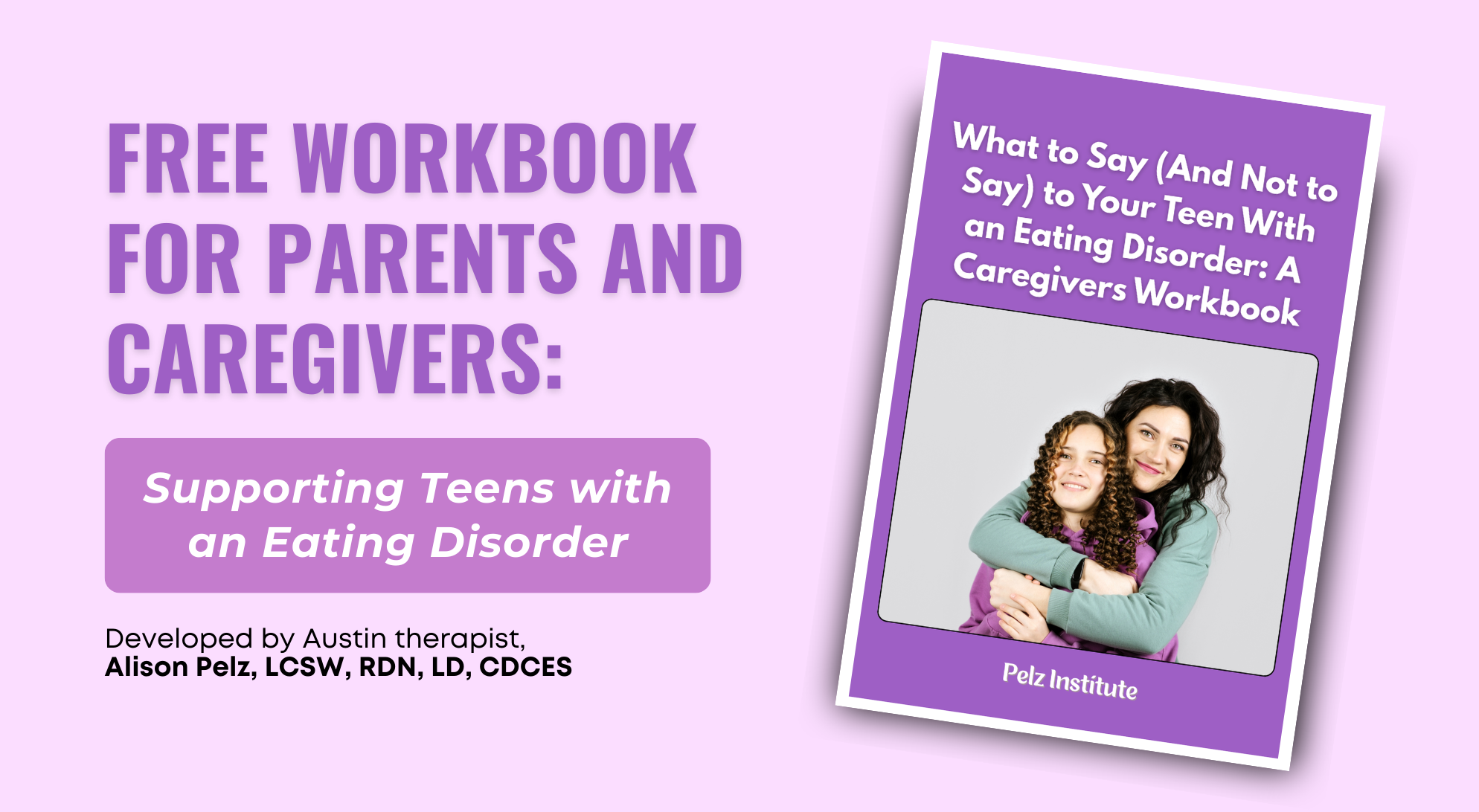
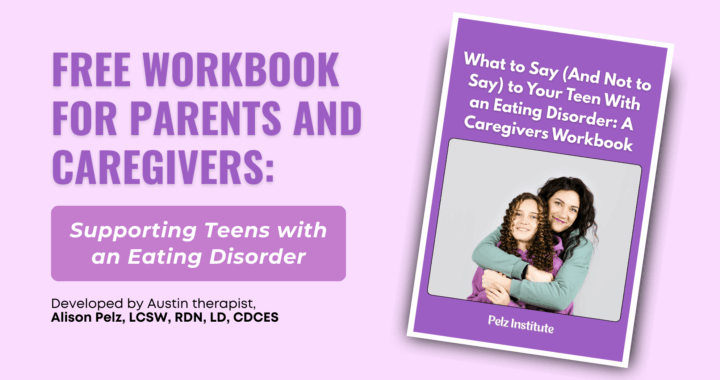
Free Workbook for Parents and Caregivers: Supporting Teens with an Eating Disorder

In March I wrote a blog post about validation and how it can be used to support your teen in their recovery from their eating disorder.

Validation stuff is tricky. Take it from me. I am a parent and a trained therapist and sometimes I still get it wrong.

And it is still worth pursuing.

Validation is not something that you learned from a typical parenting book.

In fact it is something that therapists spend endless hours learning about in grad school and practicing with clients.

Because it is so tricky I wanted to provide a resource for caregivers to help learn more and hone their skills in validation–that’s why I created this free validation workbook. This workbook is geared towards parents supporting a teen with anorexia, bulimia or binge eating (not ARFID-that is a whole other workbook-stay tuned!) I hope you find the workbook helpful!

Quick recap why validation is important:

  • It fosters trust
  • Helps regulate your teens nervous system be feeling seen and heard
  • A regulated nervous system allows your teen to engage in problem solving
  • And as a parent you may notice that it helps you feel calm!

Grab the Free Workbook for Parents and Caregivers Supporting Teens with an Eating Disorder here!

Schedule your free 20 minute consultation here.

Book Review: Sick Enough A Guide to the Medical Complications of Eating Disorders is a Must-Read

Sick Enough: A Guide to the Medical Complications of Eating Disorders is a Must-Read

Sick Enough by Dr. Jennifer L. Guadiani is a great resource both for those experiencing an eating disorder and for those who love them.

This book breaks down complex medical topics into bite-sized pieces. It helps readers understand the real medical complications of eating disorders while addressing barriers to treatment.

Dr. Jennifer L. Gaudiani, author of Sick Enough, is a board certified-internal medicine doctor specializing in the treatment of eating disorders. She is also the founder of the Gaudiani Clinic: an outpatient medical practice specializing in the treatment of eating disorders. Before that work, she worked at ACUTE Center for Eating Disorders and Severe Malnutrition, which treats people with extreme medical complications of eating disorders. Dr. Gaudiani has spoken on this topic worldwide, is published in scientific journals and much more.

All people with an eating disorder deserve care and treatment. This is a simple but powerful idea that is reinforced again and again throughout Sick Enough.

Maybe you think your eating disorder “isn’t that bad”. Or feel like you don’t “look” like you have an eating disorder”.  Unfortunately, these are common beliefs. Many reasons contribute. Many folks who experience eating disorders feel or are made to believe that their disorder isn’t legitimate.  Maybe they don’t fit the mold of “type” of people who get eating disorders. Or they’ve experienced their eating disorder minimized by well-meaning but underinformed mental health providers, doctors, and even family members.

Eating disorders affect people’s physical health, not just their mental health. It is important to know how being underfed and undernourished can affect the body. People with bulimia, binge eating, and anorexia can experience these effects. Undernourishment can happen across the weight spectrum. It affects the digestive tract, mood, muscle tone, and much more.

Yes, Gaudiani emphasizes, all who experience eating disorders are “Sick Enough” to warrant treatment. 

Why read Sick Enough?

In Part I, “Not Enough Calories” Gaudiani initiates an important discussion on what happens to the mind and body when enough calories are not consumed over time. With intentionally dramatic and jarring chapter titles like “30,000 Foot View: What Happens When You Starve Yourself?,” and “Going Into Hibernation and The Empty Tank.

Gaudiani starts off by introducing the reader to the “cave person brain”.  This part of our brain regulates some of the most basic bodily functions. Furthermore, what our brains do to keep us alive when our body is underfed. She illustrates the devastating effects (regardless of body size) that not getting enough calories can have on both physical health and psyche.

Examining Unexplored Biases in Sick Enough:

Refeeding syndrome*, which describes the condition of introducing food too much too quickly to someone who has been malnourished. Refeeding can present a real danger to patients. Gaudiani takes time to explore how the more common, equally dangerous condition of “underfeeding” is historically overlooked in eating disorder treatment, largely due to weight bias in the field.

Genetic variability is another concept Gaudiani explores within Sick Enough. As clinicians we are often baffled when a client who suffers from a severe eating disorder gets their lab work back and it all looks “normal.”Many providers can also be shocked to learn a client has lost their menstrual cycle without appearing to have lost much weight. In exploring how different people react to inadequate food intake, Dr.Gaudiani gives a thorough discussion on genetic variability as a reason we see things like this.

The book’s final section dives into the relationship and intersection of eating disorders and different gender identities, sexual orientations, ages, and chronic health conditions like diabetes. Gaudiani wraps it all up by providing a brief discussion on caring for those who have long and enduring eating disorders, and those who decline eating disorder care.

Throughout the book Dr. Gaudiani weaves in critical discussions on weight bias and weight stigma, and how they function as barriers to accurate diagnosis, treatment and care, as well as diving into and deconstructing pseudo science popularized by diet and wellness culture.

Sick Enough may be a challenging read at times–it goes into detail about some of the more rare medical complications of eating disorders which feel daunting to the reader.

While Gaudiani does her best at acknowledging the complexities of eating disorders within various identities–something historically excluded from the eating disorder treatment space– most of these sections are brief and not in-depth. Missing entirely is a discussion on neurodiversity and how it can complicate eating disorders and eating disorder treatmentRDs for Neurodiversity and Eating Disorder and Autism Collective are resources outside the scope of this book to begin learning more about neurodiversity and how it impacts eating disorders.

Who is Sick Enough for?

  • Medical professionals
  • Those who are experiencing an eating disorder and their loved ones
  • Caregivers

Sick Enough is loaded with invaluable vignettes and metaphors that can be used with clients–as a therapist and dietitian, it helps me communicate and collaborate more effectively with my client and the whole treatment team, as well as helping me advocate for clients in spaces that aren’t eating disorders friendly.

If you are a clinician wanting to learn more about eating disorders and their treatment, sign up here to receive free eating disorder resources in your inbox.

As a therapist who is also a dietitian, I can help you understand what is going on from both angles. If you are in Texas and interested in working with me, click here to fill out a contact form. I would love to support you and your child on your journey to health.

*Please consult your doctor if you think you have an eating disorder before beginning treatment. 

Cover Image courtesy of Taylor & Francis, 2019

The Power of Validation: Supporting Your Child Through Eating Disorder Recovery

The Power of Validation: Supporting Your Child Through Eating Disorder Recovery

Is your teen struggling with an eating disorder?

As a parent, witnessing that struggle and feeling like nothing you say helps or wondering if you’re helping or are making things worse, can be one of the most difficult obstacles to navigate as a parent. And if you’ve felt this way, know that you are not alone. These aren’t experiences most of us know how to prepare for–there are no tools for caring for a loved one with an eating disorder in general parenting books. Unlike clinicians who go to school and receive on-going training to help people in recovery, parents have no such roadmap.

Witnessing your child struggling with an eating disorder can feel overwhelming, confusing, and deeply painful. As a parent, you naturally want to help, but knowing how to respond in the most effective way is not always intuitive. One key tool you can use to support your child’s recovery is validation–understanding what it is, why it matters, and how to practice it can make a world of difference for both your child and your family.

What Is Validation (And what it is not)?

Validation is the act of recognizing, understanding, and accepting someone’s feelings or experiences as real and meaningful.

Caregivers often worry that their validation will give their child permission to restrict food or purge–but that’s not the effect that validation has. Validating your child’s emotional experience doesn’t mean endorsing or encouraging damaging behaviors. What it does mean is that you are able to acknowledge their emotional reality without judgment. This practice lets your teen know that you are someone safe to turn to, because you will listen without assigning “right” or “wrong” to what they are feeling, and are instead there to try and understand their experience so you can better support them. Practicing validation can also be helpful for parents or caregivers in the moment because it often diffuses intense reactions you may be experiencing, and give you a moment to listen rather than react.

What validation is:

  • Actively listening and showing empathy.
  • Communicating that their feelings make sense, given their perspective.
  • Offering a safe space for them to share their struggles without fear of criticism.

What validation is not:

  • Agreeing with unhealthy behaviors or distorted beliefs about food, body, or worth.
  • Dismissing your own boundaries or enabling harmful actions.
  • Fixing their problems or trying to reason them out of their feelings.

Why Validation Is Crucial in Healing

Validation is a cornerstone of emotional healing because it helps your child feel heard, understood, and less alone. Eating disorders often thrive in silence and shame, and by validating the emotional experience your child is having, you help dismantle the isolation that fuels their struggle.

When your child feels validated, their nervous system can move out of a heightened state of stress or fear (often referred to as “fight, flight, or freeze”) into a calmer, more regulated state. This shift is essential because a regulated nervous system allows your child to:

  • Think more clearly and process emotions more effectively.
  • Develop healthy coping mechanisms.
  • Engage more fully in therapy and other forms of treatment.

Fears Parents May Have About Validation

Parents often worry that validation might:

  • Encourage unhealthy behaviors: It’s important to remember that validating your child’s feelings is not the same as endorsing their actions. For example, “I can imagine that it is very hard for you to complete your meal right now because it makes you anxious” is letting them know that you understand what they are struggling against, without encouraging them to restrict themselves.
  • Undermine parental authority: Validation doesn’t mean you have to compromise your boundaries or expectations. In other words, because you understand how hard it is for them to eat, that doesn’t mean you let them go unnourished.
  • Reinforce disordered thoughts: Validation focuses on emotions, not necessarily agreeing with the thoughts driving them. For example, saying, “It makes sense that you feel overwhelmed right now” doesn’t mean you agree with their belief that they “must” restrict food to feel in control.

Barriers to Validating Your Child

It’s not always easy to validate your child’s emotions, especially when:

  • Their feelings seem irrational or extreme. For example, your child may be fearful that they will gain a bunch of weight if they eat a piece of bread or that if they get a B in a class they won’t get a good job.
  • You’re feeling triggered, stressed, or unsure of how to respond.
  • You’re worried about saying the “wrong” thing and making things worse. The important thing is that you are trying and your teen will see that you are trying to understand them and what they are experiencing.
  • Your own emotions—such as frustration, fear, or sadness—are taking over in the moment. If this is the case, you may need to take a step back and come back later to your teen and validate them later. It is never too late.

Validation often doesn’t come naturally to us (I know when in my personal relationships I often find it challenging, and I am a therapist!). The good news is that validation is a skill that you can learn and practice.

Examples of How to Validate

Here are some ways to practice validation in everyday conversations:

  1. Listen Without Interrupting: Show you’re fully present by maintaining eye contact, nodding, and responding with short affirmations like “I’m listening” or “Tell me more.”
  2. Reflect Their Emotions: Paraphrase what they’ve shared to make sure you understand what they are saying. For example, “It sounds like you’re feeling really anxious about eating today, am I understanding that correctly?”
  3. Normalize Their Feelings: Help them see their emotions as a natural response. For instance, “I can understand why you’d feel overwhelmed; this is a big change for you.”
  4. Acknowledge Their Struggle: Recognize the difficulty of their experience. For example, “I can see how hard this is for you, and I’m here to support you.”

Ways to Practice Validation

Validation is a skill that can be developed with practice. Here are some tips:

  • Pause Before Responding: Take a deep breath to ground yourself if you’re feeling reactive. This both gives you a moment to decide how to respond, and helps to regulate your emotions so you are more able to respond intentionally.
  • Practice Empathy: Try to see the situation from your child’s perspective. Ask yourself, “How might this feel for them?” If you don’t know how they are feeling, ask.
  • Use “I” Statements: For example, “I’m here for you” or “I want to understand how you’re feeling” or “I can see why this feels overwhelming” rather than focusing on what they “should” do can help show your teen that you want to be an active support for them, and don’t want to blame them for what they are struggling with.
  • Role-Play Scenarios: If you’re working with a therapist or support group, practice validating responses to common situations.

A Path to Healing

Validation is not a magic cure, but it lays a critical foundation for healing. By helping your child feel seen and understood, you create a space where they can face their struggles without fear of judgment. Over time, this fosters the emotional resilience and trust they need to move toward recovery.

As a parent, you don’t have to be perfect—and there will be times when you stumble. 

But each effort you make to validate your child’s emotions is a step toward connection and healing. Remember, you are not alone in this journey. Reach out for support, whether from therapists, support groups, or other parents who understand the challenges of eating disorder recovery. Together, you can help your child find their way to health and hope.

As a therapist who is also a dietitian, I can help you understand what is going on from both angles. If you are in Texas and interested in working with me, click here to fill out a contact form. I would love to support you and your child on your journey to health.

Supporting Your Child Through an Eating Disorder: A Guide for Parents

Supporting Your Child Through an Eating Disorder: A Guide for Parents

Feeling overwhelmed, frightened, and unsure of how to help when your teen is struggling with an eating disorder is a common and natural experience for parents. And while eating disorders are complex and often misunderstood, with the right resources and support, recovery is possible for your teen. And as a parent, you play a crucial role in your teen’s healing journey.

Below you can find compassionate guidance as well as therapist recommended resources to help you support your teen through their eating disorder recovery effectively.

Start With Understanding:

Eating disorders are complex, but that doesn’t mean they are unknowable. Education is one of the most powerful tools you have at your disposal, not only to help you find effective methods of support, but also to help expand your understanding of what causes and may impact eating disorders, so you can give informed care to your teen–rather than having to rely on guess work and risk causing harm. Understanding the nature of eating disorders and their impact on both physical and mental health can demystify the illness and empower you to provide informed support to your teen.

Here are some highly recommended resources to deepen your knowledge and help you in supporting your child:

When Your Teen Has an Eating Disorder by Lauren Muhlheim:

This book provides practical advice for parents navigating their child’s eating disorder, offering evidence-based strategies rooted in Family-Based Treatment (FBT) in a non-clinical manner so they’re accessible to the non-clinical reader. Muhlheim is the founder of Eating Disorder Therapy LA, an outpatient treatment center, has trained many clinicians and is a frequent speaker at eating disorder trainings and conferences. You can read my full review of this book, and why I consider it a must read here.

Sick Enough: A Guide to the Medical Complications of Eating Disorders by Jennifer Gaudiani:

Dr. Gaudiani’s offers a compassionate exploration of the medical side of eating disorders throughout Sick Enough, helping parents understand the seriousness of eating disorders and how to advocate for their child’s car by breaking down the impact of dietary restriction on your children’s bodies and brains, providing descriptions of common medical problems associated with eating disorders, as well as common co-occurring medical issues that complicate diagnosis and treatment.

Dr. Gaudiani is a board certified-internal medicine doctor who specializes in the treatment of eating disorders, as well as the founder of the Gaudiani Clinic: an outpatient medical practice specializing in the treatment of eating disorders, and a highly respected physician in the eating disorder community.

How to Nourish Your Child Through an Eating Disorder by Casey Crosbie and Wendy Sterling.

Authors Crosbie and Sterling are registered dietitians who specialize in the treatment of eating disorders. How to Nourish Your Child focuses on the Plate-by-Plate approach, a  resource which gives parents actionable steps to help their child restore nutrition-without counting calories or macros.This book helps parents answer the question, “what and how much should I be feeding my child,” especially for parents of teens with eating disorders.

Anorexia and Other Eating Disorders: How to Help Your Child Eat Well and Be Well By Eva Musby.

Eva Musby’s lived experience as parent supporting a teen daughter through in an eating disorder makes her book a wonderful resource. She provides invaluable tools for parents, including guidance on communicating with compassion, handling mealtime challenges, and navigating the emotional toll of supporting a child with an eating disorder. You can visit her website for free resources and updates.

Lean on Community

Try to remember that you are not alone in this journey. Many parents have walked this path and found solace, guidance, and strength in connecting with community and many who have found healing in connecting with others who understand your struggles.  Some places to start:

FEAST-ED.org:

F.E.A.S.T-ED (Families Empowered and Supporting Treatment of Eating Disorders) is an organization that offers resources specifically for parents and caregivers of children with eating disorders. Their community of parents provides support and shared experiences, and resources like forums, educational materials, and a library of researched back information

The Alliance for Eating Disorders Awareness:

This organization offers support groups, treatment referrals, and education for families. Their resources can help you find professionals and programs tailored to your child’s needs.

Practical Tips for Supporting Your Child Effectively:

  1. Practice Patience and Empathy: Recovery is a marathon, not a sprint. Validate your child’s feelings, even when you don’t fully understand them. If you want to learn more about why validation is important (and how to do it) in your child’s recovery I highly recommend this video on emotional coaching.
  2. Focus on Nourishment, Not Blame: Approach meals and food with a goal of healing and restoration, rather than criticism or punishment.
  3. Prioritize Your Own Well-Being: Supporting a child through an eating disorder is emotionally taxing. Seek support for yourself, whether through therapy, parent groups, or trusted friends.
  4. Communicate Openly With Your Child: Foster an environment where your child feels safe to share their thoughts and feelings without fear of judgment.

A Final Word

As daunting as this journey may seem, remember that recovery is possible. By equipping yourself with knowledge, support, and compassion, you can help your child reclaim their health and happiness. Keep taking it one step at a time, and don’t hesitate to reach out for help when you need it. You are not alone in this fight—and neither is your child.

Do you have a teen who is struggling with an eating disorder? Working with a therapist who is experienced in Family-Based Treatment can help. If you are in Texas and interested in working with me, click here to fill out a contact form.