Nourish to Heal: How Eating Enough Supports Binge Eating Recovery

Nourish to Heal: How Eating Enough Supports Binge Eating Recovery

Eating more will likely help you reduce binge eating.

This feels counterintuitive and is certainly not what the weight loss industry or the medical community typically advises, so I know this recommendation can feel very scary. 

The weight loss industry provides “tricks” to reduce binge eating, usually focusing on how to limit consumption of certain foods. However, rather than helping navigate binge eating, it often fuels and perpetuates binge eating. Science has taught us that dietary restriction is a risk factor for developing an eating disorder, including binge eating. Dietary restriction also maintains the eating disorder–in other words, a restrictive diet keeps the disorder going. 

Binge eating can cause significant distress to those who are experiencing it, so understandably, you would do almost anything to stop it. 

First, we need to normalize binge eating. Most humans experience eating episodes related to emotions, as eating can be a common way we cope with and regulate emotions. If you have sensory and neurological differences, including anxiety or ADHD, eating can be a useful tool to help you feel more comfortable. 

We hear harmful messages in our culture about binge eating: that it means something negative about us, or that we “have no will power or we are not disciplined enough”.  Of course, we then internalize these messages, meaning we believe these untrue messages about ourselves, further disconnecting us from self. 

Let’s take a closer look at why eating more helps to reduce binge eating.

Our brain’s primary job is to keep us alive. We need food to survive. Most of us experience pleasure from eating (That’s our brain’s way to ensure that we eat!).

If your meal gets delayed for some reason, you feel really hungry, often leading to feeling “hangry” (hungry & angry–that grumpy feeling we get when we’ve gone too long without food)-our body’s cue to eat. Consequently,  you might eat quickly and possibly more than usual. This is our body’s nifty mechanism to keep us alive. 

Many people who experience binge eating try to limit their food intake or the types of food they typically binge on. This makes perfect sense given the messages about food in our culture. But dietary restriction is eating less food than your body needs. An example of dietary restriction may be “I am going to eat out for lunch, so I’ll skip or have a ‘light’ breakfast”.  This simple act, which our culture often rewards, sets our body’s drive up to alert us to eat.

Dietary restriction is a key feature in what initiates and sustains eating disorders. 

Herman and Polivy coined the term dietary restraint in the 1970s. It suggests that when human eating behavior is under cognitive control, it reduces the ability to read internal satiety cues. 

In other words, simply thinking about restricting food types and amounts can lead us to eat past fullness. Dietary restraint is the key feature of EVERY DIET. And dietary restraint is a significant risk factor for developing an eating disorder. 

What can be done? 

Many clients who experience binge eating also experience dietary restriction and restraint–the natural reaction is often to focus on eliminating binge eating by using more dietary restriction and restraint. Again, this makes sense given diet culture and our medical system. However, it often maintains the eating disorder. 

One of the first steps in my work with clients is to gradually reduce dietary restraint and restriction. I can understand that this can feel very scary. 

In sessions, we explore your personal story and understand where you learned about dietary restriction and restraint.  We then consider if it makes sense to approach things differently.  

We do work on reducing binges, but that typically comes later in treatment. First, dismantling the restriction and restraint is needed to reduce binge eating. 

If you want to learn more about binge eating, I highly recommend this book. Additionally, Decolonizing Wellness is an excellent resource. If you would like to learn more about how I work with clients struggling with binge eating, the first step is to schedule an initial consultation. I would love to hear from you. 
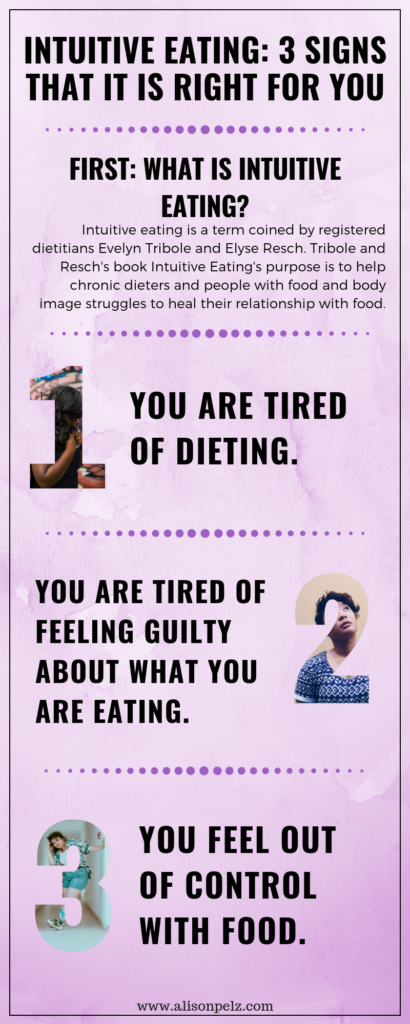
Intuitive Eating: 3 Signs That It Is Right for You

Intuitive Eating: 3 Signs That It Is Right for You

Intuitive eating is a term coined by registered dietitians Evelyn Tribole and Elyse Resch. Tribole and Resch’s book Intuitive Eating’s purpose is to help chronic dieters and people with food and body image struggles to heal their relationship with food.

Unlike diets, intuitive eating sharpens our ability to listen to our bodies and to understand when we are hungry and full, what foods to eat, and when the best time for our bodies to eat is. This results in a reduction of worry about food and guilt often associated with dieting.

In a nutshell, intuitive eating is learning to tune into your body’s signals in order to feed and nourish yourself instead of a diet or meal plan.

Are you ready for intuitive eating? Here is how to tell:

Are you tired of dieting?

Have you been on almost every diet known to man? Do you feel frustrated that diets work for a while, but then something happens-like a vacation or a stressful event-then you go off the diet?  

Trust me, it is not you, it is the diet. Most diets don’t work long -term. Diets fail, not the people on them. Dieting is a known risk factor for developing a full-blown eating disorder.   Eating intuitively can help kick diets–forever. 

Are you tired of feeling guilty about what you are eating?

Most diets have rigid rules about what, when, and how much to eat. When these diet rules are “broken,” it can leave the dieter with feelings of guilt. 

With intuitive eating, there is no set of rules about what is “good” and “bad” to eat. Eating intuitively helps people tune into their body’s wisdom in order to feed themselves.

Do you feel out of control with food?

Diets give us the illusion of control over food.  Particularly when you first start a diet, it feels like you have complete command over your eating, until your biology kicks in (because most diets don’t provide enough energy or calories) or you find yourself in a situation that you are unable to follow the diet. 

Furthermore, it is natural to have cravings for more food and certain types of foods if you have been depriving yourself by being on a diet. The overeating (perhaps even binge eating) kicks in when you have access to foods that aren’t on the diet.

Again, it is not because you don’t have enough willpower or intellect. The diet is the problem, not you. Studies show that dieting can lead to full-blown eating disorders.  

Eating intuitively rejects the diet mentality and “legalizes” all foods, thereby reducing feelings of deprivation around food. 

If you answered “yes” to any of these questions, intuitive eating may be the relief you are looking for.  

Intuitive Eating is not another diet in disguise or a weight loss program. Intuitive eating doesn’t preach what, when, and how much to eat, Rather, it teaches you to listen to your body’s signs and signals about how to best feed yourself. With intuitive eating, you will gain confidence around how to feed yourself.  

Want to learn more about intuitive eating or see if it is right for you? Call for your free 15-minute phone consultation.  

Note: If you are in treatment for an eating disorder, talk with your treatment team about if and when intuitive eating is right for you. If you think you have an eating disorder, get an assessment completed by an eating disorder treatment professional before starting intuitive eating.  

3 Important FAQs about Intuitive Eating

3 Important FAQs about Intuitive Eating

Intuitive eating is a term coined by registered dietitians Evelyn Tribole and Elyse Resch.  Tribole and Resch’s book Intuitive Eating’s purpose is to help chronic dieters and people with food and body image struggles heal their relationship with food.

Unlike diets, intuitive eating sharpens our ability to listen to our bodies and to understand when we are hungry and full, what foods to eat, and when is the best time for our bodies to eat.  This results in a reduction of worry about food and guilt often associated with dieting.

In a nutshell, intuitive eating is learning to tune into your body’s signals in order to feed and nourish yourself instead of a diet or meal plan.

Question:  Is intuitive eating the same as mindful eating?

Answer: Intuitive eating and mindful eating are not synonymous.  However, they do have some overlap.  Think of mindfulness as focusing your attention on one thing.  For example,  you can practice mindfulness when you are petting your dog.  You notice how your dog looks, how it feels to pet your dog, and how your dog responds to your touch.

You can also practice mindfulness while eating.  To do this, you may notice the appearance, temperature, consistency, and smell of what you are eating, free from other distractions.

When I teach clients intuitive eating, I encourage them to practice mindful eating because it helps increase the pleasure of eating and dial into internal signals that your body is giving you in regards to food preferences, and hunger and fullness.

Question:  I want to lose weight. Is intuitive eating going to help me achieve my weight loss goals?

Answer:  No, intuitive eating is not a weight loss program.  It is a way of relating to food.  While diets tell us to look to the diet plan to know how much and what to eat, intuitive eating postulates that we have all of the knowledge within ourselves on how to feed ourselves.  Chronic dieting teaches us to ignore our internal cues.

You may be thinking, “Well, I overeat pretty regularly.  If I start listening to my body and stop overeating, it will lead to weight loss.”  This is not necessarily true because body weight and metabolism are under substantial genetic control.

However, intuitive eating will provide a relief from the vicious diet cycle which will help alleviate the feelings of shame and guilt associated with dieting.

Question:  I think I may have an eating disorder.  Will intuitive eating help me get over my eating disorder?

Answer: I am glad that you have recognized that you may have an eating disorder.  The next step is to get assessed by a treatment professional.

If you do have an eating disorder, getting adequate treatment from professional is a must for recovery.  Unfortunately, eating disorders don’t go away on their own.  Treatment is important to reduce medical risks associated with eating disorders, including death. (Anorexia nervosa has the highest mortality rate of all psychiatric conditions.)

That being said, intuitive eating could be part of your treatment process, in the later stages of treatment.  Together with your treatment team, you will be able to determine if and when intuitive eating is right for you.

Unsure if intuitive eating is right for you?  Call me for a free 15-minute phone consultation.

3 Important FAQs about Intuitive Eating