Can Family-Based Treatment Help My Child Recover from an Eating Disorder

Can Family-Based Treatment Help My Child Recover from an Eating Disorder?

If you are a parent or caregiver desperate to help your child who is struggling with an eating disorder, family-based treatment may be the solution.

Often, families come into my office worried sick about their child.

Your child may have lost weight or become more rigid around food. Perhaps your child has been over-exercising, using laxatives, or throwing up after eating.

Or, your child only eats a small number of foods, or eats a lot of food at once.  

You may feel terrified because the doctors mention treatment centers or hospitalization. 

No matter what your child’s symptoms are, you may feel frantic, frustrated, and powerless. You have tried to make things different, but don’t know what to do. 

If you find yourself in a similar boat today, you’re not alone. I have worked with countless families who walk into my office feeling this way.

Many parents have been seeking help for a while. Unfortunately, they have found no real results. They often receive criticism, but no real guidance on how to help their child get better, or well-meaning doctors say they will grow out of it, and that it’s just a phase.

I’m here to give you hope.

After years as a therapist and registered dietitian, I’ve seen the positive results that come from family-based treatment.  When parents are properly equipped and supported to be part of the solution, their child’s needs to get better. 

Why Choose Family-Based Treatment?

Family-based treatment (FBT) for eating disorders is an evidence-based treatment for anorexia and bulimia nervosa. 

Unlike many other treatments that put the responsibility on the identified patient or the person with the eating disorder, FBT includes the parents. Instead of seeing the parents as part of the cause of the eating disorder, they are seen as part of the solution.

We use your expert knowledge of your child to help your child get better.

This method of treatment makes sense to parents. If your child had cancer or some other serious medical condition, you, as the parents, would be highly involved in treatment. Such as attending appointments, physical therapy, and all the steps to recovery.

It shouldn’t be any different for treating eating disorders.

Eating disorders are an epidemic in our country. According to the NIH, for teens between the ages of 13 and 18, the lifetime occurrence of anorexia, bulimia, and binge eating disorder is 2.7%. These disorders are twice as common among girls as boys. They also tend to be more common the older the teen gets.

How Effective is Family-Based Treatment?

Family-based treatment has been used in the United Kingdom for many years. It has proven to be more effective than other forms of eating disorder treatment.

With a 75% success rate, teens receiving FBT also recover faster than with other treatments. The research also shows that teens are doing better after engaging in FBT than in other treatments.

How Does Family-Based Treatment Work?

In family-based treatment, a clinician guides the parents in empathizing with the child while also holding boundaries around eating and food. Parents help interrupt other eating disorder behaviors like binge eating and laxative use.

The therapist coaches the parent on how to teach their child to eat again. The goal is for the child to eventually have age-appropriate responsibility for food intake and eating habits. 

Family-based treatment usually lasts around 20 sessions and happens in three stages.

During the first stage, the parents are responsible for preparing and serving food. Helping their child eat as much as their body needs to nourish them back to health. Parents do the job that a nurse would do during an inpatient stay at a hospital. There is no room for negotiation around food or other eating disorder behaviors like purging, misusing exercise, or laxatives.

The second and third phases include slowly giving responsibility for food and exercise back to the child.

During the second phase, the child may return to more normal activities while being supervised by their parents for any signs of relapse.

During the third stage, the child begins to transition back on track with their developmental stage of eating.

What Makes FBT Different?

Family-based treatment is quite different from the standard eating disorder treatment. 

First of all, at its core, FBT does not blame the child’s parents (or the child) for the eating disorder. One of the core beliefs of family-based treatment is that no one in the family is to blame. Really, the focus is on getting the child well instead of placing blame.

In other treatments, the person with the eating disorder receives the bulk of the treatment outside of the family system. But, with FBT, the parents, child, and sometimes even the siblings, are involved in treatment. 

The parents’ care and motivation to help their child are used to make some major changes in the family’s life, especially around food. Their unique expertise on their child is used to help them get better, and parents are taught how to interact with their child around food, and other eating disorder behaviors.

This allows the family to overcome the eating disorder together. 

Another difference with FBT is the focus on food, nutrition, and eating disorder behavior rehabilitation. FBT believes that a lot of the symptoms of the eating disorder will disappear when the child is better nourished and no longer using other eating disorder behaviors. So they first focus on nutrition, feeding, and decreasing other eating disorder behaviors. 

Often, parents think that their child has to be “motivated” for treatment to be effective. One of the differences with FBT is that the child does not need to be motivated to change to get better. The motivation to make change happen starts with the parents. 

What are the Benefits of Family-Based Treatment?

Family-based treatment has benefits for both the family as a whole and the child, including: 

  • The child or teen usually gets better faster than any other treatment, making it one of the quickest ways to help your child and family heal.
  • Parents are involved in the child’s treatment, allowing them to be the child’s primary support instead of feeling powerless and at fault.
  • This is a good replacement for inpatient treatment or partial hospitalization, allowing your child to stay home.
  • FBT is an evidence-based approach, so you know you are doing the best you can for your child.

Now that you know how FBT can help, let’s look at who it can help.

Who is FBT for?

FBT has been shown to be effective for kids, teens, and young adults showing signs of eating disorders.

It has been used to help kids and teens who are struggling with anorexia, bulimia, binge eating disorder, and in some cases ARFID. 

In the cases of binge eating disorder and bulimia, the family is taught to help feed their child adequately and supportively interrupt binge eating, purging, laxative use, and misuse of exercise. 

FBT works both for teens who have been to inpatient multiple times and still struggle to let go of the symptoms, and for teens who have just started to engage in eating disorder behaviors, and for any child in between.

FBT is not just for teens, however. It can also be used with children and young adults still living at home. FBT can be used in all different types of families or caregiving situations (like grandparent caregivers and single-parent households).

Who Should Not Do FBT?

FBT should not be used for children and teens who are medically unstable. Always consult a doctor if you think your child has an eating disorder. 

FBT is often used instead of higher levels of care, such as residential or day treatment. If the child is underweight and cleared by their doctor to stay outpatient, FBT can be a great option rather than high levels of care. 

In the same way, if the child needs to be supervised for other psychiatric illnesses, then this is also a situation where FBT is not going to help until the child is stable psychologically. Family-based treatment may also not be a good option if the child has experienced certain types of trauma.

What Happens During Family-Based Treatment?

Family-based treatment may last around 20 sessions. At each session, you can expect your child or teen to check in with the therapist for mental health support.

After this, the therapist will meet with the parents and child for coaching around nutrition and other eating disorder behaviors. The coaching isn’t just about what to eat but also about how to talk to your child about eating and other eating disorder behaviors, including how to express empathy without giving in.

Unlike other eating disorder treatments, where the therapist just meets with the child, most of the time, the FBT therapist meets with the caregivers and the child.

Family-Based Treatment is Worth the Hard Work

Family-based treatment can be very intense for the whole family. In the beginning, you will be very involved in your child’s day-to-day life, as well as your child’s nutritional rehab, but the hard work will be worth it when your child learns to eat and regains their health again.

Not only does family-based treatment help your child stay home, as hospitalizations can last weeks or months, but it also helps to heal your whole family from the disruption that the eating disorder has caused.

While it can be hard to find family-based treatment, don’t give up! Finding someone who is trained to do family-based treatment can make the difference for your child.

At a minimum, when you are seeking FBT you will need to at least start with a medical doctor and a therapist.  If your team includes a dietitian, initially, they will only meet with the parents and not the child.

As a therapist who is also a dietitian, I can help you understand what is going on from both angles. If you are in Texas and interested in working with me, click here to fill out a contact form. I would love to support you and your child on your journey to health.

When Exercise Becomes Too Much, Could It Be Exercise Addiction?"

When Exercise Becomes Too Much, Could It Be Exercise Addiction?

Here are some possible signs of exercise addiction. Do you…

  •   spend a lot of mental energy thinking about exercise? 
  •   think about when and how you are going to fit in? 
  •   have excessive worry or guilt if you don’t exercise? 

If any of those sound familiar to you, they could be signs that your exercise routine has become problematic.

Generally speaking, exercise is a good thing for you.

Exercise is not only fun, but it can improve physical and mental health and bolster self-esteem.  Exercise can also be social. Participating in sports, whether recreationally or competitively, has numerous benefits like introducing you to other people, giving you space to connect with your body, and improving your concentration.

However, too much of a good thing, like exercise, can lead to major health issues.

Exercise becomes problematic when exercise negatively affects your physical health and interferes with other aspects of your life. If exercising gets in the way of your social life, your family life, work, or school, you might be overdoing it.

When exercise becomes so rigid that it is harmful to your well-being it has shifted from healthy to compulsive exercise. Some people refer to compulsive exercise as an exercise addiction, because the urge to exercise often feels very strong and it can be uncomfortable to ignore it.

Are you wondering if you’re addicted to exercise? Here are six signs that you’re dealing with compulsive exercise:

There is rigidity around your exercise routine.

You may find it hard to deviate from your exercise routine. The rigidity that often accompanies exercise addiction can include the time of day the exercise is done, what type of exercise, and for how long you exercise.

Exercise is often excessive.

You spend a lot of time exercising. Usually, the length of exercise increases over time. You may be spending much of your free time exercising or thinking about exercising.

Not exercising makes you feel guilty, depressed and/or anxious.

If you have to miss your regularly scheduled exercise it makes you have intense negative emotions. You may spend significant mental energy thinking about how to “make it up”.

Exercise interferes with your social life and relationships.

You may turn down social invitations because it interferes with your exercise routine. For some, this can lead to significant feelings of isolation. You may even lie or hide how much you exercise. Work or school obligations can suffer because so much time and energy is spent on exercise.

You exercise despite feeling sick or if you have an injury.

When you are sick or injured you exercise anyway. You feel afraid that you will lose ground on your fitness level or you won’t return to exercise if you take time away.

Exercise feels like a chore or an obligation.

Initially, exercise starts off moderately but can slowly get more extreme. After a while, exercise no longer feels like something you want to do, but something that you have to do.


We may all experience some of these signs of compulsive exercise from time to time. However, the tell-tale sign of compulsive exercise is the persistent and consistent thoughts of exercise. In addition to the constant thinking about exercise, you might also experience intensely negative feelings when you miss an exercise session.

Compulsive exercise isn’t just about the exercise itself, it’s also about the enormous amount of thought and effort that goes toward thinking about exercise. Besides the time spent exercising, there is a lot of mental energy that goes into thinking about when, and how to exercise, and after a while that can be very draining.

The connection between athletes and compulsive exercise

It probably comes as no surprise that athletes are at a higher risk for developing a compulsive relationship with exercise.

Studies show that about 3% of the general exercise population struggles with compulsive exercise. Athletes are far more likely to struggle with exercise addiction. As many as 14% of endurance athletes and up to as high as 34.8% of elite athletes struggle with compulsive exercise. Compulsive exercise might feel necessary to keep up with the demands of their sport, but it has detrimental effects on physical and mental health.

The connection between eating disorders and compulsive exercise

Athletes aren’t the only people who struggle with compulsive exercise. There is a strong connection between compulsive exercise and eating disorders. Research has shown that 39% to 48% of people with eating disorders engage in compulsive exercise.

Often compulsive exercise is used to “make up for eating mistakes” or binges. In the eye of the eating disorder, it can give the person with an eating disorder permission to eat. Exercise is used in efforts to obtain or maintain a certain body weight or physic.

You can’t tell by looking at someone if they compulsively exercise. People with all different body types compulsively exercise.

What are the consequences of exercise addiction?

There are several physical consequences of compulsive exercise. They include:

    • Reduced bone density (osteopenia and osteoporosis)
    • Loss of menstrual cycle
    • Chronic muscle soreness, bone, and joint pain
    • Overuse injuries such as stress fractures

In addition to the physical effects, compulsive exercise has a major effect on mental health. Compulsive exercise is associated with decreased overall life satisfaction, negative mood, low energy, and increased rates of depression and/or anxiety.

How can compulsive exercise be treated?

If you’re struggling with compulsive exercise, you’re not alone, and help is available. There are ways to treat compulsive exercise, or exercise addiction. Therapy is an important tool for treating compulsive exercise.

In therapy, you can explore some of the problematic thinking that leads to compulsive exercise. Therapy can also help you learn how to resist and reduce the urges to compulsively exercise. Finally, working with a therapist can help you improve your relationship with exercise in order to enjoy it with both your physical and mental health in mind.

Are you concerned about your relationship with exercise? If you’re struggling with compulsive exercise, working with a therapist can help. Get in touch today for your free consultation.

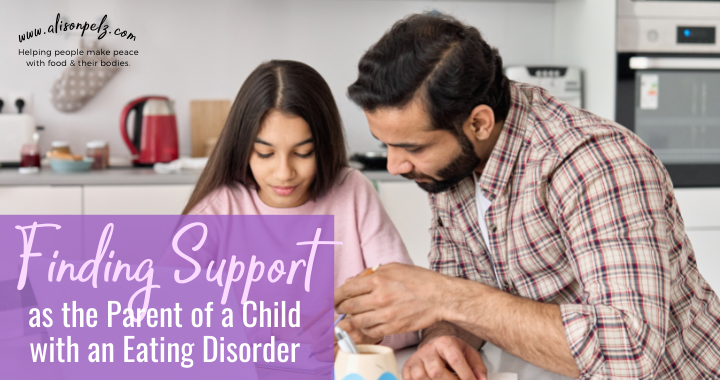
A graphic that reads "Finding Support as the Parent of a Child with an Eating Disorder" in white text on the bottom left above a stock photo of a father and daughter working together at a table on homework.

Finding Support as the Parent of a Child with an Eating Disorder

It’s not easy to be a parent or caregiver for someone who is struggling with an eating disorder, at any age.

Parenthood is often described as having your heart walk around outside of your body, so watching your child struggle with such a complicated disorder can be heartbreaking. It’s scary to feel like your child needs help beyond what you can give.

Eating disorders don’t go away without being treated. It is essential for your child to begin treatment for their eating disorder so they can get relief from the distress they are feeling.

As a parent or caregiver, you are an important pillar of support for your child as they go through eating disorder recovery.

Eating disorders are complicated, and we often don’t learn much about them until someone we know is dealing with one. Much of the ‘common knowledge’ out there about eating disorders are actually myths, like that eating disorders only affect teen girls or that they’re not that serious. Eating disorders don’t discriminate by age or gender- anyone can develop an eating disorder. In fact, a common risk factor for developing an eating disorder is a history of dieting.

As the caregiver of someone with an eating disorder, you naturally want to do what you can to help your child through this. Learning more about eating disorders can help you understand what your child is going through, and connecting with other caregivers can give you an opportunity to feel supported yourself. You don’t have to go through this alone.

Here are some resources for caregivers of children with eating disorders:

Eating Disorder Books For Caregivers:

The following books give practical strategies for families supporting their loved one with an eating disorder. They are all using a family-based treatment (FBT) approach to treating an eating disorder.

Family-based treatment empowers the family to help support their child through nutritonal rehabilitation and eating disorder behaviors.

Support Groups + Other Resources for Caregivers

Here are a list of support groups for caregivers. Many families find it helpful to learn that they are not alone in their struggle.

FEAST Resources

Families Empowered and Supporting Treatment for Eating Disorders (Feast) is a non-profit that supports caregivers and loved ones with eating disorders. FEAST provides free support to caregivers around the world:

  • FEAST’s First 30 Days Educational Service
    • Information delivered right to your inbox on how to care for your loved one.
    • “We want to change the course of a family’s caregiving journey in 30 days. These 30 days of lessons are meant to start the family on a new course of empowerment and good information. Over the 30 days you will learn about eating disorders, caregiving, and the resources available for ongoing learning. We will introduce you to the resources and the peer support of our worldwide community.
  • Forums to get support from other caregivers
    • “This is a free service provided for parents of those suffering from eating disorders. It is moderated by kind, experienced, parent caregivers trained to guide you in how to use the forum and how to find resources to help you support your family member. This forum is for parents of patients with all eating disorder diagnoses, all ages, around the world.”
  • Webinar Series that frequently feature leading researchers and experienced clinicians in the field.
  • FEAST’s Parents Do Not Cause Eating Disorders Info Page
      • This statement may seem obvious, but it is the sad history of eating disorder treatment that parents are sometimes still blamed or feel blamed when a loved one develops an eating disorder. For those families suffering from guilt, from feeling blamed, or unsure of who to believe on this topic, here are some things to keep in mind.”

Are you looking for more ways to support your child as they recover from their eating disorder? Working with a treatment team is the gold-standard for eating disorder recovery, as eating disorders impact health in many ways, from physical to mental health.

Part of a treatment team for eating disorders is a psychotherapist. For more information on how I can help, send me a message.

A graphic that reads "Parents: An Essential Part Of Eating Disorder Treatment" in white text in the bottom left corner, over a stock photo of a frustrated looking mother and daughter.

Parents: An Essential Part Of Eating Disorder Treatment

To all the parents out there: you are an important part of your child’s eating disorder treatment team! This is true even if your child is no longer a child, but a young adult or an adult. Even if you don’t live with your child, you have an important role to play in eating disorder recovery. 

Why are parents + caregivers so important in eating disorder recovery? 

Therapists, doctors, and dietitians are must-haves on any eating disorder treatment team. But parents have an important role to play too! Here are a few reasons why parents are important in the recovery process:

  • You spend much more time with your child than the treatment team does. As a therapist, I may spend one to two hours a week with your kiddo, you spend dozens of hours!
  • You are usually involved in feeding or making sure that your teen is fed.
  • You have a relationship with them. They trust and love you. If you are a parent of a teen, I know it may not always feel like it, but it is true!
  • You know your child better than anyone else!

Where do eating disorders come from?

Eating disorders are thought to function as a way to cope with uncomfortable feelings. Feeling distressing emotions is, well, distressing. Eating disorders often develop as a coping mechanism to avoid feeling those painful feelings. It’s possible to learn new ways to cope to manage those distressing feelings. 

As a parent, you can learn tools to help your child manage their feelings without using the eating disorder to cope.

When you hear this you may feel like a deer caught in the headlights. 

  • You may be thinking, “Yeah right! I can’t even get through a conversation with my teen without it turning into a fight.” 
  • Or maybe you’re thinking, “I can’t get them to say more than a few words to me.” 
  • You may even be throwing your arms up in exasperation because your kiddo is in total denial of their eating disorder.

If your child has an eating disorder, you may be feeling a range of emotions all of which are okay. You might feel anger, worry, sadness, resentment, disbelief, panic, and hopelessness, to name a few. And you may be feeling no way equipped to help your child recover from an eating disorder, but you are wrong.

Historically, parents weren’t always involved, and at times even discouraged to participate, in the treatment of eating disorders. In recent years, we are learning that parents can be a really powerful tool in their kid’s recovery process. This holds true not just for eating disorders, but for all mental health conditions. Parents have an important role to play! 

Parents often blame themselves or feel responsible for their child’s eating disorder.

I haven’t met a parent or loved one who doesn’t want what is best for their loved one – to be happy and live a productive, healthy life.

Let me be clear: you are not to blame for your child’s eating disorder. 

Eating disorders are complex. They develop for a variety of different reasons including social, biological, and psychological factors. For example, did you know that being a girl or a history of dieting are risk factors for developing an eating disorder?

As an eating disorder therapist + dietitian, I encourage parents to focus less on why their child has an eating disorder, and more on eliminating the eating disorder. 

For example, if your child developed cancer you would spend less thought on why she got it, but more on getting her good treatment.

While you are not to blame for your child’s eating disorder, you certainly can be part of the treatment and solution. Often, parents don’t feel equipped to help their children recover. Parenting is hard, and parenting a teen with an eating disorder has a unique set of challenges. 

You are right you may not have the eating disorder knowledge (yet!) to help. But, you do have a special connection and bond with your child that is so powerful in the treatment of eating disorders.

Some parents report that their kids don’t want help for their eating disorder, or even that they are in denial about their eating disorder. Certainly, this feels like it is true, but it is not. 

Remember eating disorders are a way for your child to cope with discomfort. Yep that’s right – just like their lovey or security blanket that they had as a kiddo! The disorder is serving a purpose, even if it’s not a healthy way to cope. Since the disorder is filling a need, it might seem like on the surface, your child doesn’t want to acknowledge or deal with it. However, living with an eating disorder can be a miserable existence. Your child deserves better!

Now that I have (hopefully) convinced you that you are an important part of your teens recovery, you may be asking yourself how do I help my teen? 

Here are a few tips to get you started.

  1. Get educated about eating disorders. Here are specific resources for parents.
  2. Make sure that your teen has a complete treatment team.
  3. Verbalize to your teen that while you don’t have all the answers, eating disorders are serious mental health conditions, treatment is needed, and that you are going to be there every step of the way to support them.

Are you looking for more ways to support your child as they navigate eating disorder recovery? Please feel free to book a free 15 minute phone call with me to learn how to better support your teen as they navigate an eating disorder. 

dads daughter body image

Dads: 6 tips to Help your Daughter Develop a Positive Body Image

Dads play an important role in helping daughters develop a positive body image

If you are a Dad of an adolescent girl, unfortunately, you may have heard your daughter say something like, “I am so ugly” or “I hate my thighs, they are so fat”. You may have stared at her like a deer in headlights. Or perhaps offered her well-intended advice such as “just cut down on carbs if you are worried about becoming fat” or offered re-assurance to her such as “You are not fat, you are beautiful just how you are”.  Unfortunately, societal pressure to look a certain way for boys and men is becoming more common.  For girls and women, it is a

Unfortunately, societal pressure to look a certain way for boys and men is becoming more common.  For girls and women, it is a societal norm to experience & talk about body dissatisfaction. Girls and women are inundated with media images about how they “should” look.Continue reading