"Tackling Healthism in Eating Disorder Recovery" in white text on a purple background over a photo of a wellness yoga class

Tackling Healthism in Eating Disorder Recovery

One of the most persistent and invisible roadblocks on this path of recovery is healthism.

When you’re in recovery from an eating disorder, the journey isn’t just about food or body image—it’s about unlearning many of the messages that have shaped your relationship with health, worth, and identity.

What Is Healthism?

Healthism is the belief that a person’s moral worth is tied to their health status—and that “health” is something we can fully control through the “right” choices. It often masquerades as wellness advice, clean eating trends, or motivational fitness culture. It’s sneaky. It’s normalized. And it can deeply harm those recovering from disordered eating.

It tells us:

  • That our body is a problem to solve.
  • That health looks a certain way (usually thin, active, and visibly “fit”).
  • That if we are not constantly optimizing our health, we are failing.

Sound familiar?

Where Did Healthism Come From?

Healthism isn’t just a personal mindset—it’s a cultural narrative with deep historical roots. The term was first coined in the 1980s by sociologist Robert Crawford, who observed a growing trend: people were being taught that health was a personal, moral responsibility, and that individuals—not systems—were to blame for their well-being.

Since then, this idea has been reinforced by everything from public health campaigns to social media influencers. Over time, “healthy” became a synonym for “good,” and illness or difference became something to fix or avoid.

Diet culture, fatphobia, ableism, and capitalism all amplified the message: control your body, and you’ll be safe, accepted, and successful. But here’s the truth: most of the factors that shape our health are outside of our control, including genetics, trauma, systemic oppression, and access to medical care.

If you’ve internalized the belief that your worth is tied to how “healthy” you are, that’s not a personal failure. It’s a product of living in a culture steeped in healthism.

When “Wellness” Becomes a Disguise for the Disorder

It’s not uncommon for someone in recovery to shift from calorie restriction to obsessive “clean eating,” or from compulsive weighing to compulsive step counting. All under the guise of “being healthy.”

But here’s the truth: If your pursuit of health is causing you harm, mentally, physically, and/or emotionally, it’s not actually healthy.

Therapy holds space for the messy, complicated process of rethinking what health really means. And gently challenge the idea that health should ever be the benchmark for your value as a human being.

Healing Beyond the Health Narrative

You deserve a recovery that allows you to reclaim your life. Not just fit into a new version of diet culture with a wellness filter.

Here’s what it can look like to move beyond healthism in recovery:

  • Embracing body diversity: All bodies are worthy, and all bodies are different. Health does not have one size or shape.

  • Redefining health: Instead of perfection, explore how to care for your body in a way that feels sustainable, flexible, and joyful.

  • Focusing on values: What matters most to you beyond your body? I help clients reconnect with those parts of themselves.

  • Practicing self-compassion: You are not a failure for struggling. You are a person, doing your best in a culture that makes recovery hard.

You Don’t Need to Be “Healthy” to Deserve Care

One of the most radical things we can say in a healing space is: You deserve support, rest, love, and acceptance—whether or not you’re “healthy.”

Health is not a prerequisite for dignity.

In my work with clients, I hold this truth close. Whether you’re early in recovery or years into your healing. I understand how deeply embedded healthism can be, and here to help you untangle from it with compassion and curiosity.

Ready to Explore a New Way Forward?

If you’re feeling burnt out by the pressure to “recover perfectly” or be the picture of health, you’re not alone. Let’s explore what healing could look like when it’s rooted in connection, not control.

Curious about working together?
Reach out to schedule a consultation. I would be honored to walk alongside you.

 

Nourish to Heal: How Eating Enough Supports Binge Eating Recovery

Nourish to Heal: How Eating Enough Supports Binge Eating Recovery

Eating more will likely help you reduce binge eating.

This feels counterintuitive and is certainly not what the weight loss industry or the medical community typically advises, so I know this recommendation can feel very scary. 

The weight loss industry provides “tricks” to reduce binge eating, usually focusing on how to limit consumption of certain foods. However, rather than helping navigate binge eating, it often fuels and perpetuates binge eating. Science has taught us that dietary restriction is a risk factor for developing an eating disorder, including binge eating. Dietary restriction also maintains the eating disorder–in other words, a restrictive diet keeps the disorder going. 

Binge eating can cause significant distress to those who are experiencing it, so understandably, you would do almost anything to stop it. 

First, we need to normalize binge eating. Most humans experience eating episodes related to emotions, as eating can be a common way we cope with and regulate emotions. If you have sensory and neurological differences, including anxiety or ADHD, eating can be a useful tool to help you feel more comfortable. 

We hear harmful messages in our culture about binge eating: that it means something negative about us, or that we “have no will power or we are not disciplined enough”.  Of course, we then internalize these messages, meaning we believe these untrue messages about ourselves, further disconnecting us from self. 

Let’s take a closer look at why eating more helps to reduce binge eating.

Our brain’s primary job is to keep us alive. We need food to survive. Most of us experience pleasure from eating (That’s our brain’s way to ensure that we eat!).

If your meal gets delayed for some reason, you feel really hungry, often leading to feeling “hangry” (hungry & angry–that grumpy feeling we get when we’ve gone too long without food)-our body’s cue to eat. Consequently,  you might eat quickly and possibly more than usual. This is our body’s nifty mechanism to keep us alive. 

Many people who experience binge eating try to limit their food intake or the types of food they typically binge on. This makes perfect sense given the messages about food in our culture. But dietary restriction is eating less food than your body needs. An example of dietary restriction may be “I am going to eat out for lunch, so I’ll skip or have a ‘light’ breakfast”.  This simple act, which our culture often rewards, sets our body’s drive up to alert us to eat.

Dietary restriction is a key feature in what initiates and sustains eating disorders. 

Herman and Polivy coined the term dietary restraint in the 1970s. It suggests that when human eating behavior is under cognitive control, it reduces the ability to read internal satiety cues. 

In other words, simply thinking about restricting food types and amounts can lead us to eat past fullness. Dietary restraint is the key feature of EVERY DIET. And dietary restraint is a significant risk factor for developing an eating disorder. 

What can be done? 

Many clients who experience binge eating also experience dietary restriction and restraint–the natural reaction is often to focus on eliminating binge eating by using more dietary restriction and restraint. Again, this makes sense given diet culture and our medical system. However, it often maintains the eating disorder. 

One of the first steps in my work with clients is to gradually reduce dietary restraint and restriction. I can understand that this can feel very scary. 

In sessions, we explore your personal story and understand where you learned about dietary restriction and restraint.  We then consider if it makes sense to approach things differently.  

We do work on reducing binges, but that typically comes later in treatment. First, dismantling the restriction and restraint is needed to reduce binge eating. 

If you want to learn more about binge eating, I highly recommend this book. Additionally, Decolonizing Wellness is an excellent resource. If you would like to learn more about how I work with clients struggling with binge eating, the first step is to schedule an initial consultation. I would love to hear from you. 

A graphic that reads "2021: A Year In Review" over a stock photo of some pine branches and gifts wrapped in brown paper, on a red background.

2021: A Year In Review

What a year! 2021 was our second year in a pandemic, and seemed just as chaotic and challenging as 2020 was. Take a moment to pat yourself on the back for making it to the end of this year, it certainly hasn’t been easy, but I’m so glad you’re here. This too shall pass, and until it does, I’ll be here to support you virtually to stop feeling out of control and gain a sense of calm in relationship with food and your body

This year, more than ever, people experienced anxiety and burnout. If you’re feeling like you’re running on empty, you’re not alone. I hope you get some quality time to rest and recuperate this season. It’s always important to rest, but with the constant chaos of existence right now you might be feeling the need to slow down more than ever. I encourage you to lean into it!

You’re allowed to have periods of rest, and it’s important to listen to your body when it’s trying to tell you something. Consider this your permission slip to do nothing but self-care for the rest of the year! 

Every year, I like to round up all of my blog posts from the year in one place. It’s fun to look back on the year through these posts, and I hope you find them useful as you work toward peace with food. 

Here’s what I wrote about this year: 

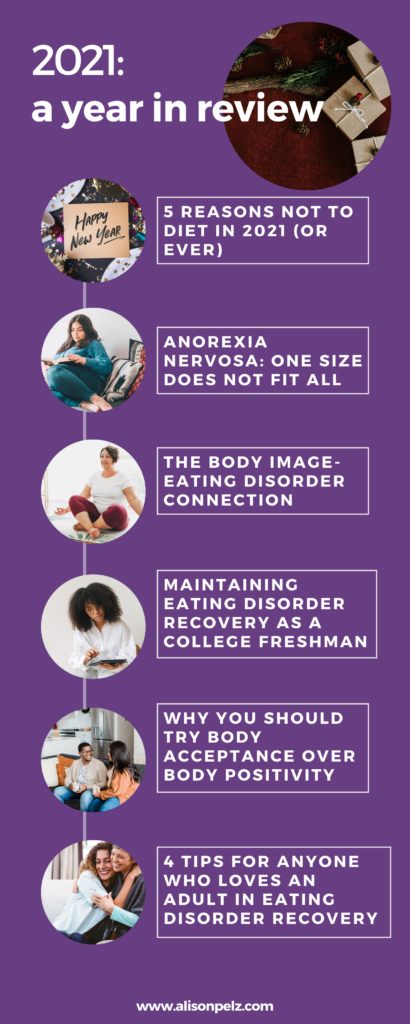
5 Reasons not to Diet in 2021 (or Ever)

“Unless you are taking a break from social media and the news, you most likely have been bombarded with messages about dieting and weight related New Year’s resolutions. Diet programs are promising the magic bullet for good health and weight loss in the New Year.

Maybe this year you are re-thinking your New Year’s resolutions. Perhaps you are beginning to notice that dieting is taking up too much space in your life or you are tired of worrying about what you eat or what you look like. It could be you are looking to “get off the diet roller coaster” permanently and heal your relationship with food and your body.

If you are ready to give up dieting, you’re not alone. Consider these five reasons to quit dieting for good.”

Anorexia Nervosa: One Size Does NOT Fit All

“Unfortunately, there are many incorrect assumptions associated with eating disorders. One I see a lot is the assumption that in order to have an eating disorder, particularly anorexia nervosa, one has to have very low body weight. This is simply not true.

Sadly these assumptions block those suffering from eating disorders from getting the life-saving treatment they need. In fact, most people with eating disorders don’t necessarily fit neatly into an eating disorder category.

Eating disorders are more about how the person relates to food, exercise, and body than what a person looks like.”

The Body Image-Eating Disorder Connection

“How we perceive our bodies is influenced by many factors, including family, friends, media, gender identity, culture, and the health-care system, to name a few. Body image is not static. It may change depending on our mood, situation, stage of life, or the season.

The majority of those who suffer with eating disorders have a negative body image. One of the key features of eating disorders is the overvaluation of weight, shape, and eating habits on self-worth.

Self-worth is how and what we think about ourselves. In other words, those who struggle with eating disorders equate much of their self-worth with their ability to control their weight, shape, and eating habits. Having a negative body image often keeps the eating disorder going.”

Maintaining Eating Disorder Recovery as a College Freshman

“College can be a difficult transition for anyone, but if you’re in recovery for an eating disorder, it can be a particularly stressful transition! 

Some of the challenges of maintaining your recovery while returning to school include change in routine, increased demands and independence, and exercise/diet culture. 

Remember: it’s normal for eating disorder symptoms to recur in times of high stress and periods of transition. But by taking time to consider how your recovery will be impacted in this period of transition, you can create a plan to cope with stress and continue with your recovery.”

Why You Should Try Body Acceptance Over Body Positivity

“The idea of body positivity has its roots in fighting diet culture, but the term doesn’t resonate with everyone. After all, feeling positive about your body is a tall order for a lot of people. 

First of all, there is a multi-billion dollar diet industry that uses its considerable resources and influence to convince us all that there is something wrong with our bodies. Feeling insecure about how our bodies look is a surefire way to get us to buy products that will “fix” us. However, consider the idea that there was nothing wrong with your body in the first place. 

People who are chronically ill or disabled might not feel like they can be positive about a body that is constantly in pain or not able to move through the world easily. People who are recovering from eating disorders might not trust their body’s cues or might feel distress when thinking about their bodies. 

Body acceptance might feel like a more attainable goal than body positivity.”

4 Tips for Anyone Who Loves an Adult in Eating Disorder Recovery

“It’s possible for eating disorders to initially develop later in life, not just during adolescence. It’s also possible that adults suffering from an eating disorder developed it during adolescence and never fully recovered.  Life stressors (like a pandemic, for example!) later in life can also cause a relapse of eating disorders.

Eating disorders develop for a variety of reasons including genetics, temperament, gender, and dieting history to name a few.

It is less important why and how the eating disorder developed, and more important to focus on supporting your loved one in their eating disorder recovery.”

A graphic that reads "2021: A Year In Review" over a stock photo of some pine branches and gifts wrapped in brown paper, on a red background.

I’ll be back in 2022, writing more about ED recovery, food peace, and weight bias. If there are any topics you want me to cover next year, let me know. You can send me a message here, and you can also follow me on Facebook. Every week, I share resources from myself + other eating disorder experts, so follow if you’re looking for more information. 

Diet Culture, COVID-19, and Weight Stigma: 2020 in Review

Diet Culture, COVID-19, and Weight Stigma: 2020 in Review

At the end of every year, I like to put together a post that collects everything I’ve published on my blog over the last year. And what a year it’s been. This year is nothing like we imagined it would be. We have lost almost a year of being with family and friends, experiencing new things, and living our ‘normal’ lives. If you’re feeling grief about this year, the lives lost and changed, and what could have been, you’re not alone. 

This year has been hard, sad, lonely, scary, weird, and pretty much any other adjective out there. It can be hard to hold space for all of those things at once, so be gentle with yourself as you work through your feelings about 2020. 

Here’s what I wrote about this year: 

This year, I wrote a lot about the COVID-19 pandemic and how that interacts with folks in eating disorder recovery. 

When things get hard, communities thrive. The eating disorder recovery community is more important than ever with many of us isolated and unable to connect with other ED survivors in real life. I wrote about 5 Ways to Stay on Track With Eating Disorder Recovery During COVID-19, Virtual (and Free) Eating Disorder Support Groups During COVID-19, and Coping With COVID-19 and Eating Disorder Recovery: Tips for College Students.

Rejecting Diet culture

One of my favorite ways to learn about rejecting the diet mentality is through podcasts! I put together a list of my top podcasts to help you break free from diet culture. (I also included a tip for how to find anti-diet resources: “It’s easy to be wary of what you find related to body positivity and anti-diet resources, since the movement has been flooded with people trying to cash in without spreading the actual message of the anti-diet movement. When looking for a trusted resource online, make sure that they mention on their website (hopefully prominently!) that they believe in dismantling diet culture, center larger bodies, and don’t mention weight loss anywhere on their site.”

Eating Disorders

Eating disorders are a complicated subject. One of my goals is to help people challenged with ED and other food & weight-related concerns to move from constantly worrying about food and their weight to being free to create the lives they want. The first step here is understanding what eating disorders actually are. To help, I discussed 3 Important FAQs about Binge Eating Disorder on the blog. While some of us understand the basics of eating disorders and anxiety on our own, it’s rare to see a blog post connect the two and tell you what you need to know if you’re living with an eating disorder and an anxiety disorder. I wrote about frequently asked questions related to eating disorders and anxiety to share what I know!

Weight Bias + Stigma

Weight bias is everywhere we look in our culture. It’s led to systematic discrimination of larger bodies in many areas of life – medical care, job opportunities, social interactions, to name a few. So many folks railing against people in larger bodies don’t realize that what really causes negative health outcomes is a result of stigma, not a result of having a larger body, so I wrote about how weight bias and stigma are the real hazards to health, not body size. 

Diet Culture, COVID-19, and Weight Stigma: 2020 in Review

If there are any topics you’d like me to cover in 2021, let me know! You can message me here. If you’re looking for even more resources, make sure you’re following me on Facebook and Pinterest!Every week, I share resources from myself + other experts in the field on both platforms!

Weight Bias and Stigma: The Real Hazards to Health

Weight Bias and Stigma: The Real Hazards to Health

Privilege disclosure: I am aware of and acknowledge my privilege as a white, cisgender, heterosexual, thin, and able-bodied person.

What are weight bias and stigma?

Weight-based discrimination is just what it sounds like. It is discriminating against people based on their body size, usually large body size. Other terms used to describe it include fatphobia and sizeism. It is well documented that rates of weight bias and stigma are on the rise. In fact, weight stigma and bias happen at higher rates than discrimination based on age or gender.

Furthermore, weight bias and stigma are socially acceptable and are reinforced in the media through the negative portrayal of those living in large bodies.

Weight stigma and bias are present in most aspects of life including education, business, and healthcare. The effects of weight bias and stigma on physical and mental health are the focus of this post.

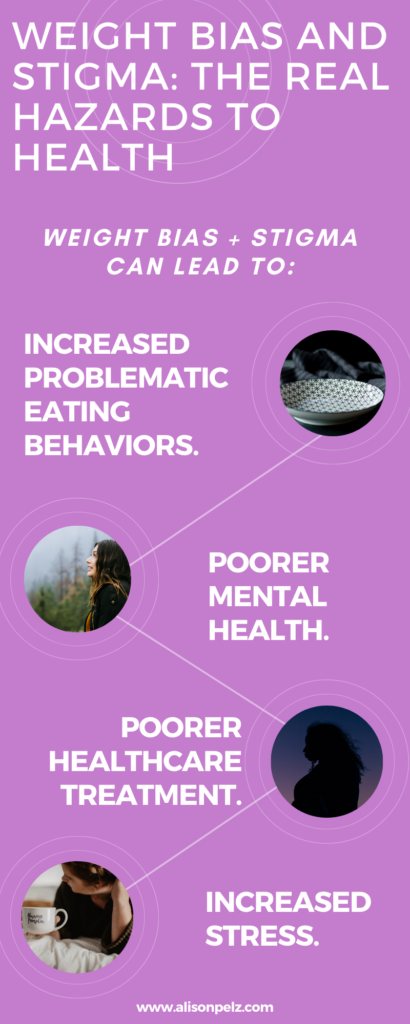
Weight bias and stigma can affect physical and mental health independent of body size in various ways:

Increased stress.

Experiencing weight bias and stigma increases chronic stress levels. Chronic stress has been shown to increase the risk of cardiovascular disease and other physical ailments. Additionally, chronic stress can wreak havoc on our mental health and general well-being.

Poorer healthcare treatment.

It has been well documented that weight bias and stigma are pervasive in our healthcare system. Studies show that the most frequent source of weight bias is family and the second most frequent source is healthcare providers. People who experience weight bias and stigma often have a negative experience at their doctor’s office, which often leads to avoidance or putting off medical care, including preventative health screenings.

Often-times large bodies are not assessed the same way thin bodies are, and body weight is blamed for every ailment. I have heard countless stories from clients about the poor healthcare they received. For example, a patient might seek medical attention because of a sore throat, but their body weight is discussed or been pointed out as the problem. (This would not happen to people who are in what the medical community refers to as a “normal-sized” bodies.)

Poorer mental health.

Studies show that weight bias and stigma, independent of body size, can contribute to increased vulnerability to depression and anxiety, poor body image, decreased self-esteem, and increased suicidality.

People who live in large bodies may experience internalized weight bias, meaning that they believe that the stereotypes about them are true. Internalized weight bias can lead to negative feelings about oneself and contribute to poorer mental health.

Additionally, eating disorders often go undiagnosed in people with large bodies because they “don’t look” like they have an eating disorder. People in large bodies do get and are at risk for eating disorders. Furthermore, diets are often prescribed to people in large bodies, which is a known risk factor for developing an eating disorder and exacerbating existing eating disorders.

People living in large bodies are also at high risk for bullying and teasing which also negatively impacts mental health.

Increased problematic eating behaviors.

People who live in large bodies are prescribed weight-loss diets in efforts to “improve health.” There are several problems with this approach.

First, there is little research that dieting is an effective treatment for long-term weight loss.

Second, weight is highly determined by genetics and is not as modifiable as the healthcare system or diet programs lead us to believe.

Third, a larger body does not indicate poorer health.

Fourth, dieting is a known risk factor for problematic eating behaviors such as binge eating, dietary restriction, purging, and even full-blown eating disorders.

Unfortunately, weight bias and stigma are rarely discussed in traditional medical and mental healthcare settings, further perpetuating them. Weight bias and stigma continue to reinforce the idea that large bodies are unhealthy with little to no data to back this up. What we do know for sure is that weight bias and stigma themselves, independent of body size, contribute to poorer health outcomes.

If you are experiencing weight bias and stigma (or want to learn more about it) here are some great resources:

If you are a healthcare provider here are additional resources to consider:

  • Michelle May, MD and Jennifer L. Guadiani, MD (Both provide training on weight-inclusive care.)
  • Project Implicit (Help assess implicit bias.)

For more resources on weight bias + stigma, intuitive eating, and anti-diet culture, sign up for my newsletter!