"Tackling Healthism in Eating Disorder Recovery" in white text on a purple background over a photo of a wellness yoga class

Tackling Healthism in Eating Disorder Recovery

One of the most persistent and invisible roadblocks on this path of recovery is healthism.

When you’re in recovery from an eating disorder, the journey isn’t just about food or body image—it’s about unlearning many of the messages that have shaped your relationship with health, worth, and identity.

What Is Healthism?

Healthism is the belief that a person’s moral worth is tied to their health status—and that “health” is something we can fully control through the “right” choices. It often masquerades as wellness advice, clean eating trends, or motivational fitness culture. It’s sneaky. It’s normalized. And it can deeply harm those recovering from disordered eating.

It tells us:

  • That our body is a problem to solve.
  • That health looks a certain way (usually thin, active, and visibly “fit”).
  • That if we are not constantly optimizing our health, we are failing.

Sound familiar?

Where Did Healthism Come From?

Healthism isn’t just a personal mindset—it’s a cultural narrative with deep historical roots. The term was first coined in the 1980s by sociologist Robert Crawford, who observed a growing trend: people were being taught that health was a personal, moral responsibility, and that individuals—not systems—were to blame for their well-being.

Since then, this idea has been reinforced by everything from public health campaigns to social media influencers. Over time, “healthy” became a synonym for “good,” and illness or difference became something to fix or avoid.

Diet culture, fatphobia, ableism, and capitalism all amplified the message: control your body, and you’ll be safe, accepted, and successful. But here’s the truth: most of the factors that shape our health are outside of our control, including genetics, trauma, systemic oppression, and access to medical care.

If you’ve internalized the belief that your worth is tied to how “healthy” you are, that’s not a personal failure. It’s a product of living in a culture steeped in healthism.

When “Wellness” Becomes a Disguise for the Disorder

It’s not uncommon for someone in recovery to shift from calorie restriction to obsessive “clean eating,” or from compulsive weighing to compulsive step counting. All under the guise of “being healthy.”

But here’s the truth: If your pursuit of health is causing you harm, mentally, physically, and/or emotionally, it’s not actually healthy.

Therapy holds space for the messy, complicated process of rethinking what health really means. And gently challenge the idea that health should ever be the benchmark for your value as a human being.

Healing Beyond the Health Narrative

You deserve a recovery that allows you to reclaim your life. Not just fit into a new version of diet culture with a wellness filter.

Here’s what it can look like to move beyond healthism in recovery:

  • Embracing body diversity: All bodies are worthy, and all bodies are different. Health does not have one size or shape.

  • Redefining health: Instead of perfection, explore how to care for your body in a way that feels sustainable, flexible, and joyful.

  • Focusing on values: What matters most to you beyond your body? I help clients reconnect with those parts of themselves.

  • Practicing self-compassion: You are not a failure for struggling. You are a person, doing your best in a culture that makes recovery hard.

You Don’t Need to Be “Healthy” to Deserve Care

One of the most radical things we can say in a healing space is: You deserve support, rest, love, and acceptance—whether or not you’re “healthy.”

Health is not a prerequisite for dignity.

In my work with clients, I hold this truth close. Whether you’re early in recovery or years into your healing. I understand how deeply embedded healthism can be, and here to help you untangle from it with compassion and curiosity.

Ready to Explore a New Way Forward?

If you’re feeling burnt out by the pressure to “recover perfectly” or be the picture of health, you’re not alone. Let’s explore what healing could look like when it’s rooted in connection, not control.

Curious about working together?
Reach out to schedule a consultation. I would be honored to walk alongside you.

 

Freshman Year of College Why Eating Disorders May Start or Reappear

Freshman Year of College: Why Eating Disorders May Start or Reappear

The first year of college is often described as a thrilling new chapter—freedom, independence, new friends, late-night pizza, dorm life, and so much possibility. For many students, this first year is fun and exciting. But it’s also filled with major transitions—many of which are invisible until you’re in them. And for students with a history of disordered eating, or even those without, the shift can be enough to stir up or intensify existing eating disorders and their symptoms.

The Perfect Storm of Change

Think about the months, even years, leading up to college: there’s pressure to get in, choose the “right” school, imagine your dream experience, and count down to this next life stage. Students often hear, “These will be the best years of your life.” That narrative leaves little room for the complicated, and very real, emotional reality of freshman year.

Starting college means stepping away from nearly everything that has felt familiar. Students leave behind the structure of high school, the predictability of home, their longstanding support systems, routines, and even the foods they’re used to eating. Meals in college are different—not just the food, but the context: dining halls, roommates watching what you eat, lack of privacy, food availability at odd hours. Schedules shift. Sleep is often disrupted. Social dynamics become more fluid and uncertain.

Our nervous systems thrive on predictability. When that predictability disappears, our bodies and brains notice.

Nervous Systems Don’t Just “Adjust”

The human nervous system is designed to keep us safe and regulated. When life feels overwhelming or uncertain, the body often reaches for something to regain a sense of control or grounding. For some students, that might be diving into academics or social life. For others—especially those with a history of disordered eating—old symptoms may resurface as a way to self-soothe, manage anxiety, or feel a sense of mastery in a suddenly unpredictable environment.

Even for students who have never struggled with an eating disorder before, the stress of transition can be enough to tip the scale. Eating disorders aren’t really about food. They are adaptive responses to stress, trauma, and dysregulation. And while they may seem counterproductive from the outside, they often serve a protective function—numbing overwhelming feelings, offering structure, or creating a sense of control.

When the Fun and the Stress Coexist

It’s important to recognize that freshman year doesn’t have to be miserable for it to be dysregulating. Students (and parents) are often surprised that eating disorder behaviors emerge during what appears to be a “good” year. It’s a common misconception that if a student is socializing, attending classes, or even enjoying college, they must be doing fine. But excitement and stress can coexist. A student might love their college experience and still be struggling silently with food or body image.

What can college students and families do?

  • Normalize the complexity of transitioning to college. Including feelings of worry, fear, and isolation. 
  • Check in with yourself or your college student about disruptions to routine, the changes in eating patterns, and the emotional rollercoaster of being away from home.
  • Support emotional regulation strategies beyond food and body control—like mindfulness, journaling, movement, and connecting with others.
  • Encourage care, especially for students with a history of an eating disorder. Ongoing therapy or nutrition support through telehealth can make a significant difference.
  • Watch for warning signs that may get masked by the “college is fun” narrative—changes in weight, food rituals, isolation, or excessive focus on body image.
  • Reinforce that relapse is not failure, but a signal from the nervous system that something is overwhelming. It’s an invitation for support, not shame.

Final Thoughts

Freshman year is a season of growth, challenge, and self-discovery. It’s normal for it to feel both exciting and hard. When we understand the nervous system’s role in regulation—and how eating disorders often function as misguided coping tools—it becomes easier to see why symptoms might arise or return during this time.

By naming these challenges openly, we can help students and families feel less blindsided—and offer the compassionate, proactive support that helps them not just survive freshman year, but move through it with resilience.

If you would like to know more about how I work with families and college students with eating disorders, please feel free to contact me.

Eating Disorder Recovery: Gain Momentum Over Summer Break

Eating Disorder Recovery: Gain momentum over summer break

For college students working towards eating disorder recovery, during the school year can feel like a constant balancing act. Between deadlines, exams, social stressors, and navigating independence, there’s often little space left for the deep emotional work that recovery requires. You may have found yourself just trying to stay afloat—doing your best to maintain stability, but without the time or energy to develop new skills that support long-term recovery.

Summer break, however, offers something the school year rarely does: breathing room. With fewer academic pressures and more control over your schedule, summer can be an opportunity to gain real momentum in your recovery journey. Here’s how you can use this season to refocus, reconnect, and strengthen your foundation for eating disorder recovery. 

1. Re-Engage With Your Eating Disorder Treatment Team

If you’ve had to scale back on therapy or nutrition sessions during the semester, summer is the time to plug back in. Reach out to your treatment team—therapist, dietitian, physician—and schedule regular appointments. Even a few months of more consistent support can create noticeable progress.

If you’ve been away from care altogether, summer is a great time to re-establish those connections or seek out new providers who can help you move forward. Virtual care has made this more accessible than ever, whether you’re at home, traveling, or staying on campus.

This could also mean considering a more intensive level of care, such as a partial hospitalization program (PHP) or intensive outpatient program (IOP). These structured treatment options—often called “day treatment”—can be an incredibly effective way to reinvigorate your recovery. With daily therapeutic support and a more contained environment, you can focus deeply on healing without the academic stress that might otherwise get in the way.

2. Learn (or Re-Learn) Coping Skills

It’s completely normal to feel too emotionally taxed during the school year to take on new coping strategies. That doesn’t mean you’ve failed—it means you were human in a high-stress environment. Summer gives you the bandwidth to revisit or discover skills that actually help regulate your nervous system and reduce the urge to rely on disordered behaviors.

Here are a few to explore:

💬 Connection with Others

Recovery can feel isolating, and sometimes shame convinces us we’re better off alone. But notice this: What happens when you simply connect with someone—a friend, a family member, even a kind stranger? Does your anxiety dip, even a little? Human connection is powerful. It doesn’t need to be deep or intense to be healing. A short walk with a friend, a phone call or text exchange, or a shared laugh can ground you and remind your brain that you are safe.

🌳 Spending Time in Nature

Nature has a unique way of soothing the nervous system. Research shows that even short periods outdoors—walking through a park, sitting near water, or lying in the grass—can reduce stress hormones and improve mood. The natural world invites presence, which is often the opposite of the chaos and noise that feed disordered thoughts.

Try noticing the small things: the sound of wind in the trees, the feel of sunlight on your skin, the rhythm of your footsteps on a trail. These aren’t distractions—they’re grounding tools that help rewire your stress response over time. 

✍️ Journaling and Self-Reflection

Without the constant stream of assignments and obligations, you may find space for reflection. Journaling can help you process emotions, track your recovery progress, or simply notice patterns in how you’re feeling. You don’t need to write every day or follow a strict structure. Even jotting down a few thoughts each week can increase self-awareness and offer insight into what’s helping (or hurting) your recovery.

3. Give Yourself Permission to Slow Down

Recovery isn’t just about doing more. Sometimes the biggest breakthroughs come when you give yourself permission to rest. Summer may feel like the time you “should” be catching up or making huge leaps—but remember, slowing down can be the leap.

Ask yourself:

  • What pace feels sustainable to me?
  • Where can I offer myself compassion rather than pressure?
  • What kind of support do I need to keep moving forward gently?

4. Plan for the Fall—Without the Pressure

Toward the end of summer, consider how to carry your progress into the school year. Maybe that means scheduling therapy sessions ahead of time, setting boundaries around school-life balance, or identifying support systems on campus.

You don’t need to have it all figured out—but having a loose plan can prevent you from feeling like you’re starting from scratch once classes resume.

Final Thoughts on Eating Disorder Recovery

Recovery during the academic year can be a slow climb—but summer offers the chance to catch your breath, look around, and notice how far you’ve come. This season isn’t about perfection. It’s about presence, curiosity, and gently returning to the practices and people that help you heal.

Use this time to reconnect—with your team, your tools, your community, and yourself.

Are you struggling with eating disorder recovery ? Working with a therapist who is experienced in Family-Based Treatment can help. If you are in Texas and interested in working with me, click here to fill out a contact form.

A graphic that reads "5 Tips for College Students in Eating Disorder Recovery" in the bottom right corner, over a stock photo of a young woman smiling and holding books.

5 Tips for College Students in Eating Disorder Recovery

Starting a new semester (or starting college for the first time) is associated with many positive feelings and excitement. However, along with these positive feelings, college students may experience feelings of isolation, worry, and sadness that often come along with major life transitions.

Unfortunately, these feelings may worsen eating disorder symptoms for college students who are struggling. When you’re already under stress from school and new social situations, it can be tricky to get a handle on your eating disorder symptoms or to move forward in your eating disorder recovery.

Why is it hard for college students to maintain eating disorder recovery?

Increased demands + independence

Returning to college, or going for the first time is exciting! It’s often a breath of fresh air to see friends you haven’t seen all summer, move into your new home for the year, and get into the swing of a new semester of classes. The taste of freedom and independence that college offers is hard to beat! 

If you have already experienced some time at college, though, you know that gaining independence also means more responsibility–which at times can be overwhelming. If you’re attending college for the first time, it’s normal to feel both excited at the opportunity for independence and totally overwhelmed by what that independence means. 

It can be challenging to set boundaries for yourself while managing-the demands of being a student, your social life, caring for yourself, and recovery. Increased demands often mean increased stress, which often is associated with an uptick in eating disorder symptoms.

Changes in Routine

When in recovery for an eating disorder, changes in routine can be tough to deal with. Routines allow for some comfort and dependability. When we have a routine, we know what to expect and when to expect it. It cuts down on the level of uncertainty or stress we feel about the unknown. College students often find that it takes a few weeks or longer to figure out their new routine.

Routines also have very practical uses in recovery. They affect meal planning, treatment appointments, sleeping habits, and more, all of which play a role in recovery! Navigating a new routine can be challenging, and can feel overwhelming. Giving care and consideration to what your new routine will be and how it works for you is important. 

Diet culture on Campus

On a college campus, you’ll be surrounded by other young people, who are also surrounded by the constant messaging on social media about diet and beauty standards. 

Gyms on campus may be full of college level athletes training in ways that other folks who don’t need intense conditioning for a sport shouldn’t be pushing themselves to compete with. 

You might be surrounded by fear of the “freshman fifteen”, or feel pressure to skip meals to study for exams with other students. The culture around food and exercise on a college campus may not be the healthiest one. It’s important to prepare for that with a counselor beforehand so you have coping mechanisms you can use when the need arises. 

Are you wondering what you can do to support eating disorder recovery at the start of a new semester? Here are 5 things college students can do to stay on track with eating disorder recovery.

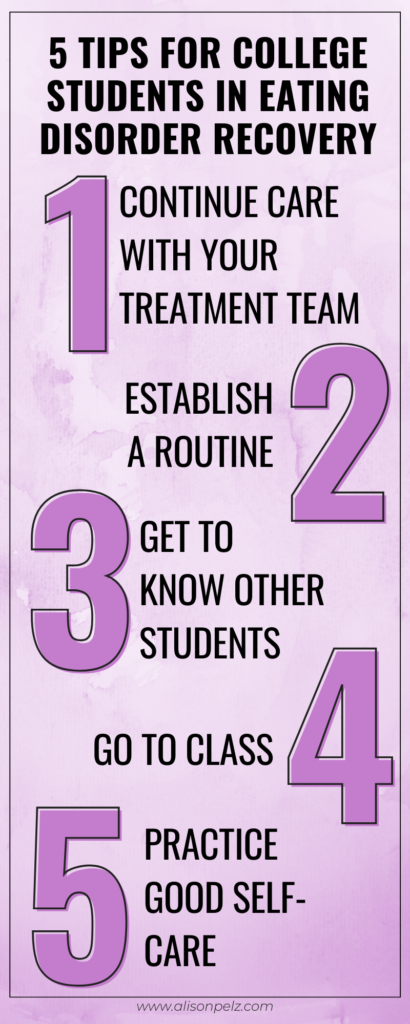
1. Continue care with your eating disorder treatment team

It’s important to continue the work you’re already doing with your eating disorder treatment team as you transition back to school. The start of a new semester means a changing schedule, routine, and living situation in many cases. Making sure you have the support of your treatment team can help you weather these changes so you can have the best experience possible at schoo.

If you don’t have a treatment team a good place to start is your college health center. Most colleges don’t provide long-term counseling for eating disorders, but they can put you in touch with providers in the community that can support you throughout the school year so you can get the help you need. 

2. Establish a routine

Remember, routines help us all, but they especially help folks with eating disorders. Routines give us peace of mind, comfort, and help us stay on track with eating, which is a crucial part of recovery. 

Just as I am sure it took some time to establish a summer routine, it will take a bit for you to establish a school routine as you find what works for you and your needs. Be patient with yourself!

3. Get to know other college students

Support is crucial in recovery, not just from your treatment team but from the people you care about. It’s easy to get so into your school routine that you forget about reaching out to your friends regularly. Make sure to check in with yourself often to see if you are getting enough socializing in (or if you are getting too much – alone time is also important for self-care). 

If you are new to campus or find yourself feeling isolated consider joining a club. Most campuses have tons of clubs and organizations that cater to a variety of interests and skills for college students. Consider joining a club for fun and a club that has to do with your major to start with so you meet a good mix of people from inside and outside of your academic department.

4. Go to class

This may sound like a no-brainer. But, it feels like since the pandemic more universities still have a fair amount of classes online. If you have a choice, consider taking all of your classes in person. We’ve done enough online for the last two years. It’s also hard enough to concentrate at times, especially in the middle of a lecture, and it can be even trickier to focus when you have all the distractions of home around you.

Actually stepping foot in the classroom can help you get more in the school mindset, and it can also be a great way to meet other college students.

Additionally, I know it is very enticing to skip classes at times (after all, most professors don’t take an attendance grade). It’s always tempting to get a few more hours of sleep or to use your time for something else, but skipping class has some drawbacks.  Missing classes often makes us feel more depressed, isolated, and guilty instead of relieving stress.

5. Practice good self-care 

What’s your self-care routine? It’s important to remember that you’re worthy of being taken care of. Self-care can include getting your nails done, taking a hot bath, or using a face mask. It can also include things like getting enough sleep, taking your medication, setting boundaries, and having hard conversations.

We often have an idea of self-care as fun little treats or splurges, but self-care isn’t only about spending money. It’s about taking care of your emotional and physical needs. 

Self-care can mean different things at different times. Sometimes it might mean decompressing by yourself in front of the TV. Other times it might mean making time for friends and social events with other college students. Try to check in with yourself regularly and ask what your self-care needs are at the moment. Remember, it’s not selfish to take care of yourself- it’s necessary.

Navigating school while in eating disorder recovery can be challenging for college students, but it can be done especially with some planning and the support of a treatment team. If you’re interested in learning more about how I can support you as part of your eating disorder treatment team, contact me here.

Recovery; White text over a purple background in the bottom left corner that reads "Maintaining Eating Disorder Recovery as a College Freshman". The rest of the image is a photo of a young woman sitting on a couch with a laptop in her lap.

Maintaining Eating Disorder Recovery as a College Freshman

College can be a difficult transition for anyone, but if you’re in recovery for an eating disorder, it can be a particularly stressful transition! 

Some of the challenges of maintaining your recovery while returning to school include: 

Change in Routine

When in recovery, changes in routine can be tough. Routines allow for some comfort and dependability, because when we have them, we know what to expect. Routines also have very practical uses in recovery–they affect meal planning, treatment appointments, sleeping habits, etc. All of which play a role in recovery! Navigating a new routine can be challenging, and can feel overwhelming, so giving care and consideration to what your new routine will be is important. 

Increased Demands + Independence

Going to college is an exciting time because it is the first taste of independence so many of us have! However, gaining independence is also a lot of responsibility–especially if we’re not used to it. It can be easy to not set any boundaries for yourself, but that’s not a sustainable way to take care of yourself. At the same time, you’ll also need to use some of that newfound independence to balance the demands of your school work, which might be more intense than you’re used to. It can be extremely stressful navigating that responsibility for the first time, and increased stress can lead to an increase in eating disorder symptoms. 

Exercise + Diet Culture

On a college campus you’ll be surrounded by other young people, who are also surrounded by the constant messaging on social media about diet and beauty standards. Additionally, gyms on campus may be full of college level athletes training in ways that other folks who don’t need intense conditioning for a sport shouldn’t be pushing themselves to compete with. You might be surrounded by fear of the “freshman fifteen” or feel pressure to skip meals to study for exams with other students. The culture around food and exercise on a college campus may not be the healthiest one–and it’s important to prepare for that with a counselor beforehand so you have coping mechanisms you can use when need be. 

What can you do to maintain your recovery?

Consider your schedule

Be gentle with yourself as you adjust! College is a big change and you don’t need to try to do it all at once. This means, don’t push yourself to take too many classes your first semester while you’re still getting used to the new expectations. Really think about what your limit is before you feel yourself burning out. 

Consider also taking classes that you wouldn’t consider as the most challenging. It’s a whole new style of learning in college, there’s nothing wrong with taking it slow to figure out what you can handle. That way you’re not overworking yourself and you are reducing the amount of stress you might experience. 

When thinking about your schedule,  consider any habits you have that are helpful to your recovery (social meals, treatment appointments, etc.) and what will be needed for those in your regular routines.

Make a recovery plan before you go

Are you working with a therapist right now? Will you continue to work with them? Or will there be someone on campus to connect with? Have group supports been part of your recovery plan? What is available in terms of group support at your school? Does your current therapist have plans or ideas on what will be important to your recovery at school? 

Be sure to set up any regular appointments and checkups with your treatment team ahead of time, to help provide you the professional support you may need to stay “on track.” 

Are you working with a dietitian right now?  Work with them to help you maintain recovery.

You might want  research on what mealtimes are like at school. Consider questions like: What food is available when? Where are the places to eat? What are their hours? Do you know what food do they provide? What are the meal plans like? Is there one that is more conducive to your recovery? Together with your dietitian it might be helpful to gather some information about what the different meal plans are, and make some pros and cons for each of them.

If you don’t have a treatment team, go to the student health center on campus and they will be able to assist you. 

Remember: it’s normal for eating disorder symptoms to recur in times of high stress and periods of transition. But by taking time to consider how your recovery will be impacted in this period of transition, you can create a plan to cope with stress and continue with your recovery. Remember, you only have to take it one day at a time! 

If you need help in your eating disorder recovery or not sure if you have an eating disorder or not, please click here to schedule a free 15-minute phone consultation with me. 

Coping with COVID-19 and Eating Disorder Recovery: Tips for College Students

Coping With COVID-19 and Eating Disorder Recovery: Tips for College Students

Let’s face it – starting a new year in college during the COVID-19 pandemic is rough. College life looks much different than it used to, with virtual classes and less socializing, to name a few things. If you add an eating disorder into the mix, it can make starting the semester feel downright daunting.

If your eating disorder symptoms have increased since the pandemic started you are not alone. Eating disorder behaviors are a way to manage and cope with stress, so more stress can equal the exacerbation of eating disorder symptoms.

Furthermore, the nature of physical distancing can lead to feelings of worry, sadness, hopelessness, and loneliness which also can trigger eating disorder behaviors, including dietary restriction, purging, binge eating, and overexercising.

Starting a new semester (or starting college for the first time) is associated with many “positive feelings” and excitement. However, along with these positive feelings, students may experience feelings of isolation, worry, and sadness, again exacerbating eating disorder symptoms.

Remember it is normal to be experiencing more stress, worry, and sadness during the pandemic. However, there are tools that you can use to manage your feelings.

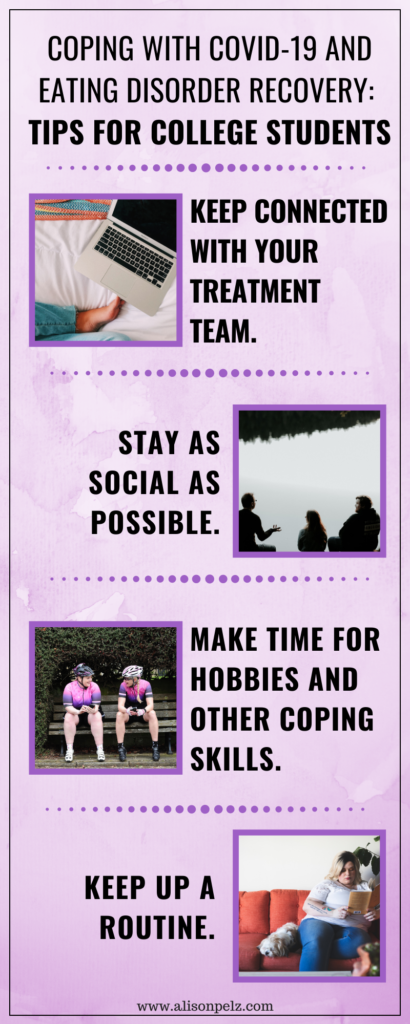
Below are some tips to help you cope with stress, the pandemic, and your eating disorder:

  • Keep connected with your treatment team.
    • Whether you are doing treatment in person or virtually, keeping regularly scheduled appointments is key to keeping your eating disorder recovery on top of the priority list. If you feel like you need more support during this time, ask your team about more frequent visits and/or attending virtual groups. To learn more about eating disorder treatment teams or how to get treatment, click here.
  • Stay social.
    • College with a side of COVID can be very isolating especially if you participating in virtual learning. It is not uncommon to experience an increase in loneliness. Social connection with family and friends can help reduce feelings of loneliness, sadness, and worry. Keep socializing in whatever way feels safe to you a top priority.
  • Make time for hobbies and other coping skills.
    • Coping skills and hobbies can help manage stress and uncomfortable feelings such as worry, sadness, and anger. Healthy coping skills are activities that you can help you positively manage stress. These can include talking with a friend, spending time outside, playing with a pet, reading, cleaning, doing a puzzle, praying or meditating, or volunteering, to name a few. Hobbies such as crafting, art, photography, and the like can also help reduce feelings of stress.
  • Keep a routine.
    • Having a routine can help reduce stress levels by adding structure and organization to your day, even during the pandemic. Having a general—but not rigid—routine around eating, sleeping, socializing, and studying can be helpful in your recovery from your eating disorders and generally improve mental health.

Remember that it is normal for eating disorder symptoms to increase during times of stress, and the COVID-19 pandemic is a very stressful time. By practicing the tools above, you can learn ways to reduce your stress and continue with recovery.

If you would like to learn how I help clients manage stress or you need help in your eating disorder recovery, please click here to schedule a free 15-minute phone consultation.