5 Signs That It Is Time to Get Treatment for Your Eating Disorder

5 Signs That It Is Time to Get Treatment for Your Eating Disorder

Anticipating getting treatment for your eating disorder can be daunting for many reasons.

Maybe your friends and family are worried about you and pushing you to get treatment, but you feel like they don’t understand.

Perhaps you have gotten treatment and feel like it hasn’t helped.

Or you may feel like you can beat the eating disorder on your own.

You are not alone.

Most clients I see are often unsure if a) they want to recover, b) they can recover, or c) Their eating disorder is “bad enough” to need treatment.

Furthermore, you may feel ambivalent about getting treatment because your eating disorder may have helped you.  What I mean by this is that your eating disorder may have stuck by your side, given you a sense of control, or provided feelings of safety.  You may even feel like it is who you are.

On the other hand, treatment can offer new ways of coping, improve your self-confidence and self-esteem, and help you achieve goals that you never thought were possible.

Eating disorders don’t go away without professional treatment.

Untreated eating disorders usually get worse and harder to treat as time goes on. They can cause serious medical problems, some of which can result in death.

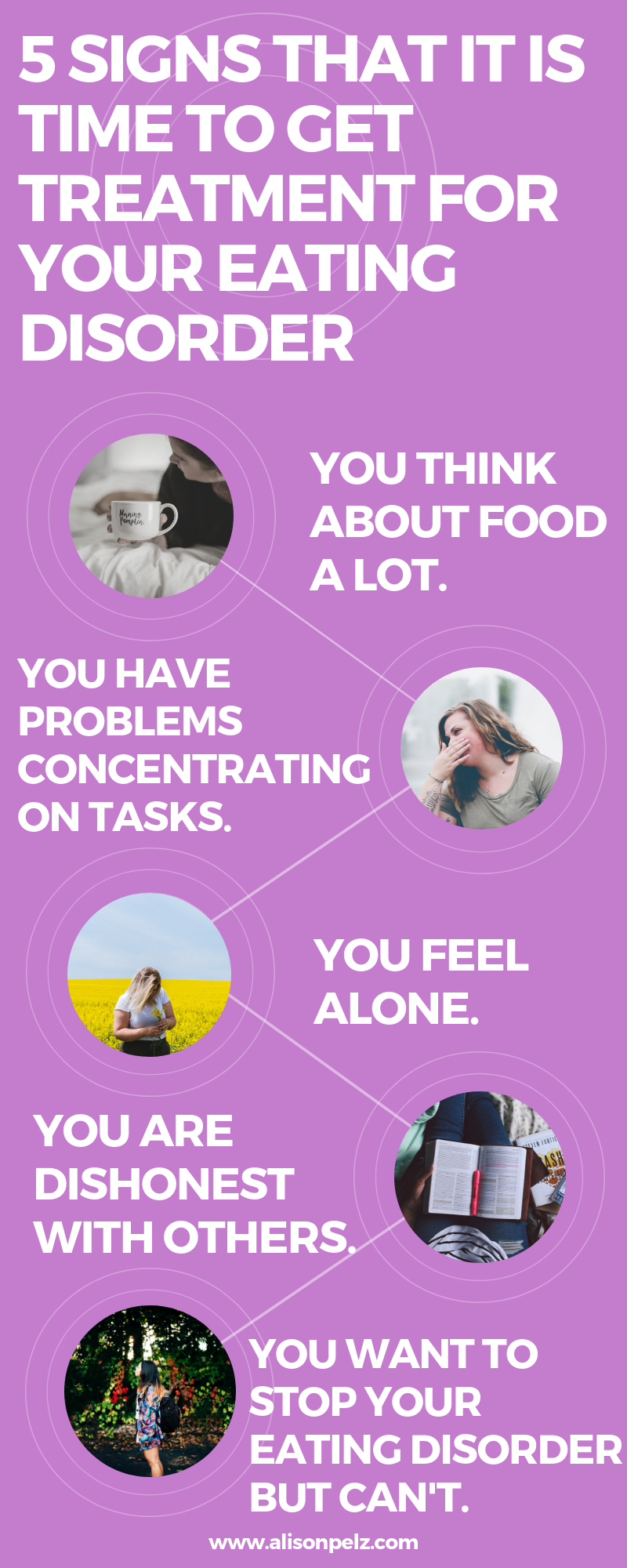
Here are 5 Signs that it is time to get treatment for your eating disorder:

1.  You think about food a lot. 

If you’re planning out your day around food as soon as your feet hit the ground-what to eat (and what not to eat), when, and how much- you might have an eating disorder.   Thoughts about food take up so much head space and can be exhausting.

For example, you may have thoughts similar to these: “Did I make the right decision about what to eat?”, “She didn’t eat a snack.  Should I be eating a snack?”. Your thoughts about food can be so pervasive at times that they lead to poor concentration, feelings of worry, sadness, and/or guilt.

2. You have problems concentrating on tasks. 

Whether you are at school, work, or at home, it is hard for you to stay focused on the task at hand (or maybe hard for you to even get started).  Your brain needs adequate fuel to function properly, and if you have an eating disorder, chances are you are not properly nourished.  Poor concentration can be the result of inadequate and/or poor quality nutrition and erratic eating.

3. You feel alone.

Eating disorders can be isolating. Eating and food can be a big part of family and social engagements. You may find yourself avoiding social situations because the food associated with these engagements is too anxiety provoking. Or you may attend the social engagement, but feel distracted or not fully present because you feel worried about food or fitting in.

Poor body image may also cause you to avoid social situations.  Feeling worried about how you look and what others are thinking of you may cause you to stay home. Isolation can make the eating disorder worse, increase feelings of depression and anxiety, and erode your self-confidence.

4. You find yourself being dishonest with others. 

Most of us value honesty.  Trustworthy and honest may be words that you use to describe yourself, except when it comes to your eating disorder. Often, eating disorder behaviors such as purging, binge-eating, and restriction are done in secret because you have feelings of guilt and shame around the behaviors.

5. You want to stop your eating disorders behaviors but can’t. 

It is not unusual for people with eating disorders to try to get better on their own.  You may have had success for short periods of time, maybe even months.  But then life happens and the behaviors come back.  Trust me, it is not because of lack of effort, intelligence, or motivation that you can’t stop your eating disorder on your own.  It is the nature of eating disorders.  They are complex, consisting of psychological, biological, and social factors.  Adequate treatment by experienced clinicians is needed to help support you in your recovery.

This is a very short list of signs.  Even if you experience one of them (or none of them but know that you are struggling), please talk to a professional.  I know taking that first step to seek treatment is hard and scary, but if you have any inclination to improve your situation, seek treatment.  The National Eating Disorder Association is a great resource.

Please call for a free 15-minute phone consultation to learn how I work with clients with eating disorders.
5 Signs That It Is Time to Get Treatment for Your Eating Disorder
3 Important FAQs about Intuitive Eating

3 Important FAQs about Intuitive Eating

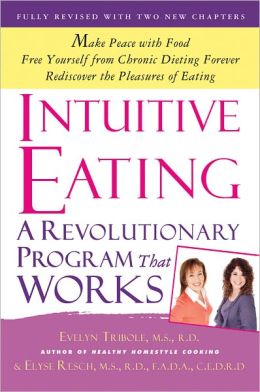
Intuitive eating is a term coined by registered dietitians Evelyn Tribole and Elyse Resch.  Tribole and Resch’s book Intuitive Eating’s purpose is to help chronic dieters and people with food and body image struggles heal their relationship with food.

Unlike diets, intuitive eating sharpens our ability to listen to our bodies and to understand when we are hungry and full, what foods to eat, and when is the best time for our bodies to eat.  This results in a reduction of worry about food and guilt often associated with dieting.

In a nutshell, intuitive eating is learning to tune into your body’s signals in order to feed and nourish yourself instead of a diet or meal plan.

Question:  Is intuitive eating the same as mindful eating?

Answer: Intuitive eating and mindful eating are not synonymous.  However, they do have some overlap.  Think of mindfulness as focusing your attention on one thing.  For example,  you can practice mindfulness when you are petting your dog.  You notice how your dog looks, how it feels to pet your dog, and how your dog responds to your touch.

You can also practice mindfulness while eating.  To do this, you may notice the appearance, temperature, consistency, and smell of what you are eating, free from other distractions.

When I teach clients intuitive eating, I encourage them to practice mindful eating because it helps increase the pleasure of eating and dial into internal signals that your body is giving you in regards to food preferences, and hunger and fullness.

Question:  I want to lose weight. Is intuitive eating going to help me achieve my weight loss goals?

Answer:  No, intuitive eating is not a weight loss program.  It is a way of relating to food.  While diets tell us to look to the diet plan to know how much and what to eat, intuitive eating postulates that we have all of the knowledge within ourselves on how to feed ourselves.  Chronic dieting teaches us to ignore our internal cues.

You may be thinking, “Well, I overeat pretty regularly.  If I start listening to my body and stop overeating, it will lead to weight loss.”  This is not necessarily true because body weight and metabolism are under substantial genetic control.

However, intuitive eating will provide a relief from the vicious diet cycle which will help alleviate the feelings of shame and guilt associated with dieting.

Question:  I think I may have an eating disorder.  Will intuitive eating help me get over my eating disorder?

Answer: I am glad that you have recognized that you may have an eating disorder.  The next step is to get assessed by a treatment professional.

If you do have an eating disorder, getting adequate treatment from professional is a must for recovery.  Unfortunately, eating disorders don’t go away on their own.  Treatment is important to reduce medical risks associated with eating disorders, including death. (Anorexia nervosa has the highest mortality rate of all psychiatric conditions.)

That being said, intuitive eating could be part of your treatment process, in the later stages of treatment.  Together with your treatment team, you will be able to determine if and when intuitive eating is right for you.

Unsure if intuitive eating is right for you?  Call me for a free 15-minute phone consultation.

3 Important FAQs about Intuitive Eating
summer eating disorder recovery college student

How to Stay on Track with Eating Disorder Recovery during the Summer: Tips for College Students

Keeping on top of your eating disorder recovery can be tough during the summer months if you are a college student.

Summers in Texas are hot.  I mean sweaty hot.  Despite the heat, I love summer because it usually means more free time to spend with family & friends, fewer demands and most importantly – vacation.  Everything just feels a little more relaxed during the summer.  Summers in my college days were the best, whether I was taking a few summer courses, traveling abroad or hanging out home.

Keeping recovery a top priority during summer can be tough if you are a college student.  Whether you are heading home or staying close to campus, eating disorders can become exacerbated in the summer.

Pitfalls of eating disorder recovery in the summer:

  1. Change in routine.  During the summer schedules change.  Most students are relieved because schedules become much less demanding during the summer.  However, change in routine can be tough.   Routines make us feel comfortable because we know what to expect.  Routines can help you stay on track with your meal plan, treatment appointments, sleeping habits, etc.  Disruption in routine can mean a disruption of established patterns of recovery.
  2. Less structured time.  One common struggle in eating disorder recovery is being able to tolerate unstructured time.  It isn’t uncommon for eating disorder sufferers to have an increase in eating disorder thoughts and behaviors when feeling bored, lonely, etc. During the summer there tends to be a lot more unstructured time.
  3. Reduction or increase in independence.  Depending on your living situation, you may experience a decrease in independence if you are returning home for summer to live with your family.  Returning to the family home may cause some stress because you are used to living away at college and making your own decisions.  Or, if you are traveling or working away from family and friends, you may have a significant decrease in social support.
  4. Exacerbation of body image disturbance.   Because of summer temperatures, we spend more time in bathing suits, short sleeves, and shorts which can often increase body checking and preoccupation of body weight and shape/size which can lead to an increase in eating disorder behaviors.

Although there are some potential obstacles during summer, there are several ways to keep the momentum of recovery going over the summer months.

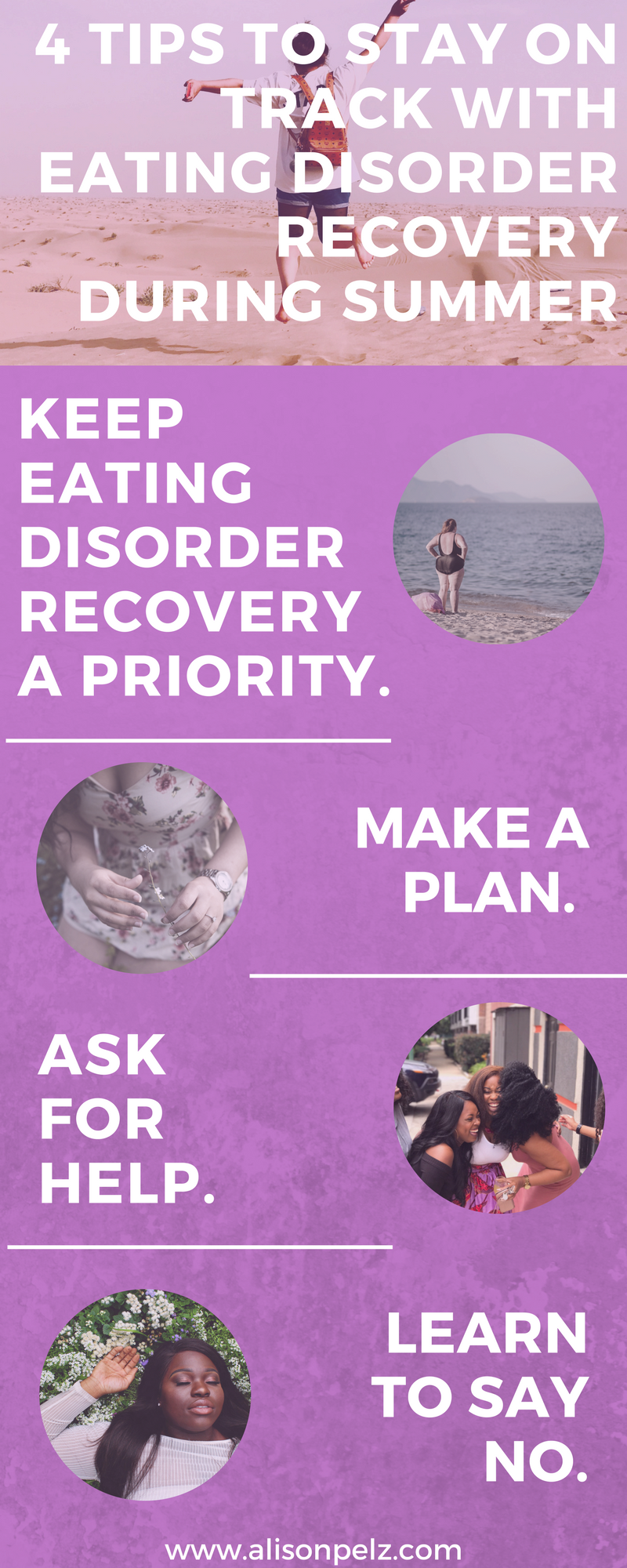
4 tips to stay on track with eating disorder recovery during summer:

  1.  Keep eating disorder recovery a priority. It is summer break from school, but not from recovery.   Keep recovery front and center if you don’t want to backslide on the progress you have made!  There are several ways to keep recovery a priority such as having regular check-ins with your treatment team, journaling about your progress and areas to improve on, reading books & articles about recovery, attending support groups, etc.
  2. Make a plan.  Whatever your summer plans are, strategize ahead of time. How are you going to keep on top of your meal plan, self-care and treatment appointments?  Talk to your treatment team in advance about your summer schedule. Collaborate with them on your care over during the summer months.
  3. Ask for help. Talk with your family, loved ones or support person about how you plan to stay on track with your eating disorder recovery.  Discuss potential areas of concern,  learn how to ask for help and communicate areas of success to loved ones.  Interact regularly with your treatment team, particularly if you feel like you are struggling.
  4. Learn to say no.  Taking on too much, particularly early on in eating disorder recovery, is an easy way to get derailed.  This may mean saying “no” to fun social engagements, a job, an internship or a vacation in order to spend time on your recovery.

While there are ways to hinder eating disorder recovery over the summer, with planning and persistence you can keep recovery front and center!

Are you interested in learning more tips about eating disorder recovery?  If so, sign-up for free tips here!


summer eating disorder recovery college student
2017 year in review

2017 Year in Review

Wow! This year really flew by! Can you believe we’re already at the end of 2017?


I’ve covered a bunch of different topics on the blog this year. You can find them here, all in one place. Now, you can look back with me and see everything we covered with ease!  


If you’ve been reading for a while, you can revisit some past favorites or refresh your memory on any of the topics that speak to you. If you’re new here, this is a great place to get to know what I’m all about and become familiar with my style. My goal is to work collaboratively with clients to reduce food and weight preoccupation and teach clients to trust their bodies, rather than a diet, to know how to feed themselves.


First off, make sure you check out 5 reasons not to diet in 2017!

It’s relevant for every year, not just 2017. Since we’re heading into the season where everyone and their brother will be talking about their New Year’s Resolutions it’s good to have these facts in mind to support you in your choices.


Don’t suffer in silence!

The theme for National Eating Disorder Awareness week this year was “It’s Time to Talk About It.” Check out this post for the best place to get started on your journey.


Are you ready to break up with dieting?

Learn about what intuitive eating is, and the 10 basic principles that can help you get off the diet roller coaster for good.


There are a lot of questions you can ask yourself about your relationship with food.

Do you feel out of control with food? Is the good-bad food trap ruining your relationship with food? Are you an emotional eater?


Diet culture is everywhere these days.

It surrounds us on social media, on TV and in movies. It’s even present in the interactions we have with others. It’s important to understand that dieting is hazardous to your health. There are lots of myths and inaccuracies floating around that people use to justify diet culture and that lead to misunderstanding eating disorders, such as anorexia nervosa and binge eating disorder. Eating disorders don’t just affect teens- they are common in midlife, in people who suffer from anxiety disorders, and can even occur in people who are perfectionists.


There is hope.

Eating disorders are treatable, and there are resources available for people who are ready to ditch diet culture. It’s possible to like your body better without having to change it!


Let me know if there are any topics you’d like me to cover in 2018. Don’t forget to share your favorite posts with friends and family!

2017 year in review

Get Off the Diet Roller Coaster, For Good!

Chronic dieter?   Feel out of control with food?  Tired of weight cycling?  Feel guilty after eating “bad” foods?  Feel at war with your body?  Concerned about your health?

If you answered “yes” to any of these questions, I highly recommend reading and learning about Intuitive Eating developed by Evelyn Tribole, MS, RD and Elyse Resch, MS, RD, FADA.   

The first edition of Intuitive Eating was published in 1995.  For over 15 years, I have been using principles of Intuitive Eating with clients.  Recently, I trained with Evelyn Tribole, MS, RD to become a Certified Intuitive Eating Counselor.  I am excited to share the ins & outs of Intuitive Eating & other tools, over my blog, webinars and in one-on-one sessions.

Intuitive Eating is an evidence-informed approach to making peace with food used by counselors, dietitians and eating disorder treatment centers across the country and worldwide.Continue reading