"Tackling Healthism in Eating Disorder Recovery" in white text on a purple background over a photo of a wellness yoga class

Tackling Healthism in Eating Disorder Recovery

One of the most persistent and invisible roadblocks on this path of recovery is healthism.

When you’re in recovery from an eating disorder, the journey isn’t just about food or body image—it’s about unlearning many of the messages that have shaped your relationship with health, worth, and identity.

What Is Healthism?

Healthism is the belief that a person’s moral worth is tied to their health status—and that “health” is something we can fully control through the “right” choices. It often masquerades as wellness advice, clean eating trends, or motivational fitness culture. It’s sneaky. It’s normalized. And it can deeply harm those recovering from disordered eating.

It tells us:

  • That our body is a problem to solve.
  • That health looks a certain way (usually thin, active, and visibly “fit”).
  • That if we are not constantly optimizing our health, we are failing.

Sound familiar?

Where Did Healthism Come From?

Healthism isn’t just a personal mindset—it’s a cultural narrative with deep historical roots. The term was first coined in the 1980s by sociologist Robert Crawford, who observed a growing trend: people were being taught that health was a personal, moral responsibility, and that individuals—not systems—were to blame for their well-being.

Since then, this idea has been reinforced by everything from public health campaigns to social media influencers. Over time, “healthy” became a synonym for “good,” and illness or difference became something to fix or avoid.

Diet culture, fatphobia, ableism, and capitalism all amplified the message: control your body, and you’ll be safe, accepted, and successful. But here’s the truth: most of the factors that shape our health are outside of our control, including genetics, trauma, systemic oppression, and access to medical care.

If you’ve internalized the belief that your worth is tied to how “healthy” you are, that’s not a personal failure. It’s a product of living in a culture steeped in healthism.

When “Wellness” Becomes a Disguise for the Disorder

It’s not uncommon for someone in recovery to shift from calorie restriction to obsessive “clean eating,” or from compulsive weighing to compulsive step counting. All under the guise of “being healthy.”

But here’s the truth: If your pursuit of health is causing you harm, mentally, physically, and/or emotionally, it’s not actually healthy.

Therapy holds space for the messy, complicated process of rethinking what health really means. And gently challenge the idea that health should ever be the benchmark for your value as a human being.

Healing Beyond the Health Narrative

You deserve a recovery that allows you to reclaim your life. Not just fit into a new version of diet culture with a wellness filter.

Here’s what it can look like to move beyond healthism in recovery:

  • Embracing body diversity: All bodies are worthy, and all bodies are different. Health does not have one size or shape.

  • Redefining health: Instead of perfection, explore how to care for your body in a way that feels sustainable, flexible, and joyful.

  • Focusing on values: What matters most to you beyond your body? I help clients reconnect with those parts of themselves.

  • Practicing self-compassion: You are not a failure for struggling. You are a person, doing your best in a culture that makes recovery hard.

You Don’t Need to Be “Healthy” to Deserve Care

One of the most radical things we can say in a healing space is: You deserve support, rest, love, and acceptance—whether or not you’re “healthy.”

Health is not a prerequisite for dignity.

In my work with clients, I hold this truth close. Whether you’re early in recovery or years into your healing. I understand how deeply embedded healthism can be, and here to help you untangle from it with compassion and curiosity.

Ready to Explore a New Way Forward?

If you’re feeling burnt out by the pressure to “recover perfectly” or be the picture of health, you’re not alone. Let’s explore what healing could look like when it’s rooted in connection, not control.

Curious about working together?
Reach out to schedule a consultation. I would be honored to walk alongside you.

 

A graphic that reads "Exploring Values Instead of New Year’s Resolutions in 2022" in the bottom left corner over a small purple overlay. the rest of the image is a stock photo of a Black woman writing in a journal while sititng on a bed with white bedding.

Exploring Values Instead of New Year’s Resolutions in 2022

How do you feel about New Year’s Resolutions? The new year often feels like the perfect time to implement changes, and the constant flood of “New Year New You” marketing definitely adds to the pressure to shake things up each January. Unfortunately, a lot of that marketing is heavily influenced by diet culture. Instead of making a New Year’s Resolution in 2022, try exploring your values instead. 

Diet culture, or a cultural belief that values thinness over physical and emotional health, absolutely reinforces resolutions that are focused on weight, food, or exercise.

New Year’s Resolutions focused on food, weight and exercise can wreak havoc, even when they’re well intentioned. 1 in 4 dieters will go on to develop an eating disorder, so a new year’s resolution to lose weight can spiral out of control no matter what intentions are behind it. Remember, dieters themselves are never the problem – the problem is that diets don’t work. 

Values are something many therapists explore with clients. Values are the cornerstone of Acceptance and Commitment Therapy, or ACT. ACT “teaches mindfulness skills to help individuals live and behave in ways consistent with personal values while developing psychological flexibility.” Values are fundamental beliefs that guide our attitudes and our actions. 

You might be wondering how values and goals differ. 

Values are different from goals because goals are something that you achieve and can check off. 

Values, unlike goals, don’t have an end. They’re a part of your basic belief system about the world and your role in it. Values may shift over time, but they are often long-term. 

For example, a goal could be “I want to travel to all 50 states”. In contrast, the value in this case could be “travel”. Booking a trip lets you meet your goal and uphold your value. As they say in ACT, you are participating in a value-driven behavior by booking the trip.

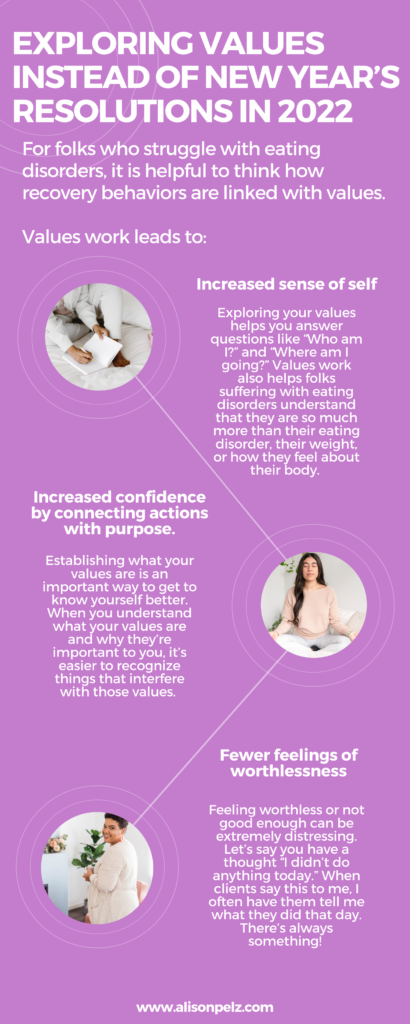
I find using values work is helpful for clients with eating disorders for several reasons. Values work leads to:

Increased sense of self

Exploring your values helps you answer questions like “Who am I?” and “Where am I going?” Values work also helps folks suffering with eating disorders understand that they are so much more than their eating disorder, their weight, or how they feel about their body. 

When you’re doing values work, it helps to come from a place of abundance versus a place of scarcity. So often, people don’t feel like they are enough or they’re doing enough. In contrast, coming from a place of abundance helps you to recognize that you are enough just as you are, and that you are doing your best.

It’s kind of like looking at the glass half-full instead of half-empty. Instead of assuming the worst about yourself, work on assuming the best. 

Increased confidence by connecting actions with purpose.

Establishing what your values are is an important way to get  to know yourself better. When you understand what your values are and why they’re important to you, it’s easier to recognize things that interfere with those values.

Values work can help those with eating disorders recognize that their eating disorder interferes with many of their values. This can often serve as a motivator for recovery.

Fewer feelings of worthlessness.

Feeling worthless or not good enough can be extremely distressing. Let’s say you have a thought “I didn’t do anything today.”  When clients say this to me, I often have them tell me what they did that day. There’s always something! 

For example, maybe they texted a friend, called their mom, went to work, paid a bill and went to the grocery store to pick up some items for dinner to cook for their family.

These everyday tasks or activities most likely reinforce their values:

  • Texting a friend is connected with the value of relationships and caring
  • Calling their mom connected with the value of family and caring
  • Went to work and paid a bill connected with a value of financial health and reliability
  • Going to the grocery store is connected with health and family.

Are you stumped on what values are important to you? Here are a few examples of values to consider:

  • Health
  • Financial wellbeing
  • Recreation
  • Personal growth
  • Family
  • Relationships
  • Spirituality
  • Community
  • Social justice
  • Honesty
  • Reliable
  • Caring
  • Fun
  • Kindness
  • Authenticity
  • Learning
  • Stability

For folks who struggle with eating disorders, it is helpful to think how recovery behaviors are linked with values.

So if you value health and have an eating disorder…it might feel uncomfortable to hold both of those at the same time. Acting in a way that is aligned with your values can be a powerful motivator for recovery. 

For example, if you think you may have an eating disorder and you value health, merely reading this post is a value-driven behavior (a behavior that upholds your values). Or let’s say you are in treatment for your eating disorder. When you attend treatment appointments you are behaving in a value-driven way. 

Rather than focusing on resolutions in 2022, exploring your values can be a more impactful way to make changes that are in alignment with what’s important to you. 

Are you interested in exploring your own values and how your behaviors stem from them? Click here to learn more.

A graphic that reads "2021: A Year In Review" over a stock photo of some pine branches and gifts wrapped in brown paper, on a red background.

2021: A Year In Review

What a year! 2021 was our second year in a pandemic, and seemed just as chaotic and challenging as 2020 was. Take a moment to pat yourself on the back for making it to the end of this year, it certainly hasn’t been easy, but I’m so glad you’re here. This too shall pass, and until it does, I’ll be here to support you virtually to stop feeling out of control and gain a sense of calm in relationship with food and your body

This year, more than ever, people experienced anxiety and burnout. If you’re feeling like you’re running on empty, you’re not alone. I hope you get some quality time to rest and recuperate this season. It’s always important to rest, but with the constant chaos of existence right now you might be feeling the need to slow down more than ever. I encourage you to lean into it!

You’re allowed to have periods of rest, and it’s important to listen to your body when it’s trying to tell you something. Consider this your permission slip to do nothing but self-care for the rest of the year! 

Every year, I like to round up all of my blog posts from the year in one place. It’s fun to look back on the year through these posts, and I hope you find them useful as you work toward peace with food. 

Here’s what I wrote about this year: 

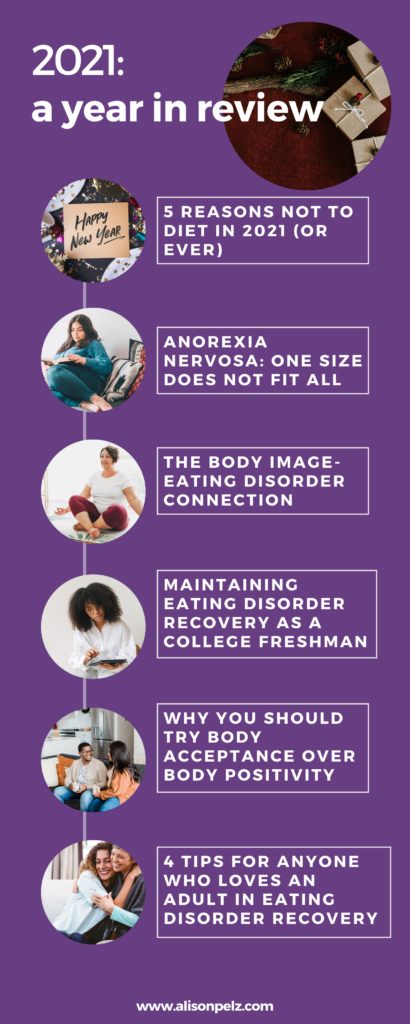
5 Reasons not to Diet in 2021 (or Ever)

“Unless you are taking a break from social media and the news, you most likely have been bombarded with messages about dieting and weight related New Year’s resolutions. Diet programs are promising the magic bullet for good health and weight loss in the New Year.

Maybe this year you are re-thinking your New Year’s resolutions. Perhaps you are beginning to notice that dieting is taking up too much space in your life or you are tired of worrying about what you eat or what you look like. It could be you are looking to “get off the diet roller coaster” permanently and heal your relationship with food and your body.

If you are ready to give up dieting, you’re not alone. Consider these five reasons to quit dieting for good.”

Anorexia Nervosa: One Size Does NOT Fit All

“Unfortunately, there are many incorrect assumptions associated with eating disorders. One I see a lot is the assumption that in order to have an eating disorder, particularly anorexia nervosa, one has to have very low body weight. This is simply not true.

Sadly these assumptions block those suffering from eating disorders from getting the life-saving treatment they need. In fact, most people with eating disorders don’t necessarily fit neatly into an eating disorder category.

Eating disorders are more about how the person relates to food, exercise, and body than what a person looks like.”

The Body Image-Eating Disorder Connection

“How we perceive our bodies is influenced by many factors, including family, friends, media, gender identity, culture, and the health-care system, to name a few. Body image is not static. It may change depending on our mood, situation, stage of life, or the season.

The majority of those who suffer with eating disorders have a negative body image. One of the key features of eating disorders is the overvaluation of weight, shape, and eating habits on self-worth.

Self-worth is how and what we think about ourselves. In other words, those who struggle with eating disorders equate much of their self-worth with their ability to control their weight, shape, and eating habits. Having a negative body image often keeps the eating disorder going.”

Maintaining Eating Disorder Recovery as a College Freshman

“College can be a difficult transition for anyone, but if you’re in recovery for an eating disorder, it can be a particularly stressful transition! 

Some of the challenges of maintaining your recovery while returning to school include change in routine, increased demands and independence, and exercise/diet culture. 

Remember: it’s normal for eating disorder symptoms to recur in times of high stress and periods of transition. But by taking time to consider how your recovery will be impacted in this period of transition, you can create a plan to cope with stress and continue with your recovery.”

Why You Should Try Body Acceptance Over Body Positivity

“The idea of body positivity has its roots in fighting diet culture, but the term doesn’t resonate with everyone. After all, feeling positive about your body is a tall order for a lot of people. 

First of all, there is a multi-billion dollar diet industry that uses its considerable resources and influence to convince us all that there is something wrong with our bodies. Feeling insecure about how our bodies look is a surefire way to get us to buy products that will “fix” us. However, consider the idea that there was nothing wrong with your body in the first place. 

People who are chronically ill or disabled might not feel like they can be positive about a body that is constantly in pain or not able to move through the world easily. People who are recovering from eating disorders might not trust their body’s cues or might feel distress when thinking about their bodies. 

Body acceptance might feel like a more attainable goal than body positivity.”

4 Tips for Anyone Who Loves an Adult in Eating Disorder Recovery

“It’s possible for eating disorders to initially develop later in life, not just during adolescence. It’s also possible that adults suffering from an eating disorder developed it during adolescence and never fully recovered.  Life stressors (like a pandemic, for example!) later in life can also cause a relapse of eating disorders.

Eating disorders develop for a variety of reasons including genetics, temperament, gender, and dieting history to name a few.

It is less important why and how the eating disorder developed, and more important to focus on supporting your loved one in their eating disorder recovery.”

A graphic that reads "2021: A Year In Review" over a stock photo of some pine branches and gifts wrapped in brown paper, on a red background.

I’ll be back in 2022, writing more about ED recovery, food peace, and weight bias. If there are any topics you want me to cover next year, let me know. You can send me a message here, and you can also follow me on Facebook. Every week, I share resources from myself + other eating disorder experts, so follow if you’re looking for more information. 

Recovery; White text over a purple background in the bottom left corner that reads "Maintaining Eating Disorder Recovery as a College Freshman". The rest of the image is a photo of a young woman sitting on a couch with a laptop in her lap.

Maintaining Eating Disorder Recovery as a College Freshman

College can be a difficult transition for anyone, but if you’re in recovery for an eating disorder, it can be a particularly stressful transition! 

Some of the challenges of maintaining your recovery while returning to school include: 

Change in Routine

When in recovery, changes in routine can be tough. Routines allow for some comfort and dependability, because when we have them, we know what to expect. Routines also have very practical uses in recovery–they affect meal planning, treatment appointments, sleeping habits, etc. All of which play a role in recovery! Navigating a new routine can be challenging, and can feel overwhelming, so giving care and consideration to what your new routine will be is important. 

Increased Demands + Independence

Going to college is an exciting time because it is the first taste of independence so many of us have! However, gaining independence is also a lot of responsibility–especially if we’re not used to it. It can be easy to not set any boundaries for yourself, but that’s not a sustainable way to take care of yourself. At the same time, you’ll also need to use some of that newfound independence to balance the demands of your school work, which might be more intense than you’re used to. It can be extremely stressful navigating that responsibility for the first time, and increased stress can lead to an increase in eating disorder symptoms. 

Exercise + Diet Culture

On a college campus you’ll be surrounded by other young people, who are also surrounded by the constant messaging on social media about diet and beauty standards. Additionally, gyms on campus may be full of college level athletes training in ways that other folks who don’t need intense conditioning for a sport shouldn’t be pushing themselves to compete with. You might be surrounded by fear of the “freshman fifteen” or feel pressure to skip meals to study for exams with other students. The culture around food and exercise on a college campus may not be the healthiest one–and it’s important to prepare for that with a counselor beforehand so you have coping mechanisms you can use when need be. 

What can you do to maintain your recovery?

Consider your schedule

Be gentle with yourself as you adjust! College is a big change and you don’t need to try to do it all at once. This means, don’t push yourself to take too many classes your first semester while you’re still getting used to the new expectations. Really think about what your limit is before you feel yourself burning out. 

Consider also taking classes that you wouldn’t consider as the most challenging. It’s a whole new style of learning in college, there’s nothing wrong with taking it slow to figure out what you can handle. That way you’re not overworking yourself and you are reducing the amount of stress you might experience. 

When thinking about your schedule,  consider any habits you have that are helpful to your recovery (social meals, treatment appointments, etc.) and what will be needed for those in your regular routines.

Make a recovery plan before you go

Are you working with a therapist right now? Will you continue to work with them? Or will there be someone on campus to connect with? Have group supports been part of your recovery plan? What is available in terms of group support at your school? Does your current therapist have plans or ideas on what will be important to your recovery at school? 

Be sure to set up any regular appointments and checkups with your treatment team ahead of time, to help provide you the professional support you may need to stay “on track.” 

Are you working with a dietitian right now?  Work with them to help you maintain recovery.

You might want  research on what mealtimes are like at school. Consider questions like: What food is available when? Where are the places to eat? What are their hours? Do you know what food do they provide? What are the meal plans like? Is there one that is more conducive to your recovery? Together with your dietitian it might be helpful to gather some information about what the different meal plans are, and make some pros and cons for each of them.

If you don’t have a treatment team, go to the student health center on campus and they will be able to assist you. 

Remember: it’s normal for eating disorder symptoms to recur in times of high stress and periods of transition. But by taking time to consider how your recovery will be impacted in this period of transition, you can create a plan to cope with stress and continue with your recovery. Remember, you only have to take it one day at a time! 

If you need help in your eating disorder recovery or not sure if you have an eating disorder or not, please click here to schedule a free 15-minute phone consultation with me. 

white text on a purple background over a photo of balloons in the sky that reads "5 Reasons not to Diet in 2021 (or Ever)"

5 Reasons not to Diet in 2021 (or Ever)

Unless you are taking a break from social media and the news, you most likely have been bombarded with messages about dieting and weight related New Year’s resolutions. Diet programs are promising the magic bullet for good health and weight loss in the New Year.

Maybe this year you are re-thinking your New Year’s resolutions. Perhaps you are beginning to notice that dieting is taking up too much space in your life or you are tired of worrying about what you eat or what you look like. It could be you are looking to “get off the diet roller coaster” permanently and heal your relationship with food and your body.

If you are ready to give up dieting, you’re not alone. Consider these five reasons to quit dieting for good:

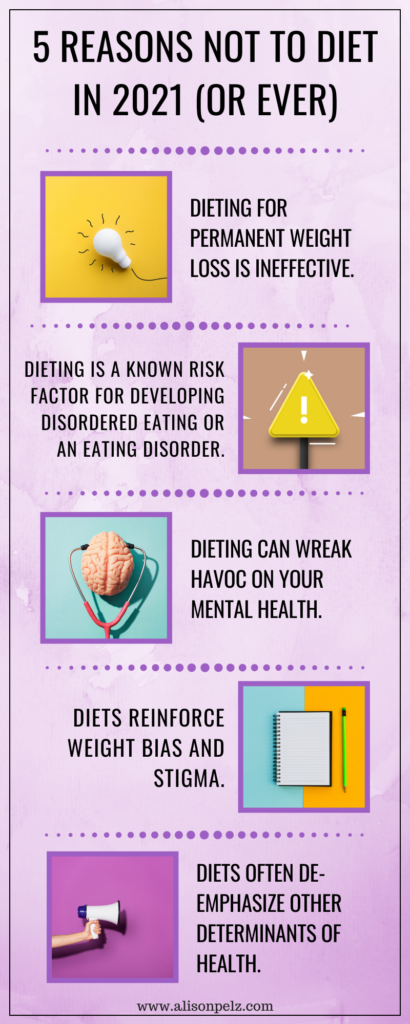
1. Dieting for permanent weight loss is ineffective.

While dieting can be effective for weight loss for some, usually weight loss is short-lived. In fact, scientists have little to no evidence to show that dieting is an effective means for keeping lost weight off. Maybe you haven’t been able to stick to your diet. It is not you, it is the diet. Diets are nearly impossible to follow for the long term. And then when diets are “broken”, it leaves the person feeling bad about themselves and disconnected from their body, doing more damage than good.

2. Dieting is a known risk factor for developing disordered eating or a full-blown eating disorder.

The causes of eating disorders are complex and can be caused by a range of biological, social, and psychological factors. Researches have identified that dieting is a risk factor for developing an eating disorder. The majority of clients that I treat with an eating disorder have had experience with dieting, usually motivated by body dissatisfaction. Dieting can contribute to more problems with your relationship with food instead of solving them.

3. Dieting can wreak havoc on your mental health.

Diets often promise control over food and even our lives. Starting a new diet can even feel exhilarating. But, have you ever noticed when you are dieting you spend more time thinking about food? Or you begin to feel out of control around food, maybe experience binge eating-like behavior? You may even avoid certain social situations in order to stay on the diet.

Additionally, when a “diet rule” is “broken” (not because of laziness or lack of willpower on your part—remember, clinical studies show that diets can’t be followed long term), you might experience increased feelings of shame, loss of control and failure. These feelings can drive us further from self-care and contribute to a poorer relationship with food.

4. Diets reinforce weight bias and stigma.

Weight bias and stigma are just what they sound like- discriminating against people based on their body size, usually large body size. Diets inherently send the message that large or fat bodies are “bad” or “unhealthy”, which reinforces fatphobia. It is well documented that rates of weight bias and stigma are on the rise. In fact, weight stigma and bias happen at higher rates than discrimination based on age or gender. Weight bias and stigma can affect physical and mental health independent of body size in various ways, including an increase in stress, poorer mental and physical health, and can contribute to problematic eating behaviors independent of body size. To read more about weight-bias and stigma, click here.

5. Diets often de-emphasize other determinants of health.

You have probably heard the saying, “You are what you eat”. This couldn’t be further from the truth. What and how we eat may be one part of our health, however, there are multiple factors that contribute to health. There are several determinants of health including genetics, economic status, environmental and physical influences, medical care, and social factors. Diet programs often give the illusion that by eating in a particular way you are guaranteed good health, often neglecting other health factors.

These are just a few good reasons to ditch dieting. However, you may be thinking, “Now what? How do I not diet? How do I feed myself?”. These are common and valid questions. If you have been dieting on and off for years or have an eating disorder, navigating food in our society that is steeped in diet culture can be confusing and downright daunting.

Here are some resources to get you started on learning how to improve your relationship with food and your body:

an infographic that titled " 5 reasons not to diet in 2021 (or ever)". The tips read, in order: "Dieting for permanent weight loss is ineffective." "Dieting is a known risk factor for developing disordered eating or an eating disorder." "Dieting can wreak havoc on your mental health." "Diets reinforce weight bias and stigma." "Diets often de-emphasize other determinants of health." There is a small photo next to each statement. The photos, in order, show: a white lightbulb on a yellow background, a yellow caution sign on a blush background, a brain wearing a red stethoscope on a blue background, a blank notebook page next to a green pencil on a blue and yellow background, and a person holding a megaphone on a purple background.
white text on a purple background over a photo of balloons in the sky that reads "5 Reasons not to Diet in 2021 (or Ever)"

If you’re looking for more support as you make peace with food and ditch the diets for good, I can help you learn to trust your body and learn to feed yourself again. Get in touch today!

Diet Culture, COVID-19, and Weight Stigma: 2020 in Review

Diet Culture, COVID-19, and Weight Stigma: 2020 in Review

At the end of every year, I like to put together a post that collects everything I’ve published on my blog over the last year. And what a year it’s been. This year is nothing like we imagined it would be. We have lost almost a year of being with family and friends, experiencing new things, and living our ‘normal’ lives. If you’re feeling grief about this year, the lives lost and changed, and what could have been, you’re not alone. 

This year has been hard, sad, lonely, scary, weird, and pretty much any other adjective out there. It can be hard to hold space for all of those things at once, so be gentle with yourself as you work through your feelings about 2020. 

Here’s what I wrote about this year: 

This year, I wrote a lot about the COVID-19 pandemic and how that interacts with folks in eating disorder recovery. 

When things get hard, communities thrive. The eating disorder recovery community is more important than ever with many of us isolated and unable to connect with other ED survivors in real life. I wrote about 5 Ways to Stay on Track With Eating Disorder Recovery During COVID-19, Virtual (and Free) Eating Disorder Support Groups During COVID-19, and Coping With COVID-19 and Eating Disorder Recovery: Tips for College Students.

Rejecting Diet culture

One of my favorite ways to learn about rejecting the diet mentality is through podcasts! I put together a list of my top podcasts to help you break free from diet culture. (I also included a tip for how to find anti-diet resources: “It’s easy to be wary of what you find related to body positivity and anti-diet resources, since the movement has been flooded with people trying to cash in without spreading the actual message of the anti-diet movement. When looking for a trusted resource online, make sure that they mention on their website (hopefully prominently!) that they believe in dismantling diet culture, center larger bodies, and don’t mention weight loss anywhere on their site.”

Eating Disorders

Eating disorders are a complicated subject. One of my goals is to help people challenged with ED and other food & weight-related concerns to move from constantly worrying about food and their weight to being free to create the lives they want. The first step here is understanding what eating disorders actually are. To help, I discussed 3 Important FAQs about Binge Eating Disorder on the blog. While some of us understand the basics of eating disorders and anxiety on our own, it’s rare to see a blog post connect the two and tell you what you need to know if you’re living with an eating disorder and an anxiety disorder. I wrote about frequently asked questions related to eating disorders and anxiety to share what I know!

Weight Bias + Stigma

Weight bias is everywhere we look in our culture. It’s led to systematic discrimination of larger bodies in many areas of life – medical care, job opportunities, social interactions, to name a few. So many folks railing against people in larger bodies don’t realize that what really causes negative health outcomes is a result of stigma, not a result of having a larger body, so I wrote about how weight bias and stigma are the real hazards to health, not body size. 

Diet Culture, COVID-19, and Weight Stigma: 2020 in Review

If there are any topics you’d like me to cover in 2021, let me know! You can message me here. If you’re looking for even more resources, make sure you’re following me on Facebook and Pinterest!Every week, I share resources from myself + other experts in the field on both platforms!