Eating disorders in midlife

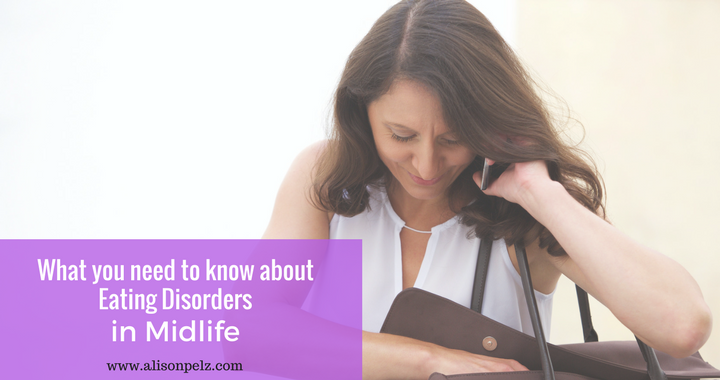
Not Your Teens Eating Disorder: What you need to know about eating disorders in midlife.

Unfortunately, eating disorders in midlife are on the rise.  Many eating disorders in adult women may go undiagnosed because of the mistaken belief that older women don’t develop eating disorders.   It is true that adolescent girls are at a higher risk, but women of all ages are at risk for developing and maintaining an eating disorder.

Adult women usually present with eating disorders in the three following ways:

  1. An eating disorder was developed earlier in their life. That is, as an adolescent or young adult the individual developed her eating disorder, but never fully recovered.  Adequate treatment, motivation to change, social & family support, etc. are all necessary for a full recovery.
  2. The second scenario is similar to the first, an eating disorder developed in adolescence or early adulthood and the individual fully recovered through treatment.  But, then in midlife, a relapse took place either in response to environmental, social, psychological and/or physical stressors and the eating disorder returned.
  3. In this last scenario, which is the least common, is that the onset of the eating disorder first occurred in midlife. That is to say, the individual had no pre-existing eating disorder. The most common type of eating disorder that starts in mid-life is binge eating disorder (click here to learn more about binge eating disorder).
Continue reading

Dieting increases risk for an eating disorder

Why Dieting is Hazardous to your Health

We are knee-deep in the diet culture.   Messages about what we should and shouldn’t eat are everywhere: social & print media, TV, on food labels and even well-meaning friends and family.

We forget that food is necessary to survive. Food is not optional. Dieting makes us think we can go without carbohydrates, fats or other food groups. But, we just can’t. Food and eating are not about willpower, it is about biology.

Dieting leads to food preoccupation

The most basic function of our brain is to keep us alive. When our basic needs are not being met, our bodies experience stress. Our brain sends us alerts to get us what we need. Most diets aren’t sufficient in energy (calories) or macronutrients (carbohydrates, protein & fat). Therefore, our brains alert us that we need to eat.
Continue reading

food addiction

Feeling Out of Control with Food? Could it be Food Addiction?

There is a lot of controversy around food addiction…

Among clinicians, there is much debate if food addiction is a bonafide diagnosis. Some believe absolutely food can be addictive. In fact, science shows that our brains are activated in the same way it is with drugs when we eat highly palatable, good tasting food.

People who describe themselves as food addicts have a compulsive drive to eat, even when they are not hungry.  Eating, perhaps, to soothe emotions or to “check-out”.  Short-term overeating feels good. But, long-term it can feel pretty uncomfortable.  There is a sense of loss of control described by people who feel like they are food addicts. Furthermore, attempts to stop overeating are made, but with little success. Sounds similar to drug or alcohol addiction, right?

Continue reading

Eating Disorder Awareness Week 2017

Every year in late February the National Eating Disorder Association (NEDA)  hosts eating disorder awareness week.  This year’s theme is “It’s Time to Talk About It”.

I love this theme as often people struggle for years with eating and exercise problems in silence.  Due to our crazy diet culture, it is hard to separate what is normative and what is an eating disorder.  Furthermore, there are a lot of people struggling with sub-clinical eating disorders or disordered eating.  Sub-clinic eating disorders mean that someone struggles with food issues, but doesn’t meet the criteria for a full-blown eating disorder.

Clinical eating disorder or disordered eating causes pain to the sufferer and those around them.   Therefore, the key is getting help & not suffer in silence.

NEDA is a great place to start they offer:

⇒Free and confidential on-line screening tools

⇒Confidential helpline

⇒Blog and videos from recovered individuals & clinicians

⇒And much, much more!


Get Off the Diet Roller Coaster, For Good!

Chronic dieter?   Feel out of control with food?  Tired of weight cycling?  Feel guilty after eating “bad” foods?  Feel at war with your body?  Concerned about your health?

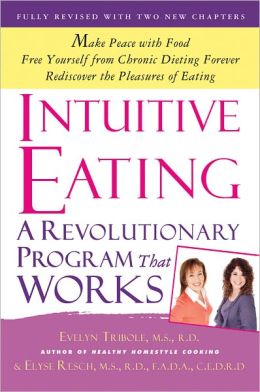
If you answered “yes” to any of these questions, I highly recommend reading and learning about Intuitive Eating developed by Evelyn Tribole, MS, RD and Elyse Resch, MS, RD, FADA.   

The first edition of Intuitive Eating was published in 1995.  For over 15 years, I have been using principles of Intuitive Eating with clients.  Recently, I trained with Evelyn Tribole, MS, RD to become a Certified Intuitive Eating Counselor.  I am excited to share the ins & outs of Intuitive Eating & other tools, over my blog, webinars and in one-on-one sessions.

Intuitive Eating is an evidence-informed approach to making peace with food used by counselors, dietitians and eating disorder treatment centers across the country and worldwide.Continue reading